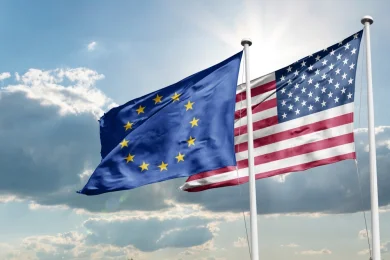
Europe could take over collective defense within NATO without building a separate alliance




Always see our news on Google
Three security experts propose that European allies should be able to lead the defense of the continent through NATO structures even if the United States chooses not to participate in a European conflict. The model would expand the “separable but not separate” principle from the Berlin Plus mechanism and would entail European capabilities of their own, clear command, the integration of nuclear deterrence, and new political decision-making rules.
European allies should prepare to lead the continent’s collective defense through NATO even in a scenario in which the United States does not participate militarily in a European conflict, Hans-Dieter Lucas, Adam Thomson, and Pierre Vimont argue in an analysis published by Carnegie Europe. The authors propose the gradual development of European capabilities that are “separable but not separate” from NATO and identify 2035 as a possible political horizon by which Europe could assume primary responsibility for its own defense.
In brief
The authors propose that Europe should be able to lead collective defense through NATO even in a scenario in which the United States does not wish or is unable to participate militarily in a European conflict.
France, Germany, and the United Kingdom could initiate the process, in the authors’ view, with the participation of countries such as Poland, Italy, Finland, or Sweden.
The 2035 horizon is the authors’ proposal for assuming European responsibility, not a deadline adopted by NATO for transferring leadership of collective defense.
The model is inspired by Berlin Plus, which currently allows the European Union to use certain NATO capabilities and structures for EU-led operations when the Alliance as a whole is not engaged.
The main unresolved issues are military command, access to capabilities currently supplied largely by the United States, nuclear deterrence, unanimity among Europeans, and the rules under which Washington would not block an operation it had decided not to participate in.
The proposal starts from the changing relationship between Europe and the United States within the Alliance. At the 2026 NATO summit in Ankara, the allies reaffirmed Article 5 on collective defense and spoke about building a “stronger Europe in a stronger NATO.” At the same time, European countries and Canada are taking on a larger share of investments and military responsibilities.
The 2026 United States National Defense Strategy explicitly sets the objective for NATO allies to assume primary responsibility for Europe’s conventional defense, while maintaining critical but more limited American support. The Carnegie analysis starts from this shift and asks how such a redistribution of responsibilities should be organized politically and militarily.
Lucas, Thomson, and Vimont do not propose dismantling NATO or immediately creating a parallel European structure. Their idea is for Europe to develop sufficient capabilities within the Alliance to lead defense operations if the United States does not participate in a particular conflict.
This distinction is essential to the concept of “separable but not separate.” European forces, planning, and capabilities would continue to be part of NATO, use its common standards, and retain interoperability with American forces. In a scenario in which Washington participates, defense would continue to operate transatlantically. In a scenario in which it does not, the European component could be operationally separated and used by the European allies.
The authors suggest that the political process be initiated by France, Germany, and the United Kingdom. The choice reflects the combination of conventional military power, French and British nuclear capabilities, and Germany’s economic and industrial role. Poland is identified as an important partner because of its position as a frontline state and its development of military capabilities, while Italy, Finland, Sweden, and other countries could join the process.
The creation of a formal directorate of these countries is not proposed. The group’s role would be to initiate a discussion that the authors consider difficult to launch simultaneously among all allies and to formulate a plan that would subsequently be negotiated within NATO structures.
The year 2035 appears in the analysis as a possible deadline by which Europe could assume primary responsibility for collective defense. The authors link this horizon to the allies’ commitment to increase defense investment by 2035, but the two objectives are not identical. NATO has not decided through its financial commitment that Europe’s defense will be transferred to European leadership at that time.
The proposed plan should set deadlines for developing specific capabilities and clarify which military capabilities Europeans must be able to provide without immediate dependence on the United States. At present, certain essential functions of NATO defense are supported to a significant extent by American capabilities.
These include command and control, intelligence and surveillance, certain long-range strike capabilities, logistics, strategic transport, and elements of air and missile defense. The analysis does not establish a definitive list of capabilities from which Europe must become autonomous and acknowledges that the necessary level of self-sufficiency should be reassessed over time.
The nuclear issue is even more complicated. NATO bases its deterrence on a combination of nuclear and conventional capabilities and missile defense. The United States continues to play a central role in extended nuclear deterrence, while France and the United Kingdom are the Alliance’s only European nuclear powers.
The authors believe that any real transfer of responsibility for Europe’s defense must also clarify the relationship between these nuclear capabilities. The analysis refers to Franco-British nuclear cooperation and to discussions initiated by France regarding the role of its deterrent in European security, without claiming that a new NATO arrangement already exists in this area.
For governance, the authors examine several options. The first is the use of coalitions of states willing to act together. These offer flexibility and have been used to coordinate military initiatives, but the analysis notes that permanent collective defense requires command structures, prepared forces, continuous planning, and rules established before a crisis.
A second option is shifting collective defense to the European Union. The EU has its own institutions, budget, regulatory powers, and a mutual assistance clause in its treaties. Such a system could more directly link industrial policy, procurement, and defense financing.
The limitation identified by the authors is that an exclusively EU solution would exclude the United Kingdom, Norway, and Türkiye from the core decision-making process, even though all are NATO states with military relevance to the security of the continent. The analysis also raises the issue of member states’ differing positions on nuclear deterrence.
The third option discussed is a distinct European defense structure, potentially built around a European Security Council and, over time, a European Defense Union. Such an architecture would, however, require resolving issues concerning membership, decision-making power, and possible treaty amendments.
The proposal developed primarily by the three authors therefore remains within NATO and starts from an adaptation of the Berlin Plus concept.
The current Berlin Plus dates back to NATO-EU cooperation developed in the late 1990s and formalized in 2003. It allows the European Union to use NATO planning and certain common assets and capabilities for EU-led operations in which NATO, as an organization, is not engaged.
The mechanism was first used in 2003, when the EU’s Concordia operation took over NATO’s mission in North Macedonia, and was later used for the EUFOR Althea operation in Bosnia and Herzegovina.
The Carnegie proposal goes further than Berlin Plus in its current form. It would extend the principle from EU-led crisis-management operations to the collective defense of European NATO member states.
It would also concern the capabilities of the European allies as a whole, not exclusively those of the European Union. This difference would allow the inclusion of countries such as the United Kingdom, Norway, and Türkiye.
Such an arrangement would require significant political changes in decision-making. The authors consider a prior agreement necessary under which the United States would accept not to block a European decision in a situation where Washington had decided not to participate.
The issue would not disappear once the United States withdrew from a particular operation. European states would still have to reach a common decision among themselves, and the analysis assumes that this would continue to require unanimity.
This creates another difficulty: political and military leadership. No European state currently has within NATO the structural role held by the United States, and a transition toward defense led primarily by Europeans would require the allies to determine how command responsibilities are shared.
The authors present the entire process as a long-term transition. They acknowledge that Europe will continue to depend on certain American capabilities for an extended period and that interoperability with the United States should be preserved even as the European share increases.
The analysis is not a NATO decision, an EU legislative proposal, or an institutional position of the Carnegie Endowment. The organization states that the opinions belong to the authors. The document’s purpose is to formulate a possible governance model for a situation in which the redistribution of military responsibilities between the United States and the European allies continues.
https://2eu.brussels/ro/news/europa-ar-putea-prelua-apararea-colectiva-in-interiorul-nato-fara-sa-construiasca-o-alianta-separata
Latest News
00:32
22:56
22:37
22:23
22:09
See more news
NEWS ON THE SAME TOPICS