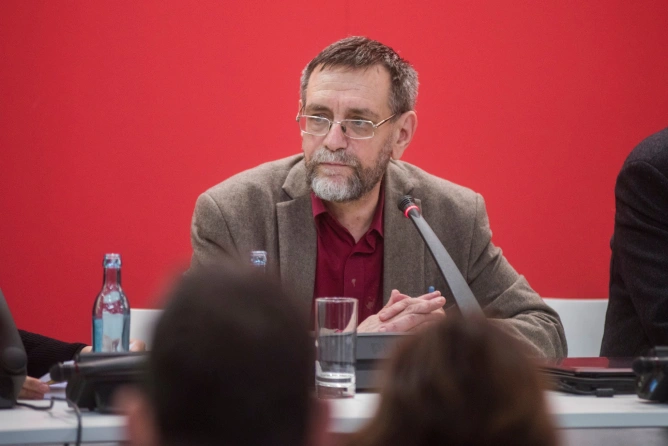
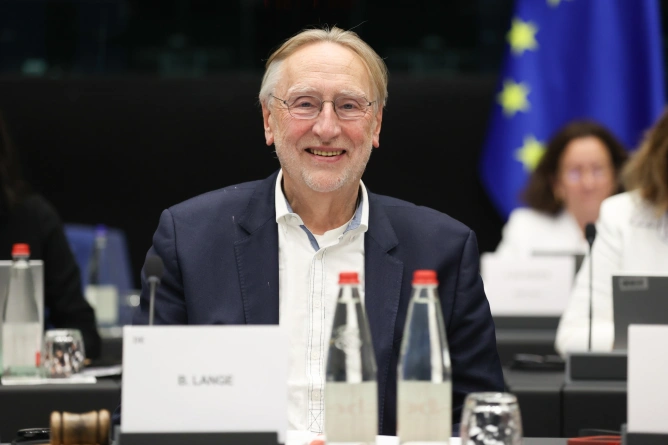
Bernd Lange proposes minimum prices for electric bicycles from China, in addition to existing trade duties



Always see our news on Google
Electric bicycles imported from China could be subject to a minimum price mechanism as a trade alternative worth examining in relations between Brussels and Beijing, considers Bernd Lange, chair of the European Parliament’s Committee on International Trade (INTA). The German MEP from the Socialists and Democrats (S&D) group argues that protecting European industry must include component manufacturers and the entire manufacturing chain, in a sector where the European Union already applies anti-dumping and countervailing duties on Chinese electric bicycles.
In brief
Bernd Lange proposes examining minimum prices for electric bicycles imported from China, inspired by solutions discussed in the automotive sector.
The EU applies anti-dumping duties ranging from 10.3% to 70.1% and countervailing duties ranging from 3.9% to 17.2%, depending on the manufacturer and the applicable legal regime.
The European Commission extended the measures in January 2025 for another five years, citing the continuation of dumping practices and subsidization.
The European electric bicycle industry provides approximately 12,000 direct jobs, according to the Commission.
Lange’s proposal does not represent an EU decision and currently has no established legislative timetable.
“For example, a regulation on minimum prices for imported electric bicycles, similar to the approach currently being discussed for hybrid cars, could be considered,” says Bernd Lange in the 15 October 2026 edition of his Europa-Info newsletter. The proposal introduces into the debate on the bicycle industry a trade option different from the system of additional customs duties. It would involve examining price conditions for imported products, but the MEP does not specify the minimum level, the legal mechanism, or how it would interact with the duties already in place. At this stage, it is a political negotiating idea, without a legislative proposal announced by the European Commission.
Lange justifies his intervention by the pressure exerted on European manufacturers by China’s industrial capacity and public subsidies that can artificially reduce the price of exported products. In the newsletter, he estimates annual Chinese production at up to 80 million bicycles, nearly 40 times higher than Germany’s. The comparison concerns bicycles in general and does not constitute a separate statistic for the electric segment. The MEP also acknowledges the technological advances of the Chinese industry, including in the development of propulsion systems for electric bicycles, and considers industrial performance in itself to be a legitimate form of competition.
“The problem arises when good products are made artificially cheaper through massive state subsidies,” says Lange. In his assessment, the European response must target practices that distort competition while preserving incentives for innovation and quality improvement. This distinction is relevant for an industry in which the final price, technology, reliability, and services offered to consumers influence manufacturers’ ability to compete.
The European Union already has specific trade measures for this sector. On 23 January 2025, the European Commission adopted two implementing regulations maintaining anti-dumping and countervailing duties on pedal-assisted bicycles with an auxiliary electric motor originating in China. The acts were published in the Official Journal on 24 January and entered into force the following day. They resulted from a review of the measures introduced in 2019, before the expiry of the initial application period.
Anti-dumping duties, which seek to counteract imports made at dumping prices when they injure European industry, range between 10.3% and 70.1% for the main rates presented by the Commission. There are also specific treatments resulting from court rulings, including a 9.9% rate reimposed on one manufacturer. Separately, countervailing duties for established subsidies range between 3.9% and 17.2%. The applicable values depend on the manufacturer, the customs code, and the provisions of the regulations, and simply adding the maximum percentages does not describe the duty payable on a particular import.
The reviews were based on requests from the European Bicycle Manufacturers Association, submitted on behalf of European industry. The Commission investigated the likelihood that injurious trade practices would continue or recur if the measures expired and concluded that maintaining protection was justified. These findings concern the products and periods examined in the trade investigations and do not represent a general assessment of all Chinese industrial exports.
According to the European Commission, the European electric bicycle sector provides approximately 12,000 direct jobs. The institution’s assessment shows that the measures introduced in 2019 helped reduce the effects of subsidized and dumped imports, especially for European manufacturers in the low- and mid-priced market segments. The Commission considers that this protection enabled new businesses to enter the European market and encouraged investment in technological development and more sustainable production methods.
Bernd Lange wants the debate, however, to go beyond imports of finished bicycles. “It is not enough to look only at complete bicycles. We must also pay more attention to component production and the entire value chain,” says the MEP. The distinction matters for businesses producing motors, transmission systems, frames, batteries, and other components used in assembling electric bicycles. The competitiveness of a European manufacturer depends both on the costs and quality of these components and on the ability to integrate the technologies into the final product.
Lange illustrates this issue through a visit to Yoonit, a Hamburg-based company that develops and manufactures electric cargo bicycles and which, according to the MEP, deliberately uses European components. The example shows the importance he attaches to small and medium-sized enterprises, industrial specialization, and maintaining local production capacities. Protection applied exclusively to finished bicycles does not automatically resolve the difficulties faced by European component suppliers, whose products may be exposed to different trade conditions.
This broadening of the trade perspective also raises questions about the effects on the market. Any potential minimum price mechanism would have to be assessed against the EU’s international obligations, existing trade measures, and the interests of manufacturers, importers, and consumers. Depending on its form, such an instrument could affect the prices of electric bicycles available on the European market, including in segments accessible to people who use bicycles for daily commuting and companies that use cargo bicycles for urban distribution. There is currently no draft on the basis of which these effects could be quantified.
At the same time, the sector’s development depends on European manufacturers’ ability to compete with new technologies and quality products. Lange emphasizes this industrial dimension and states that “customs duties alone will not secure the future of the European bicycle industry.” In his view, innovation, quality, and investment-friendly conditions must complement the response to unfair trade practices.
The proposal concerning minimum prices comes ahead of Bernd Lange’s announced visit to Beijing and Shanghai, between 26 and 30 October, together with a delegation from the INTA Committee. The visit is intended to continue trade dialogue with Chinese authorities and stakeholders. However, there has been no announcement that a minimum price mechanism for electric bicycles is already on the official agenda of these meetings. Any concrete change would require defining an instrument compatible with the applicable legal framework and following the appropriate procedures.

Latest News
23:01
22:57
22:53
22:50
22:43
See more news
NEWS ON THE SAME TOPICS



.webp)