



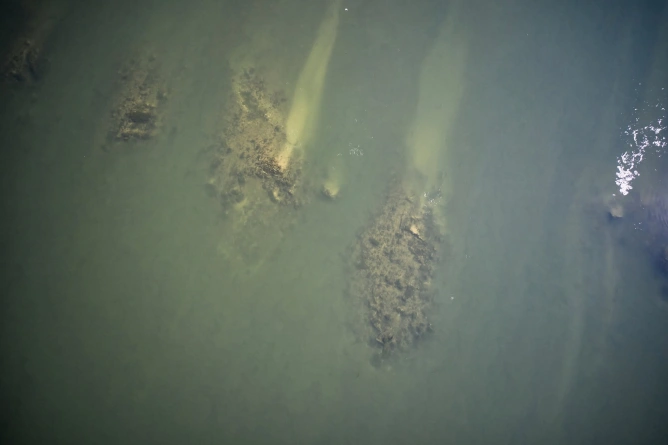
The low level of the Danube has revealed the foundations of the old Bridge of Constantine, providing Bulgarian archaeologists with a rare opportunity to study this Roman engineering achievement.



Always see our news on Google
The extremely low level of the Danube has exposed the foundations of the old Bridge of Constantine, an impressive achievement of the Roman Empire, according to Bulgarian archaeologists. Pavel Popov from the Regional Historical Museum in Pleven stated that this natural phenomenon provides a unique opportunity to observe and document the structure, which usually remains hidden under water.
The bridge, commissioned by Emperor Constantine I and inaugurated in 328 AD, connected the town of Ulpia Oescus to Sucidava, having a length of over two kilometers, making it one of the longest in antiquity, although it had a short existence, being destroyed around 367 AD. A team of researchers used drones to map and photograph the exposed remains, assessing their condition. The severe drought in Europe, caused by heatwaves, has affected important watercourses, including the Danube, thus facilitating this archaeological discovery.
Sources


Latest News
13:51
13:41
13:39
13:38
13:34
See more news
NEWS ON THE SAME TOPICS












.webp)


.webp)


