Who is afraid of artificial intelligence?



Always see our news on Google
Artificial intelligence is no longer a science fiction topic, but for a good part of Romanians, it remains a distant and, especially, unsettling reality. The latest sociological data shows that concern about the impact of AI on the labor market is not evenly distributed, but follows major social divisions.
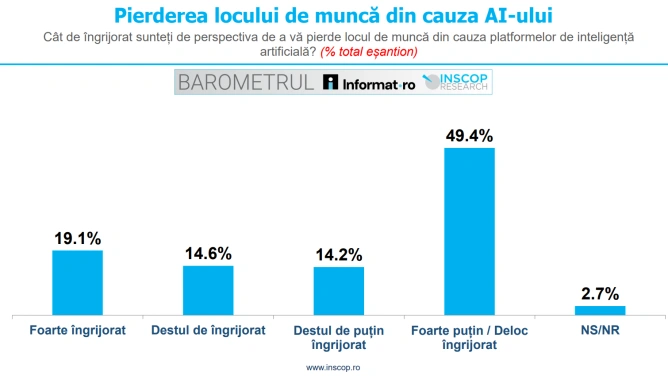
According to the BAROMETER Informat.ro – INSCOP Research, conducted between March 2-6, 2026, approximately one third of Romanians (33.7%) declare that they are worried (very and somewhat worried) about the possibility of losing their job due to AI. The most worried are those who do not use AI technologies, people over 45 years old, those with primary education, and residents of rural areas. These categories are already in a fragile position in the labor market, and the emergence of a new technology that has the potential to radically transform labor relations exacerbates the feeling of insecurity, especially in the absence of solid digital skills.
On the other hand, almost half of Romanians (49.4%) say they are not at all or are very little worried. Interestingly, it is precisely the categories most exposed to change and who use artificial intelligence the most — young people, those with higher education, urban residents — that are the least worried. It is presumed that familiarity with technology gives them, at least at this moment, a sense of control. The paradox is, however, that these very categories, which work in highly digitized fields, could feel the effects of the AI revolution more strongly as automation advances in areas such as IT, data analysis, or operational support. In other words, while their confidence is fueled by digital skills, their actual exposure to change is, in fact, higher.
Therefore, the fear of the impact of AI on the labor market seems to be largely shaped by access to technology and the socio-economic vulnerability felt at present.
Methodology: The data from the eighth edition of the BAROMETER Informat.ro – INSCOP Research was collected between March 2-6, 2026. Research method: interview via questionnaire. The data was collected using the CATI method (telephone interviews), with a simple stratified sample volume of 1100 people, representative of significant socio-demographic categories (gender, age, occupation) for the non-institutionalized population of Romania, aged 18 and over. The maximum allowable error of the data is ± 3%, at a confidence level of 95%.
Latest News
09:27
09:26
09:20
09:16
09:12
See more news
NEWS ON THE SAME TOPICS
.webp)