search icon
search icon
Flag Arrow Down
Română
Română
Magyar
Magyar
English
English
Français
Français
Deutsch
Deutsch
Italiano
Italiano
Español
Español
Русский
Русский
日本語
日本語
中国人
中国人

Change Language

arrow down
  • Română
    Română
  • Magyar
    Magyar
  • English
    English
  • Français
    Français
  • Deutsch
    Deutsch
  • Italiano
    Italiano
  • Español
    Español
  • Русский
    Русский
  • 日本語
    日本語
  • 中国人
    中国人
Sections
  • News
  • Exclusive
  • INSCOP Surveys
  • Podcast
  • EU
  • Diaspora
  • Republic of Moldova
  • Politics
  • Economy
  • Current Affairs
  • International
  • Sport
  • Health
  • Education
  • IT&C knowledge
  • Arts & Lifestyle
  • Opinions
  • Elections 2025
  • Environment
About Us
Contact
Privacy policy
Terms and conditions
Quickly scroll through news digests and see how they are covered in different publications!
  • News
  • Exclusive
    • INSCOP Surveys
    • Podcast
    • EU
    • Diaspora
    • Republic of Moldova
    • Politics
    • Economy
    • Current Affairs
    • International
    • Sport
    • Health
    • Education
    • IT&C knowledge
    • Arts & Lifestyle
    • Opinions
    • Elections 2025
    • Environment
127 new news items in the last 24 hours
  1. Home
  2. Opinions
7 hours ago
Editorials and opinions

Let AI Be…

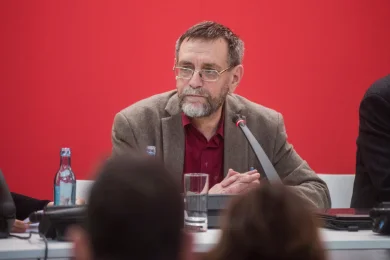
Darie Cristea, director de cercetare INSCOP Research
whatsapp
facebook
linkedin
x
copy-link copy-link
21 September 2026, 09:13
main event image
Opinions
Foto: Facebook
google-preference

Always see our news on Google

For decades, the theory was that mechanization, robotization, digitalization, and so on would protect people from hard and excessively routine work. In these visions, shared by both capitalist and authoritarian societies throughout recent history, everyone stood to gain: the state, companies, and workers.

And since modernity was feverishly transforming the surrounding natural and societal environment, the story made sense and no one seemed to be in danger. Those engaged in intellectual work were expected to focus on supervising processes, checking, thinking about data, and making decisions, while those doing manual labor were expected to be upgraded into workers operating a machine—whether mechanical or digital—or supervising such industrial machinery. Because the end of work never seemed to arrive, the world hoped for work that would be easier, more creative, more dignified, more meaningful, and less dangerous.

As the specter of the Second World War recedes, the need for that kind of massive reconstruction also comes to an end. After 1970, the general optimism fades, and the dream of near-full employment proves to have been a strictly contextual reality on both sides of the Iron Curtain. The progress of automation helps and does not help at the same time. Some professions expand enormously, while others disappear. Then, gradually, computers emerge, opening the way toward what we now call artificial intelligence. Many of these developments were, of course, interestingly described in the highly fashionable science-fiction literature of the time. With the emergence of computers, the focus shifts from mechanically operating a machine to the fact that this helpful tool of our worker begins to think. At first, strictly guided; later, increasingly autonomous, offering alternatives and operating on vast quantities of data that the person behind it could not actually manage as well or within a reasonable time using only their mind, pen, and paper. Operating a computer is no longer something learned through a short vocational course, on-the-job experience, or two or three days of training at a factory. We are now talking about a profession, an intellectual occupation, years of education and experience, and practically learning a parallel reality capable of creating things from a black box equipped with keys. From there came increasingly powerful computers, laptops, the internet, smartphones, tablets, and automobiles that are more computers than cars—and the AI revolution, which is moving at a truly dizzying pace.

The problem is not merely whether we want AI or not, or whether we are capable of creating rules for integrating it into life, education, and work. The problem is whether we are capable of understanding what we use, and whether it will become so complex that understanding it will be impossible without formal education. I fear that the reasonable answer—to use it, but as a tool and nothing else; not to abuse it, and so on—is operationally nonsense.

Then these systems evolve so extensively and become so deeply embedded in everyday life—at present, their managers and users are not being held particularly accountable, because, well, we are not going to oppose progress—that they develop so quickly that whatever we regulate about them today will run up against the fact that, by the time we finish regulating them, they will no longer be what they were when regulation began.

Latest News

18:56

Greece, reclassified by FTSE Russell as a “developed market”

18:43

Hungarian Prime Minister Peter Magyar rejects the Naftogaz-MOL agreement on oil storage facilities intended for Ukraine

18:42

The Republic of Moldova declares a state of emergency in the energy and hydrological sectors. Maia Sandu: “The government must prepare plans for different scenarios”

18:37

Robert Fico: Slovakia will not send troops if a war breaks out between NATO and Russia

18:36

The Ministry of Environment has issued the environmental permit for the completion of works at the Cornetu-Avrig hydroelectric power plant / The investment is estimated to produce 156.8 GWh annually

See more news

NEWS ON THE SAME TOPICS

event image
Opinions
Andrei Cornea: How AI Will Kill Us
event image
Opinions
Sever Voinescu, Dilema.ro: He says it's a mirror, not a conscience
event image
Opinions
Andrei Cornea: The world is aging
event image
Opinions
Sever Voinescu: Temptation and tendency
event image
IT&C knowledge
Over 200 economists warn that artificial intelligence could change the economy faster than the Industrial Revolution did.
event image
IT&C knowledge
Anthropic’s CEO calls for slowing AI development, warning that intelligent agents could take control of the internet in the coming months
app preview
Personalized news feed, AI-powered search, and notifications in a more interactive experience.
app preview app preview
artificial intelligence technological education emerging technologies digital transformation

Editor’s Recommendations

main event image
Current Affairs
54 minutes ago

Călin Georgescu, detained for 24 hours by DIICOT prosecutors in a fraud case (Sources)

Sources
imagine sursa
imagine sursa
imagine sursa
main event image
Politics
1 hour ago

UDMR, warning for Siegfried Mureșan: He should resign his mandate if he does not have a majority

Sources
imagine sursa
imagine sursa
imagine sursa
imagine sursa
imagine sursa
+1
main event image
Exclusive
43 minutes ago

SPECIAL Informat.ro / Ranking of international political topics from the past week. Effects on Romania

main event image
Politics
1 hour ago

Mircea Abrudean: Siegfried Mureșan will present the governing program in Parliament on Tuesday / “He will not take a step back”

Sources
imagine sursa
imagine sursa
imagine sursa
imagine sursa
main event image
EU
6 hours ago

Europe must prepare for renewed US pressure after the November elections, an EUISS analysis warns

app preview
Personalized news feed, AI-powered search, and notifications in a more interactive experience.
app preview
app store badge google play badge
  • News
  • Exclusive
  • INSCOP Surveys
  • Podcast
  • EU
  • Diaspora
  • Republic of Moldova
  • Politics
  • Economy
  • Current Affairs
  • International
  • Sport
  • Health
  • Education
  • IT&C knowledge
  • Arts & Lifestyle
  • Opinions
  • Elections 2025
  • Environment
  • About Us
  • Contact
Privacy policy
Cookies Policy
Terms and conditions
Open source licenses
All rights reserved Strategic Media Team SRL

Technology in partnership with

anpc-sal anpc-sol