



The new geography of winners and losers


Always see our news on Google
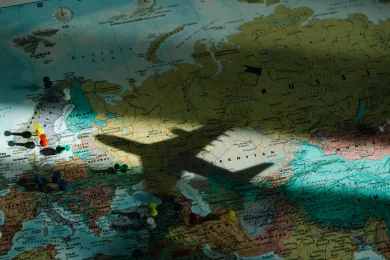
The world is not flat. A new economic geography is emerging: brutal and fragmented, where maps are no longer drawn by accountants, but by military strategists, intelligence agency directors, and energy ministers. The idea that economic interdependence guarantees global peace has died. Capital, goods, and labor will no longer flow smoothly to the cheapest and most efficient point on the globe. And the great global realignment is no longer a forecast for the coming decades; it is happening now, before our eyes.
In this new order, efficiency has been dethroned by a new imperative: resilience. And this comes at a cost. But who wins and who loses from this radical rewriting of global power lines?
At the macro level, global competition has transformed from a game of cooperation into a zero-sum match. The United States has understood first that national security and economic security are two sides of the same coin. Through massive policies of subsidizing domestic production and forcing the repatriation of critical technologies, Washington has turned America into a giant vacuum cleaner for global capital. The U.S. is reindustrializing its economy, attracting giant semiconductor and battery factories, often to the detriment of its traditional allies.
At the other pole, China is reconfiguring itself. The model of the "world's cheap factory" has faded, eroded by demographic costs and Western tariffs. Beijing no longer wants to assemble iPhones; it wants to hold a monopoly on the future. Through quasi-total control over the processing of critical minerals – lithium, cobalt, rare earths – and through aggressive dominance in the electric vehicle and solar panel markets, China is building its own sphere of influence. It is no longer an emerging economy but a technological fortress exporting its model of "state capitalism."
In the wake of these two titans, the European Union risks becoming the great systemic loser. Suddenly deprived of cheap energy from Russia – which fueled the German industrial miracle – and caught in the vise of American subsidies and Chinese dumping, Europe faces the specter of a slow but structural deindustrialization. Without a profound reform to reduce the stifling bureaucracy and without a unified capital market capable of financing innovation, the "Old Continent" risks becoming a beautifully regulated museum, a premium tourist destination, but technologically irrelevant.
In the wake of this fracture, a new category of economic actors is claiming glory: the swing states. They are neither in Washington's camp nor in Beijing's, but pragmatically navigate the cracks of the system. Mexico has already surpassed China as the main trading partner of the U.S., becoming the preferred destination for near-shoring. Vietnam, India, and Malaysia are taking over the factories leaving the Chinese coasts. In Europe, Poland is emerging as the new industrial engine of the continent, attracting massive investments in logistics and microelectronics. These "geopolitical opportunists" are the big winners of the new geography: they are no longer just selling cheap labor but geopolitical security.
This realignment completely redraws the importance of industries. Critical infrastructure no longer means just bridges and roads, but submarine data cables, LNG terminals, and smart electrical grids. Energy is no longer a simple tradable commodity but a primary geopolitical weapon. Those who hold transition technology – from modular nuclear reactors (SMR) to hydrogen and large-scale storage – and those who can secure supply routes win. Meanwhile, reindustrialization has ceased to be a populist slogan. Next-generation microprocessors have become the "oil" of the 21st century: those who do not produce them or do not have guaranteed access to them cannot ensure either military or economic sovereignty.
Where does Romania stand on this new map of power? The answer is paradoxical: we are in the most favorable geographical and historical position of the last century, but we risk missing the train due to our own administrative incapacity. On paper, Romania has all the assets to be a major winner of European friend-shoring. We are NATO's and the EU's eastern flank, an island of stability in a volatile region. Unlike our neighbors, we have an enviable energy mix and a relatively substantial independence, bolstered by gas from the Black Sea, investments in nuclear energy, and renewable potential. Moreover, we are the logical hub for the future reconstruction of Ukraine, and the Port of Constanța has the historic chance to become the main gateway for goods into Central and Eastern Europe, bypassing northern routes.
However, geography is not destiny if left to decay. Western companies looking to move production from Asia are not just seeking a politically safe country but also a functional one. And here Romania is bleeding. If mountain highways remain promises, if the railway infrastructure continues to run at speeds from the last century, and if the Port of Constanța remains mired in bureaucracy and lacks logistical vision, investors will choose Poland, Hungary, or even Morocco.
Furthermore, the competitive advantage of cheap labor has disappeared. Romania can no longer win through low wages but must win through added value. If the educational system continues to produce diplomas instead of competencies, we will remain just an "assembly periphery" – a country where screws designed elsewhere are tightened, dependent on decisions made in boardrooms in Berlin or Paris.
The new global geography does not offer consolation prizes. It penalizes not only ill intentions but, above all, indolence and lack of vision. Those who do not sit at the table of those designing the future will inevitably find themselves on its menu.
Latest News
11:02
11:02
11:01
10:49
10:26
See more news
NEWS ON THE SAME TOPICS








.webp)



.webp)


