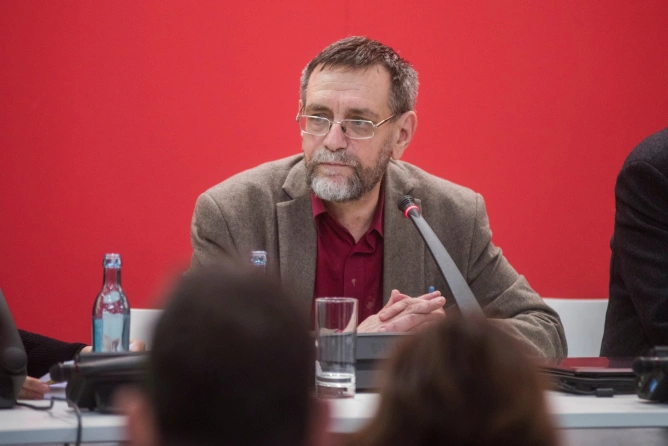
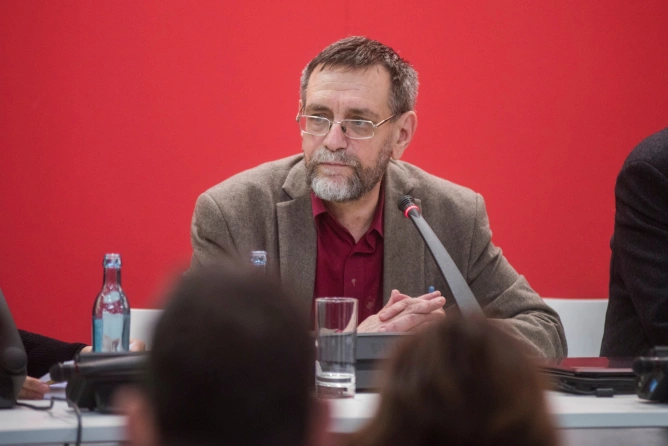
Andrei Cornea: Order from disorder



Always see our news on Google
The notion of "progress" – that is, a massive transformation and a certain generality towards greater complexity or from an inferior quality to a superior one – seems to me to have been among the most paradoxical and counterintuitive notions. It is true that, especially in the last century, we have become accustomed to it – which often does not mean that we no longer think about it; but avoiding its "harshness" through denial does not mean we still understand it.
There are, in exchange, two types of transformations that seem evident to us and in the logic of nature. The first, which I call "maturation," means that an undeveloped organism develops according to a pre-established plan from the very beginning. Aristotle spoke here about the transition from virtuality or potentiality (dynamis) to actuality (energeia). The seed and the tree are not two organisms – one inferior and the other superior – but the same organism that passes, over time and under certain conditions, from virtuality to actuality, gradually manifesting what existed anyway, but undeveloped and invisible.
The second type of transformation with which we are very familiar is the "artisanal" one: it is characteristic of human "artificial" productions: someone has a plan and, according to it, intervenes on several materials that he shapes in a certain way, trying to reproduce the plan as closely as possible. For Aristotle and those who followed him for many hundreds of years, it is still about a transition from virtuality to actuality, only that the "motor" of the transformation is no longer natural and immanent, but artificial and external.
What truly associates the two transformations (and this was well seen by Aristotle) is the existence of a "depth" of a "plan": a pre-existing ordered structure that defines once and for all the species, in the natural case, an explicitly intelligent structure in the artificial case. From here, the idea that all natural transformations can also be explained by an intelligent plan, similar to the artificial ones, was just a step and it was already taken by Plato in Timaeus, who imagined a divine Artisan (demiurgos) who crafted the entire world in the same way that a craftsman or an architect creates works.
In short, the traditional idea of transformation – whether natural or artificial – is this: there is always a pre-established plan and an intelligent actor who puts it into action (unless he conceived it himself beforehand). From here also the consequences: any order is the work of a more advanced, superior order; any creation or production is inferior to its creator; the "natural" tendency of the world is towards decline and degradation, unless an intelligent creator intervenes to reverse it.
Modern thinkers have overturned this vision: with Adam Smith in economics, with the Enlightenment in history and society, with Darwin in the evolution of species and, more recently, with the Big Bang theory regarding the origin and development of the Universe, we are obliged to always think of a paradoxical situation: we have a superior order deriving from an inferior order or even from disorder: the disorder of the competitive market creates the wealth of nations and the capitalist organization of the economy and society, without "someone" intervening; lifeless matter becomes alive, then organizes itself more and more complexly based on spontaneous natural selection, without a prior intelligent plan; perhaps the same type of increasingly higher organization occurs, over time, at the level of the Universe. The phenomenon of evolution (from inferior to superior) is paradoxical and counterintuitive: not only does it frustrate our expectations and representations with which we are accustomed, but it seems to contradict the second principle of thermodynamics (although physicists warn us that this principle "works" only in a closed system – which Earth, with all the life on it, is not, of course; but is the Universe as a whole "closed" or "open"?)
I do not want to draw attention to more than a single consequence: if, according to the traditional view of change, a work can never be superior to its creator, the evolutionary view contradicts this rule: if a superior order can spontaneously and evolutionarily arise from an inferior order, nothing prevents a work from becoming superior, possibly more perfected, more intelligent than the one who created it or than the order from which it derived. This seems to be exactly the case with today's Artificial Intelligence, which, it is said, will eventually surpass us, humans, who created it. If that is the case – as its authors predict – the fact, beyond its enormous practical consequences, will indirectly prove, once again, not necessarily that gods do not exist, but that, as in Epicurus' philosophy, they have no place to explain the world, life, and us themselves.
Latest News
22:52
22:34
22:28
21:56
21:29
See more news
NEWS ON THE SAME TOPICS
.webp)