Andrei Cornea, about Nicușor Dan's message on Europe Day: Immunity or insensitivity?



Always see our news on Google
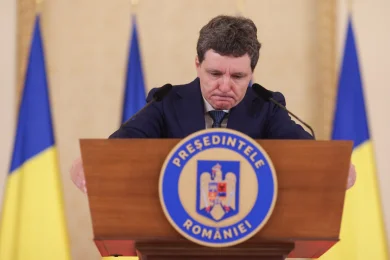
Recently, President Nicușor Dan has considerably angered his supporters and, in general, a significant part of the "reformist" electorate, adopting an agenda increasingly aligned with PSD and even AUR. After not supporting the Prime Minister during the circumstances of the PSD-AUR censure motion and allowing it to be understood that he is not very disturbed by the idea of resuming the PSD-PNL-USR-UDMR coalition, but without Ilie Bolojan (the PSD plan, meanwhile derailed), last week the president annoyed many by adopting a soft AUR (or MAGA) vision in his speech on the occasion of Europe Day on May 9. The online environment exploded with recriminations from the "reformist bull" regarding this vision declared "pro-Western," but not "pro-European," which briefly echoed the criticisms of the Trump administration towards the European Union – which saves me from summarizing them here. It is enough to say that the ideological and political position of the president, after almost a year in office, leaves little room for doubt: on the one hand, the president leans towards a moderate sovereignism in foreign and European policy, with reverberations in domestic policy by almost openly favoring PSD against USR and PNL and Prime Minister Bolojan. On the other hand, the president repeatedly and firmly states that he will not accept a government with AUR in its composition.
That this agenda, consistently pursued by the president, angers, outrages, or frightens a part of society – especially those who actively supported him during the electoral campaign – is also evident and natural. The question now is not whether the president's agenda pleases some or not, but whether it is useful or valuable for the general course of things in Romania.
Trying to give a response – of course, provisional – we note that the respective agenda contains a fundamental internal contradiction: although it refuses the AUR party (the second in terms of seats in Parliament) participation in a new government, the president still adopts some of AUR and MAGA's criticisms of the EU. Moreover, emphasizing in his speech on May 9 that the merits of the EU for Romania included in a special way the support of identity symbols (from the restoration of churches and monasteries to works at Sarmizegetusa), Mr. Dan tends to court sovereignists and nationalists, voters either of AUR or PSD. The opposition, stirred for several months against the "Vexler law" can only be interpreted as a "slap" against the neolegionary extremists of Călin Georgescu or the supporters of George Simion. And the absence of mentioning in the same May 9 speech of the constant European pressures for Justice and the rule of law in Romania (see the CVM from a few years ago) aligns quite well with the refusal to satisfy the "European party" in the matter of appointing prosecutors of the major prosecutor's offices.
We understand that the president would like to eliminate the major social rifts and cultural wars in Romania, but the contradiction I mentioned has every chance of making the plan fail, widening the rifts or even creating new ones. Sovereignists will only be partially satisfied with the soft version offered by the president. After all, they have the hard options of AUR or SOS. Also, the American administration will remain cautious towards Romania. The gesture of participating in Trump's Peace Council or allowing military flights from Romanian bases in the context of the war in the Middle East are likely appreciated, but more will be demanded. And Romania cannot take Hungary's place in the EU, simultaneously pro-Putin and pro-Trump, now that Orbán is history. I do not see any Romanian government without AUR blocking EU mechanisms, as Hungary did. Consequently, Trump's people, sovereignists, nationalists, Putinists, etc. will remain dissatisfied, as long as their own remain excluded from governance. They will demand more and will always have stronger examples – both internal and external. They are also right in their way: why choose the pale copy when you have or could have the original?
On the other hand, the reformist electorate and civil society in general, as well as their European friends, who promoted and voted for Nicușor Dan, have every reason to feel betrayed. (Adrian Papahagi published a very eloquent text on FB on Sunday that makes this feeling of betrayal manifest.) And betrayal, more than other gestures, triggers massive frustration and anger. Even if Nicușor Dan will gain some support (little anyway) from the sovereignist side, he will lose massively from the liberal and pro-European side, which will not forgive him, even without AUR in the government. But the betrayal will also be noted by the other side: a president who seems to abandon the Prime Minister in difficult times will never be considered a trustworthy partner by anyone. No matter how many compromises the president makes, any temporary ally will always remind him of the immortal words of Farfuridi: "I love betrayal, but I hate traitors."
Perhaps the president wants to "vaccinate" Romanian society with the "microbe" of sovereignism in a softened form, to protect it from a severe form. And thus sacrifices his good reputation and personal prestige, risking that "his name will be inadequate," as Mihai Maci well wrote in the magazine 22. The goal would be to strengthen society. I fear, however, that the social organism does not function like the individual organism: what the "sovereignist injection" in modest doses will succeed – if this is the plan – will probably not eliminate the disease, but "normalize" it, reducing society's defensive reactions, namely refusals, indignations, protests: it will make increasingly larger doses of anti-Europeanism and anti-liberalism, of chauvinism, of national-communist and legionary nostalgia, of conspiratorialism and anti-Semitism acceptable to the bulk of society. There are already enough people making efforts to explain the president's gesture, sweetening its significance. The symptoms of habituation have already appeared. Gradually, what scandalizes today will be routine tomorrow. Numerous historical examples suggest that the president's remedy – if that is what it is about – does not eliminate but aggravates the disease of extremism, causing it to metastasize throughout the social body. Vaccinating society with a "softened evil" does not make most people immune, but insensitive.
The devil, it has been said, hides in details. Let us add that he rarely comes in all his dimensions at once; on the contrary, he loves gradual insinuation, in small doses, even mixed with something good. His allies are weariness, routine, and boredom. But at the end of the road, if we do not know how to stop in time, hell awaits us, unyielding.
https://www.dilema.ro/situatiunea/imunitate-sau-insensibilitate
Latest News
15:55
15:55
15:55
15:51
15:51
See more news
NEWS ON THE SAME TOPICS