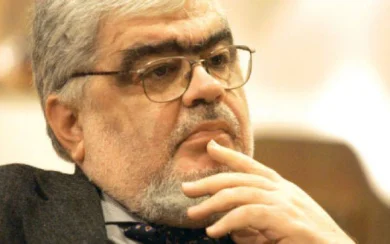
Sever Voinescu: Hating Nicușor and “healthy nationalism”



Always see our news on Google
Hating Nicușor is already a national sport. There is nothing healthier across Romanian-language social media than practicing daily rhetorical blows—slaps, punches and kicks—with the president’s face on the punching bag. I would even say that hating Nicușor is a recreational sport, insofar as exercising aversion to President Dan gives the exhibitionist a strange satisfaction, placing him in the broad trend of “the good people” without actually exposing him to any risk. The person who detests President Dan declares himself disappointed and deceived, a good-faith and honorable victim of this venal man. He also declares himself ready to wage the great battle from his armchair, frantically pressing the keyboard in visceral rhythms, as befits any mighty guardian of civic virtues.
I do not deny that President Dan’s performance is bewildering, irritating those who believed they had voted for an anti-PSD reformer, a tireless activist for progress and the fight against corruption. I do not detest the president (I know, this statement exposes me, but I am used to it by now) because I knew from the start that he was not such a thing and I knew from the start what he was. I hasten to clarify that, since he is not an anti-PSD reformer, a tireless activist for progress and the fight against corruption, Nicușor Dan is not the opposite either. And this is where I part ways with the cohort of outraged disappointeds. The problem with those who practice hating Nicușor is that they judge in binary terms: if you do not bite into the PSD members with relish on television, you are a PSD member; if you do not curse the Church and applaud the Vexler law with an emotionally heaving chest, you are a legionnaire; if you do not attack Lia Savonea, you support the corrupt. Nicușor Dan is neither a legionnaire, nor a PSD member, nor a lover of the corrupt. But he is not otherwise anything else, either. I admit that the man is difficult to read, and I believe that this is why people quick to draw conclusions and apply labels rush to hate him. Elites and ordinary people alike, the right and the left, progressives and reactionaries all nervously get caught in this anti-presidential vortex. Indeed, many swear by all the saints that, if they get the chance in a referendum to remove him, they will bring him down with their stamp before you can see it. Since I am spared disappointment (because I was not deceived—I repeat, I know what I voted for and I would still vote for him now, both in a contest with Crin Antonescu and in a contest with George Simion), I also allow myself the luxury of refusing to join the great dance, paying, of course, the tiny price of a day’s worth of abuse in this new temple of paganism called Facebook.
I do not detest the president, but neither am I delighted by him. And the difference between me and the practitioners of the national sport of hating Nicușor is that on several points I agree with the country’s president, whereas they agree with nothing. One of the points on which I agree with President Dan, and which I want to address now, is the statement that we must rediscover within ourselves what he called (perhaps using an unfortunate phrase) “healthy nationalism.” And, moreover, just to annoy the respectable establishment completely, I do not dislike the fact that Nicușor Dan made this statement in the National Cathedral. Before explaining why, I want to recall what is obvious: the president is not good at speeches at all and has difficulty finding the most suitable wording when speaking in public.
The expression “healthy nationalism” annoyed some because it used the word “nationalism” in a positive context—more precisely, it gave a positive meaning, through the adjective “healthy,” to something that cannot be given a positive meaning. For these people, “nationalism” is a horrible word and a poisonous sentiment, a kind of antechamber to crime and the cause of Europe’s greatest evils in the past. Quite a few people hope that the success of the European Union’s grandiose project will at least temper nationalisms. Others were annoyed by the adjective “healthy.” In other words, they say, what could be unhealthy about nationalism? For them, nationalism is good, period; there is no other kind of nationalism than healthy nationalism. The reason is that nationalism is natural; it is normal for every person to feel primarily attached to their nation, and it is even normal to assert this identity firmly and proudly. Being “natural,” normal and instinctive, nationalism can only be healthy, just like breathing or sleeping. Do you not see that throughout Europe, policies intended to dilute nationalism are failing (see, above all, generous policies toward migration), and even leading to an exacerbation of nationalism, itself a natural counterreaction?
Finally, other dissatisfied people were annoyed by the location. The usual anticlerical and anti-Orthodox phalanx once again found an opportunity to express its protest.
We can, of course, discuss whether the president used the right words, but I warn that sensibilities are so varied that it is objectively impossible to speak today in Romania about nationalism and the nation without irritating someone. And if you want to talk about nationalism, you have to accept that you will step on some toes. In addition, we have the learned commentators, who will know how to twist words and concepts so that things turn out badly (if they want them to turn out badly) and well (if they want them to turn out well).
What the president said, however, must be placed in a political context. The major problem we face in terms of public discourse is the seizure of national themes by the so-called “sovereigntists,” who speak about the nation without competition, thereby creating the idea that the subject belongs only to them. The paradox is that those who speak about the nation propose anti-national policies. Weakening the European Union, massive nationalizations, supporting Russia’s advance by suppressing support for Zelensky’s Ukraine, legalizing the suspicion that civic NGOs are spy agencies, and many other things are central lines of the political proposals of the “sovereigntists” who, at least in my opinion, oppose our national interest. The rise of this kind of nationalist discourse must be stopped, and the president’s intuition is also mine. Infectious nationalists must be confronted on the ground of nationalism, not anti-nationalism. There is such a thing as healthy nationalism. And I believe this. It is the nationalism of someone who understands that a nation is more than an ethnicity, that Romanians’ privilege is that they made the leap from ethnicity to nation long ago—that is, from tribe to political body. It is the nationalism of someone who, without hating others, looks after their own first. What is wrong with that?
Well, this good sentiment, which has produced good for the country throughout history, can very easily be hijacked and produce catastrophes or abominable crimes. The president—and I alongside him—believes that the struggle must not be waged to eliminate nationalism, as those who imagine it is the job of the police and prison to rid us of infectious nationalism believe, but to give healthy discourse a recognized place in our politics. More clearly: AUR-style nationalism, infectious as I call it, can be countered only with healthy nationalism, not with anti-nationalism. Is there anti-legionnaire and pro-Western nationalism? I believe there is. The president’s critics believe there is not. If it is of interest, I am ready to continue this discussion.
Latest News
08:12
08:04
07:54
07:33
07:27
See more news
NEWS ON THE SAME TOPICS