Analysis. 3rd place in the production of honey, 14th place in prices. Why is gasoline and diesel not cheap in Romania and the EU?




Always see our news on Google
The price of diesel has just jumped over the psychological threshold of 8 lei/liter of diesel. A study conducted by the Intelligent Energy Association shows that Romania is in a situation that, at first glance, seems paradoxical. Although it is the third largest producer of diesel in the European Union, and although the price of oil has decreased in the last 6 years by about 52%, in Romania the price of petroleum products has increased by about 21%, especially against the backdrop of a 79% increase in excise duties and taxes.
But this is not strictly a Romanian practice but a European one. Comparing the USA (€5,590/year) with the EU (€21,000–€33,000/year) for the same 100,000 km traveled by car, the difference in taxes is about 4–7 times higher.
The excise duty on diesel is much more toxic than VAT. VAT taxes consumption only once. Diesel is taxed every time a good moves: wheat, flour, and bread are all transported and taxed. It is a cascading tax that multiplies in prices and suffocates the economy.
The United States has understood a simple truth: cheap transport means a large market and high productivity.
Europe has chosen the opposite — expensive transport, fragmented market, stagnation.
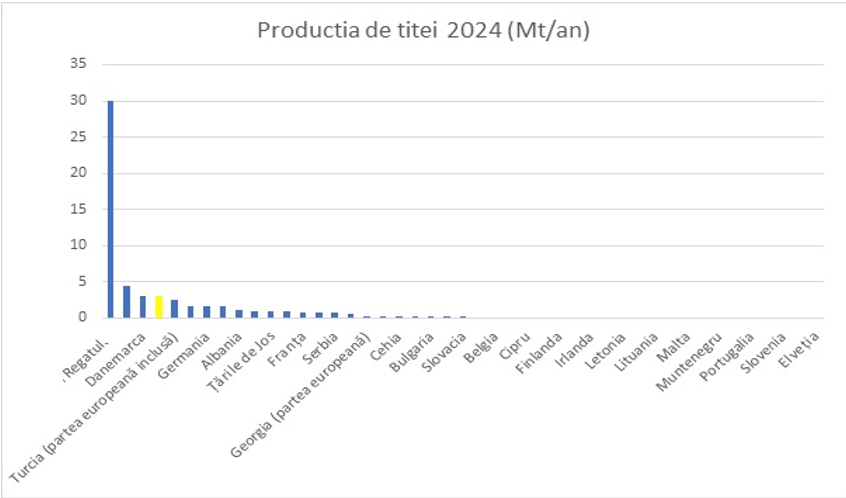
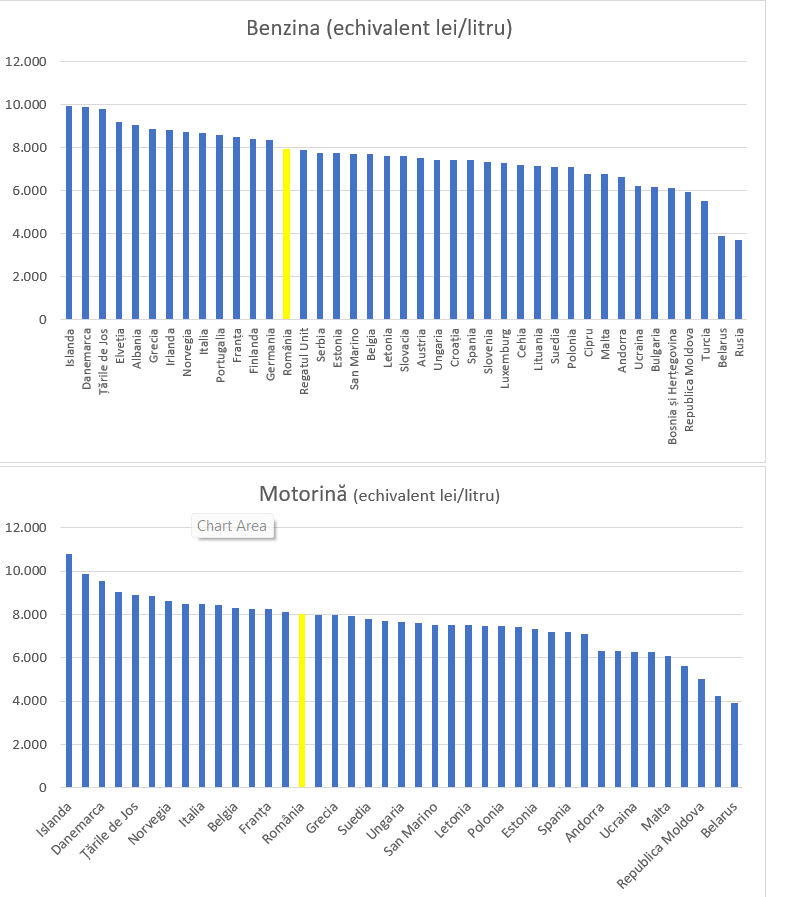
Romania is in a situation that, at first glance, seems paradoxical. Although it is the third largest producer of diesel in the European Union, after Italy and Denmark, the price of fuel at the pump places it only in the first half of the European ranking. In 2024, domestic production reached approximately three million tons of diesel, a not insignificant volume. However, this reality does not directly reflect in the prices paid by drivers, and the explanation lies less in how much oil we extract from the ground and more in how the market operates and especially in the fiscal impositions.
Gasoline and diesel are not raw products, but the result of a complex chain of refining, transport, storage, and distribution. Their price is not determined based on the local extraction cost, but on the regional and international quotes of finished petroleum products. Even if diesel is extracted in Romania, it enters an open market, where it can be sold where the price is more advantageous. The same mechanism works in reverse: finished products can be imported at prices dictated by the European market or even the Southeast European market. Thus, even a producing country ends up paying prices close to the regional average.
Diesel Production – Europe, 2024 (mil. tons/year)
Romania has significant refineries and a significant processing capacity, but it is not completely independent. Part of the consumption is covered by imports, either of diesel or of finished petroleum products. Additionally, refineries cannot process any type of diesel without additional costs or yield losses, and the "mix" between local diesel and imported diesel directly influences the final cost per liter. All these technical details accumulate and are reflected, in one way or another, in the pump price.
The high price at the pump is due to taxes. Excise duties and VAT in Romania represent over half of the final price of gasoline. The excise is a fixed amount per liter, and VAT is applied over the value, including over the excise, which amplifies the fiscal effect. The increase in excise duty on January 1, 2026, and the standard VAT rate to 21% has accentuated this share, pushing Romania higher in the price rankings, even if it does not approach the levels in Nordic or Western European countries, where the tax is even higher.
Tax Share Comparison in Gasoline Price (2025)
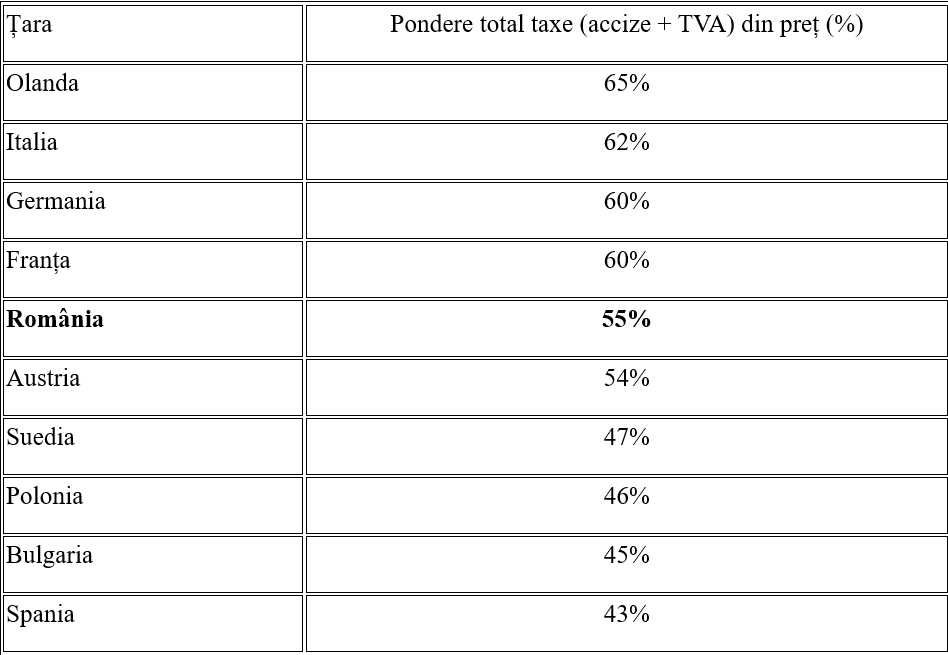
From here comes the feeling that Romania is "expensive" compared to its neighbors. Differences in tax, exchange rates, logistics costs, and the structure of the local market can shift a region several positions in the ranking from one month to the next. Thus, the 14th place is not a definitive verdict, but a snapshot in time. In reality, Romania does not have the highest prices in Europe, but neither does it have the advantage that many would expect from a producing country of diesel.
In the end, the link between production and price is broken from several directions: domestic production is insufficient for consumption, the market sets prices, refining and logistics have real costs, and taxes weigh decisively. All these factors cause the price of fuel in Romania to gravitate around the European average, demonstrating that, in the modern economy, the resource from the subsoil no longer automatically guarantees a low price at the pump.
Normally, such a strong decrease in the price of diesel (-52%) should have led to a clear decrease in the price of petroleum products or at least to stagnation. The fact that the final price has increased by about 21% in the same period indicates that: the increase in excise (77%) (and related taxes - 2%) completely canceled the effect of the oil price drop and pushed the final price up.
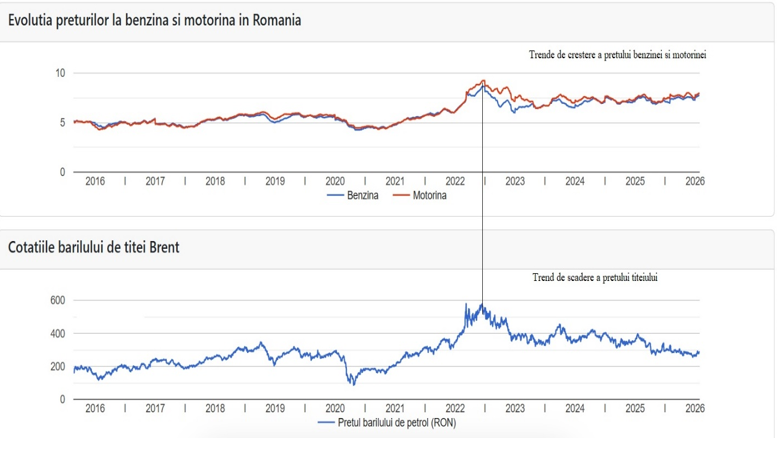
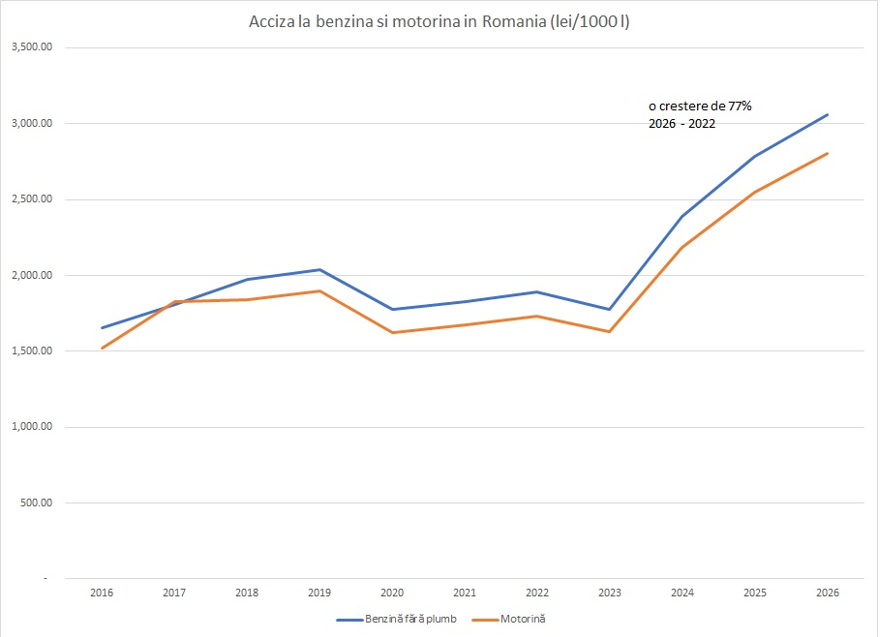
In the period 2020–2026, the price of gasoline and diesel has become much less dependent on the price of oil and much more dependent on taxation (taxes and excise duties).
We will make a comparison with the USA and find that there is a fundamental difference between the taxation on diesel/gasoline in the USA and the EU, in the USA it is - 15-16% in the EU - 45-65%.
In the USA, taxation is predominantly "per volume" (cents/gallon), consisting of federal diesel tax plus state taxes (varying from state to state). A frequently used average in analyses is 60.29 cents/gallon. It should be noted that there is no VAT in the USA.
Annual taxes paid in the USA for 100,000 km traveled: about €5,590/year
In the EU, in the price of petroleum products, there are excise duties, VAT (which is also applied over the excise) and other components. The European Commission publishes weekly prices with and without taxes, plus VAT/excise by country. In the EU, the minimum excise on diesel is €0.330/l, and many countries are above this.
Annual taxes in the EU taking into account the various national taxes, paid for 100,000 km traveled: €21,000–€33,000/year
Comparing the USA (€5,590/year) with the EU (€21,000–€33,000/year) for the same 100,000 km, the difference in taxes is about 4–7 times higher.
This tax does not only hit the final consumer. It breaks the competitiveness of European exports. A product made in Germany and delivered to Italy or Poland carries about €300 in fuel taxes. An American product transported the same distance pays four or five times less. Europe starts global competition with the brake on.
The most severe effect is seen in geography. When transport becomes expensive, only factories near ports or large cities survive. Rural areas die, small towns empty, and production concentrates in cities. Exactly what we see today in Eastern and Southern Europe.
The excise duty on diesel is much more toxic than VAT. VAT taxes consumption only once. Diesel is taxed every time a good moves: wheat, flour, and bread are all transported and taxed. It is a cascading tax that multiplies in prices and suffocates the economy.
The United States has understood a simple truth: cheap transport means a large market and high productivity. Europe has chosen the opposite — expensive transport, fragmented market, stagnation.
Latest News
22:57
22:46
22:39
22:25
21:55
See more news
NEWS ON THE SAME TOPICS
.webp)
.webp)