Valeriu Stoica, Dilemma: False dilemmas



Always see our news on Google
In any governing coalition, anywhere, not just on the banks of the Dâmbovița, there are misunderstandings, conflicts, and hiccups. No matter how thoroughly the governing program has been negotiated, the differences in ideas, opinions, people, habits, and quirks among political allies do not dissolve overnight. Even less so in Romania. The parties in the coalition periodically measure their electoral support and agitate in their own style, with rhetorical fireworks and existential struggles in televised debates after each opinion poll. Perfect harmony is an illusion; if it were hypothetically possible, the governing partners would merge and result in a single party. By its nature, any coalition is and remains heterogeneous; negotiations and compromises are always useful, if... they are possible. Otherwise, smoldering dissent explodes.
The turmoil in the current governing coalition is neither new nor unnatural. What is new and unnatural in this coalition is that some partners have barely completed negotiating the governing program and have begun to Hamletize: to be or not to be in a coalition, to be or not to be together with one party or another, to be or not to agree with the reforms they committed to, to change or to keep the prime minister. The PSD is the champion of Hamletization. Its leaders are in a constant state of dilemma about leaving the government: they want to leave, but they also want to stay. Sociologists, political scientists, and other advisory experts explain the advantages that social democrats would have if they broke the governmental path. Journalists of all orientations have been tirelessly presenting and debating news on this topic for several months.
PSD leaders know that the dilemma of leaving the government is false, but they believe they can successfully use it in their communication strategy for hypothetical electoral gains. The dilemma of changing the prime minister is also false. Any of these political moves would require negotiations to form a new government and obtain a vote of confidence in Parliament. A different governing coalition would be needed to form another parliamentary majority. The solution of a minority government was possible under different political conditions, for example in the years 1992-1994 and 2007-2008, but today no party has the strength to coalesce the parliamentary support necessary for voting and the survival of such an executive. If social democrats leave the government, they will have only two political options: either a majority with AUR, or early elections. The first is suicidal, as PSD would be swallowed by AUR; the second is practically impossible, as has been proven since the current Constitution came into force until today.
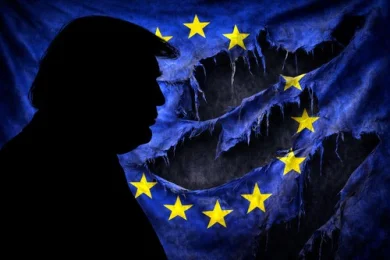
Another dilemma, equally false and just as agitated in public debate and at the corners, transfers the Dâmbovița Hamletization from the internal political space to the external: with whom does Romania play, with the European Union or with the United States? This dilemma is not only false, it is also foolish. It can be explained, but not justified by the recent heightened tensions in the Euro-Atlantic world due to the inadequacy to reality of some policies promoted by the bureaucracy in Brussels and the unprecedented personalization of the current American administration, with abrupt and untimely reactions. There have also been tensions in the Euro-Atlantic world in other periods, smoldering or manifest, generated either by opposing economic interests or by different visions on political and security strategies. Now, as then, such tensions – inevitable not only in internal political structures but also in international ones – can overshadow, but cannot dynamite either the values and principles that constitute the indestructible foundation of the Euro-Atlantic world, nor the institutions built on this foundation.
Attempts have been made and are being made on both sides of the Atlantic (in competition with pseudo-debates on the banks of the Dâmbovița) to introduce a disjunction that is as false as it is dangerous. The institutional and legal architecture of the Euro-Atlantic world – including the commitment to the rule of law and constitutional democracy, the international order based on multilateral and bilateral treaties, economic and technological cooperation – is opposed to the roots from which this architecture has grown and which continue to nourish it. The legal and institutional architecture – which defines the free world and distinguishes it from the world of dictatorships and theocracies – would not have emerged if the Greco-Roman culture and the Judeo-Christian culture had not existed. Ignoring or denying one's own roots deprives the Euro-Atlantic world, the world of freedom, of the sources of existence and regeneration.
Recognizing these cultural affiliations is vital, but it also becomes dangerous when it is diverted into an inverse negation, in blaming the legal and institutional architecture that has grown from Greco-Roman roots and Judeo-Christian ones. The Euro-Atlantic world would lose its identity as a world of freedom if it cuts its roots and destroys its fruits. Neither the European Union nor the United States could withstand the increasingly harsh confrontations that disrupt the international order if they do not save this common identity, in which the contractual essence of the rule of law and constitutional democracy coexists with the long cultural history that made it possible.
Romania has no choice between the European Union and the United States because they can only exist together, through the legal and institutional architecture they have created based on values and principles formed and consolidated through a cultural and political history of over two millennia. Moreover, Romania has integrated into this architecture, and such a choice would mean amputating a part of its own identity.
Latest News
23:08
22:58
22:57
22:55
22:54
See more news
NEWS ON THE SAME TOPICS