How much did the energy cap cost? 30 billion lei to keep the lights on and the houses heated.




Always see our news on Google
The energy crisis that began in Europe in 2021 has pushed Romania into an unprecedented situation: electricity and gas prices have risen sharply, a situation that risks becoming a heavy burden for millions of households and a large part of the economy. To avoid a social and economic shock, the state decided to introduce a capping scheme, whereby consumers paid a limited price, and the difference compared to the real market price was covered from the budget.
The effect of the capping allowed the population to remain at a manageable level, during a period when prices in European markets had reached historic highs. Additionally, the capping contributed to maintaining the functioning of medical units, schools, public services, and small and medium-sized enterprises, which otherwise could have faced interruptions, closures, or layoffs.
According to cumulative data until 2025, the total cost of these interventions amounts to approximately 30 billion lei. Of these, about 18 billion lei were used to cover electricity, while approximately 12 billion lei went towards natural gas. In total, the scheme was applied for more than three years and covered both household consumers and a significant part of the economic environment.
 In addition, the state has outstanding debts to suppliers of 6 billion lei (according to the Ministry of Energy) or 8.3 billion lei in arrears, in November 2025 according to ACUE.
The short-term advantage of the capping was that it calmed the population at a time when prices were exploding and avoided a social shock (arrears on bills, massive disconnections, bankruptcies of SMEs). The significant medium-long term disadvantages led to market distortions, the price to the consumer no longer reflected reality, giving a false economic signal that "energy is cheap," although it was not. It also led to the blockage of funds in subsidies and not in investments, but created arrears and high risks for suppliers (suppliers actually financed the capping scheme from their own money, waiting years to recover the difference from the state, thus generating cash flow problems, but also additional costs with loans, costs that are recovered from customers after the removal of the capping and lead to high prices).
In parallel, during the capping period, the state collected 67-80 billion lei from taxes (according to AFFER), dividends, and various additional taxes generated by the increase in energy prices – that is, more than twice what was paid in compensations.
In the end, the story of energy capping in Romania is the story of a balance: on one side, the peace of mind of people in the face of impossible bills; on the other, the collective financial effort. The capping scheme did not allow darkness to enter homes and did not let the cold descend into rooms — but it left behind a common debt, paid not at the switch, but through the country's budget.
The financial resources allocated for capping came from taxes applied to energy companies. Economists point out that similar amounts could have been directed towards modernizing the energy system or developing production capacities that would have led to lower prices structurally. Additionally, some of the amounts intended for suppliers are still in the process of being paid, which prolongs the budgetary impact of the scheme.
With this money, 36 billion lei (7.2 billion euros) could have built about 9,000 MW in solar panels, 7,200 MW in gas plants, 4,000 MW wind, which would have reduced structural prices and dependence on imports. Capping remains one of the most extensive public interventions of the last decade: a measure that protected consumers and cushioned the effects of the crisis, but which came at a significant cost to the state's finances. The debate is related to the duration of this scheme's application.
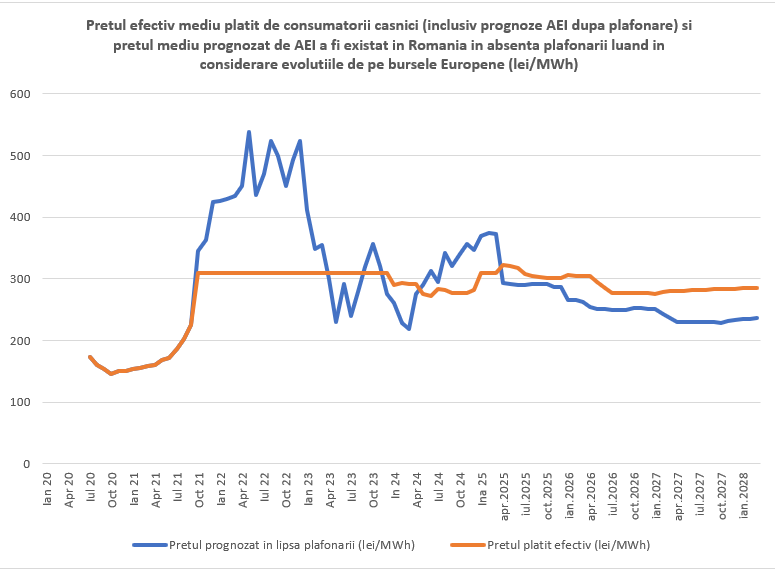
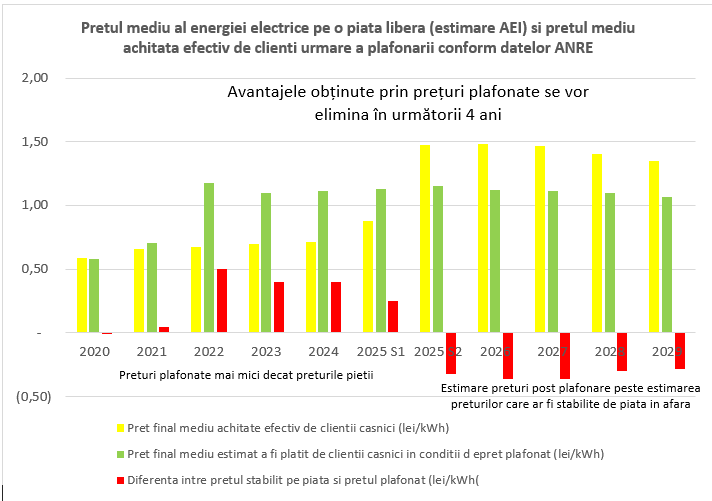 Analyzing the period 2020 – 2025, the evolution of the average price actually paid by customers as a result of capping according to ANRE data and the forecasts of the average price of electricity that would have formed on a free market, if the price capping had not been applied (AEI estimate) and the price estimates for the two scenarios for the next 4 years, the following can be observed:
- in the period 2021 – First Semester 2025, people paid an average price 33% lower than the estimated average price that would have existed on a free market.
- in the Second Semester 2025, people will pay a price 28% higher than the estimated price that would have existed on the free market.
- in the period 2026 – 2029, we estimate that people will pay an average price 32% higher than the maximum price during this period.
 Analyzing the period 2020 – 2025, the evolution of the average price actually paid by customers as a result of capping according to ANRE data and the forecasts of the average price of natural gas that would have formed on a free market, if the price capping had not been applied (AEI estimate) and the price estimates for the two scenarios for the next 4 years, the following can be observed:
- in 2022, people paid an average price about 26% lower than the estimated average price that would have existed on a free market.
- in the period 2023 – 2025, people paid on average a price about 14% higher than the estimated price that would have existed on a free market.
- in the period 2026 – 2028, we estimate that people will pay on average a price about 18% higher than the maximum price during this period.
Based on the assumptions and estimates used, the analysis highlights that the financial advantages obtained by consumers in the period 2021–2025 as a result of the capping of electricity prices are counterbalanced – and potentially exceeded – by the higher anticipated price levels for the period 2026–2029, in relation to the reference scenario of the free market. This finding suggests that the measure generated a temporary benefit, but also induced a temporal redistribution of costs, with negative externalities on market functioning, investment signals, and consumer behavior.
From a macroeconomic and institutional perspective, the results indicate significant limitations in the capacity of administrative interventions on prices to produce sustainable long-term results without subsequent compensatory effects. At the same time, the implications for the stability of household budgets and the efficiency of the energy market highlight the need for structural, predictable public policy tools aimed at correcting fundamental causes, not just temporarily mitigating effects. In this framework, the final assessment outlines an unfavorable net balance for consumers and raises the question of the opportunity to continue or replicate such measures in the absence of systemic reforms.
Latest News
16:18
16:04
15:51
15:35
15:30
See more news
NEWS ON THE SAME TOPICS