Romania, champion in major bids for electric vehicle charging




Always see our news on Google
The fact that Romania appears in the Tesla application with a rate of 0.43 euro/kWh exactly like in Austria and almost double compared to Spain or Croatia — can no longer be explained by market accidents or temporary fluctuations. It is the result of a deliberate commercial strategy, applied in a market considered marginal, of transit and with low bargaining power.
The selling price of electricity at electric vehicle charging stations, the price to the end consumer, and the PZU electricity price in several countries in Europe
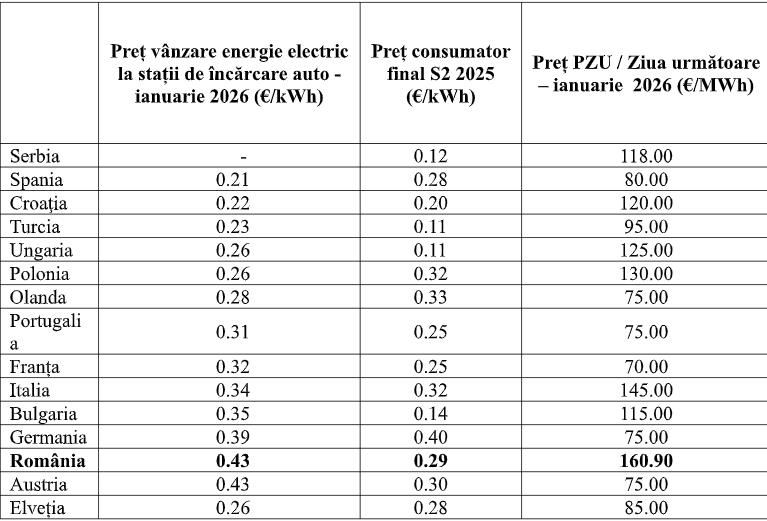 Romania does not have the most expensive electricity in Europe (if we do not report to purchasing power). On the contrary, in many periods, the wholesale price of electricity is below the EU average. However, electric vehicle users pay among the highest fast charging rates. This contradiction says a lot about how the Romanian market is perceived by major operators.
For Tesla, Romania is not a volume market. It is a safety market, with a few well-placed stations on important road corridors, mainly intended for regional transit. In the absence of a constant flow of local users, investment and operating costs are recovered through a higher price per kWh. In other words, few pay a lot, instead of many paying a little.
This economic logic is easy to understand from the company's perspective, but hard to accept for consumers. Especially when the comparison with other countries in the region is inevitable. Hungary or Poland, with significantly lower rates, demonstrate that the difference does not lie in geography or energy costs, but in the level of usage and local competition. Here lies the real problem, Romania still does not have real competition in the ultra-fast charging station area. Few stations, limited coverage, and rare alternatives outside major cities. In such a context, the price is not constrained by the market, but dictated by the operator. And Tesla knows very well that the Romanian user often has no real options (lack of competition in this sector). Moreover, Tesla's regional pricing policy treats Eastern Europe as a zone where investments must be amortized quickly, because the risks are considered higher, slow adoption of electric vehicles, legislative instability, modest road infrastructure. All of these are "encapsulated" in the final price paid by the user.
The case of Serbia, where charging is free, shows that Tesla knows how to be flexible when it wants to stimulate a market. Romania, however, has surpassed the "promotion" phase and has entered directly into the monetization phase, without benefiting from the advantages of a mature market.
The problem is not just the price of 0.43 euro/kWh. The problem is the message it conveys, that Romania is a market that can be charged more, because it does not have enough critical mass to matter. As long as the number of electric vehicles remains relatively small, and alternative infrastructure does not develop aggressively, this message will not change. Prices will not decrease out of goodwill. They will only decrease when the stations are full, competition will be real, and the Romanian user will finally have a choice.
Latest News
19:00
18:48
18:41
18:41
18:30
See more news
NEWS ON THE SAME TOPICS



.webp)
.webp)