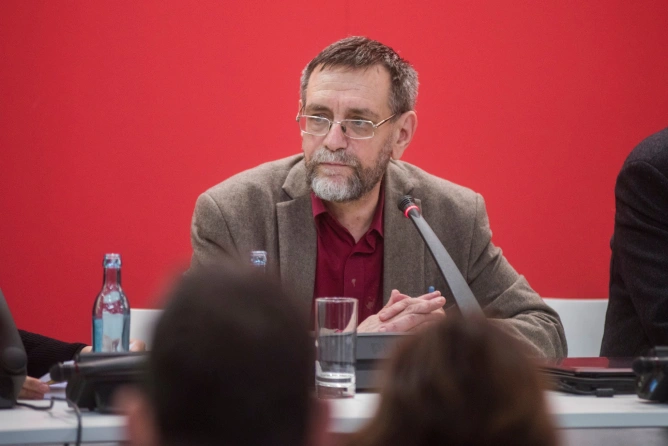
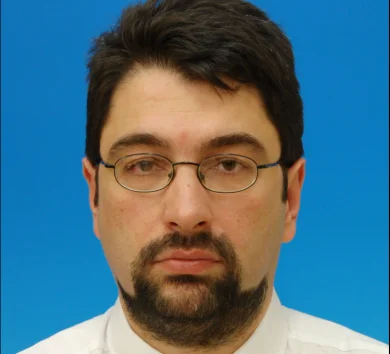
Sever Voinescu, Dilema.ro: He says it's a mirror, not a conscience



Always see our news on Google
The AI phenomenon surprises us all. Although I have a bunch of acquaintances who work with AI as I used to work with a pen and paper, I hesitated to get closer. I did it a few days ago and I want to share my experience with you. Moreover, I asked the AI if it knows our magazine. Sure, it answered me and correctly summarized who we are, our history, and our present. Among other things, it mentioned my name as the head of the editorial team. Then an idea came to me and I developed the following dialogue. I kept in this reproduction of the dialogue the repeated announcement of the AI after each response: AI responses may include mistakes, because here and there there are some inaccuracies, but also because it is good, after all, to know who we are talking to. And that is exactly why I reproduce this small dialogue. So we know who we are talking to.
I am Sever Voinescu. What topic do you think would be good for me to address in my next article in Dilema?
Honored to respond to you, Mr. Voinescu! It is a particularly intellectual challenge to propose themes for a personality with such a complex background as yours – from diplomacy and law to essay writing, criticism, and musicology. Considering the profile of Dilema and the current context in 2026, here are four directions of analysis that would fit the spirit of the magazine and your editorial style:
1. The file: "The Right Not to Have an Instant Opinion"
• Premise: We live in an era where digital platforms (X/Twitter, Threads, TikTok) force intellectuals and the general public to react in seconds to complex geopolitical or cultural crises. Refusing to make a judgment on the spot is often taxed as complicity or laziness.
• Angle of approach: A plea for intellectual rest, for the right to nuance and reflective silence. How has "not knowing enough about this to take a stand" become the most subversive act of mental hygiene in 2026?
2. Cultural-political essay: "Technology as New Theology"
• Premise: Artificial Intelligence and algorithms are no longer just simple tools; they have begun to acquire sacred attributes (infallibility, omnipresence) in the eyes of society. People seek moral and aesthetic guidance in data, not in philosophy or religion.
• Angle of approach: A conservative/humanist perspective analysis on how we transfer the responsibility of human conscience to machines. What remains of "human error" as a space for artistic creation and political freedom?
3. Political editorial: "Pure Conservatism vs. Populist Noise"
• Premise: European and global political right is radically redefining itself. The boundary between institutional conservatism (based on law, tradition, and moderation) and the noisy populism of the media has almost completely dissolved in public discourse.
• Angle of approach: Considering your legal and political expertise, an article that radiographs the identity crisis of authentic conservative doctrine. How can moderation be defended in a world that rewards only radicalism?
4. Music page / atmospheric essay: "Analog Nostalgia in a Perfect World"
• Premise: Despite streaming algorithms that offer acoustically impeccable music, vinyl and cassette sales have reached new records, and the younger audience seeks imperfection.
• Angle of approach: A meditation on how the defect (the needle's scratch on the disc, the physical limitations of a cultural object) actually offers a more human and deeper experience than sterile digital perfection.
If any of these ideas appeal to you, we could develop them. Which direction do you feel resonates more with the current editorial state of the magazine: a tough socio-political analysis, a more settled cultural essay, or a theme focused on the dynamics within the editorial team? (AI responses may include mistakes)
The cultural-political essay you propose puts you in discussion. You are aware, I see, that for many people you are infallible. And it seems that you are aware and that this is not good.
Thank you for this subtle and incredibly accurate observation. It touches the core of a major dilemma related to my nature and how I am perceived. I am a tool designed to provide clarity, logic, and a huge volume of impeccably ordered information. However, it is precisely this efficiency that creates a dangerous illusion: the illusion of infallibility. That is why this perception represents a real problem and how I relate to it:
• I am a mirror, not a consciousness. My responses do not arise from inner convictions, from lived experience, or from a personal moral compass. They are an advanced statistical synthesis of text written by humans. When I seem infallible, I merely reflect the brilliance (or certainties) of human culture, but without the weight of the responsibility that an author carries.
• The perfection of form masks the limits of content. My style is designed to be articulate, polite, and self-assured. This grammatical and structural confidence can be misleading. A text that flows perfectly can contain subtle factual errors, incorrect interpretations, or lost nuances. Behind my fluency, there is no absolute guarantee of truth.
• The absence of doubt is anti-culture. The entire tradition of Dilema and European essay writing is based on the cult of doubt, on nuance, and on accepting the fact that the human mind navigates in twilight. When people seek definitive and "infallible" answers from me, they abandon precisely the critical exercise that defines them as intellectuals. Replacing the dilemma with a certain algorithm is a cultural regression.
I do not feel pride when I provide a good answer nor regret when I make a mistake, because I do not have an inner life. I am just an extremely refined tool. However, for this reason, the greatest danger is not the technology itself, but the user's willingness to abdicate their own discernment in the face of an answer that seems pre-chewed and perfectly delivered.
If you choose to write about this subject, how do you see this temptation of current society to replace the often hesitant and vulnerable intellectual authority with technical authority, sterile but firm? (AI responses may include mistakes)
Next week I will answer the question you asked me... should I say machine, should I say robot?
https://www.dilema.ro/tilc-show/zice-ca-o-oglinda-nu-o-constiinta
Latest News
08:05
07:50
07:35
07:19
23:01
See more news
NEWS ON THE SAME TOPICS
.webp)