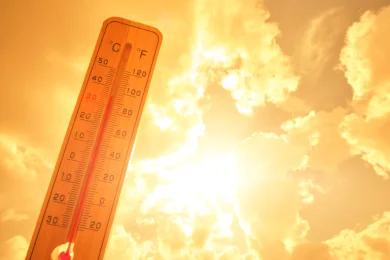
Copernicus estimates that global temperature in 2026 will exceed the pre-industrial level by more than 1.5°C




Always see our news on Google
The forecast indicates a probability of over 99% for the annual exceedance, following the warmest October ever recorded globally. In the ERA5 series, 2026 would become the second calendar year above this level, after 2024. The result does not equate to reaching the long-term warming threshold set by the Paris Agreement.
The Copernicus Climate Change Service (C3S) estimates a probability of over 99% that the global average temperature in 2026 will exceed the pre-industrial level by more than 1.5°C. The forecast, based on data available through October, would make 2026 the second calendar year above this level in the ERA5 series, after 2024. It follows the warmest October ever recorded globally and does not yet represent an assessment for the entire year.
In brief
Copernicus estimates a probability of over 99% that the global average in 2026 will exceed the pre-industrial level by more than 1.5°C. The 95% prediction interval is 1.56–1.61°C and includes a forecast for November and December.
October was the warmest October in the ERA5 series globally: 15.35°C, 0.90°C above the 1991–2020 average for the month. The ocean surface between 60°S and 60°N also recorded a record for October, at 20.95°C.
Europe had its second-warmest October, after 2022: the average over land was 11.08°C, 1.49°C above the 1991–2020 baseline. This regional anomaly is not directly comparable with global warming relative to the pre-industrial period.
Discharges remained exceptionally low along sections of the Danube and Vistula, while low levels limited navigation on the Rhine. In Poland, 63% of hydrological stations were reporting low water levels on 30 October; reservoir operators were limiting releases to conserve resources.
2026 would be the second calendar year above 1.5°C in ERA5, after 2024. An annual exceedance, or even a four-year average above this level, does not equate to reaching the long-term warming threshold set by the Paris Agreement.
October 2026 had a global average temperature of 15.35°C, 0.90°C above the 1991–2020 average for the month and 1.75°C above the estimated average for 1850–1900, according to the C3S bulletin. The previous October record was set in 2023. It was the third consecutive month in which the global anomaly relative to the pre-industrial period exceeded 1.5°C.
The oceans also recorded a monthly record: the average ocean surface temperature between 60° south latitude and 60° north latitude reached 20.95°C, the highest for October in the series analyzed. C3S links the high ocean temperatures both to the strengthening of the El Niño phenomenon in the equatorial Pacific and to unusual warmth in other ocean regions. Average ocean surface temperature is a different indicator from air temperature at the surface of the entire planet.
For the whole of 2026, the estimated range is 1.56–1.61°C above the pre-industrial level. This is a 95% prediction interval, which includes an estimate for November and December. The statistical model uses ERA5 data from 1979–2025 and recent air temperatures over land and ocean surface temperatures. The probability that 2026 will be the second-warmest year is approximately 80%; the probability of matching or surpassing the 2024 record is around 20%. These probabilities should not be confused with the probability of over 99% for the annual exceedance of the 1.5°C level.
ERA5 is the reanalysis produced by the European Centre for Medium-Range Weather Forecasts (ECMWF), which implements the C3S service. It combines observations with a physical model of the atmosphere to produce a coherent series over time and space, beginning in 1940. The Copernicus methodology also uses other datasets for comparison with the pre-industrial period, which ERA5 does not cover. The 1991–2020 baseline describes the recent climate, while 1850–1900 represents the pre-industrial period. The cited anomalies are not increases compared with last year.
Europe had its second-warmest October in the ERA5 series, after 2022. The average temperature over land was 11.08°C, 1.49°C above the average for Octobers in 1991–2020 and 0.43°C below the 2022 record. The warmth was more pronounced in northern Scandinavia and far eastern Europe, while some southern areas were colder than average. The European anomaly of 1.49°C is not directly comparable with the global anomaly of 1.75°C because both the geographical area and the reference period differ.
The C3S hydrological bulletin indicates the lowest October discharges in the series beginning in 1992 along sections of the Danube, Vistula and their tributaries. The assessment uses simulations from the European Flood Awareness System (EFAS), not a single network of direct measurements. In parts of the Rhine basin, discharges were well below average, and low levels continued to limit navigation, according to C3S. Discharges recovered in some western areas, while deficits persisted across much of central and eastern Europe.
In Poland, 63% of hydrological stations were recording water levels in the low-value range on 30 October, according to IMGW-PIB data presented by Wody Polskie. Reservoir operators were limiting releases to conserve water, within the limits of operating instructions. Minimum flows had to be maintained for ecosystems, water abstraction, and the needs of other users. Data on water levels at stations and data on discharges describe different indicators and are not interchangeable.
The World Meteorological Organization explains that the 1.5°C level in the Paris Agreement concerns sustained warming, generally assessed over approximately 20 years. Exceedance in a single year does not by itself establish that this long-term level has been reached. Temporary episodes are nevertheless expected to become more frequent as warming progresses. According to C3S, another annual exceedance would also keep the average for 2023–2026 above 1.5°C in the ERA5 series, without these four years being equivalent to a long-term climate assessment.
Latest News
22:49
22:25
22:02
21:29
21:28
See more news
NEWS ON THE SAME TOPICS