A correct graph, corresponding...


Always see our news on Google
Recently, there has been much discussion about how divided Romanian society is; obviously, this awareness of the cleavages has its roots in the electoral divisions of the last two years (elections), during which we experienced all possible types of elections. Public memory is short, but a similar and strong burden has existed since 1989, repeatedly in electoral contexts: immediately after the revolution, then among the supporters of PDSR and CDR before the 1996 elections, in the tumultuous context of choosing the lesser evil in 2000, at the 2004 elections, when, in the scenario of the orange revolution, Traian Băsescu embodied the anti-system option; then again, during his two suspensions, in the Iohannis-Ponta duel, and in many other situations. From crisis to crisis (political and/or economic), we have reached the great division during the long electoral year 2024-2025.
Is it different now? Each cleavage was deeply felt in its time. However, now we are facing a discussion of some Euro-Atlantic options that, after 1996 and then after 2000, became confused with the state project (perhaps the only one we had) and which for a long time were considered untouchable, both by the political spectrum and from public opinion. And the current is visible everywhere in Europe.
In public discussions, many sociological indicators of this true social rupture are invoked. Here, we have commented on several situations based on the figures provided by INSCOP. But I believe that a graph published these days shows, at least for the tension of the present moment, better than any others, this.
I refer to the graph below and to the question regarding a hypothetical withdrawal of PSD from government.
The graph is much more than just a snapshot of a political moment, although the question is very clearly contextualized.
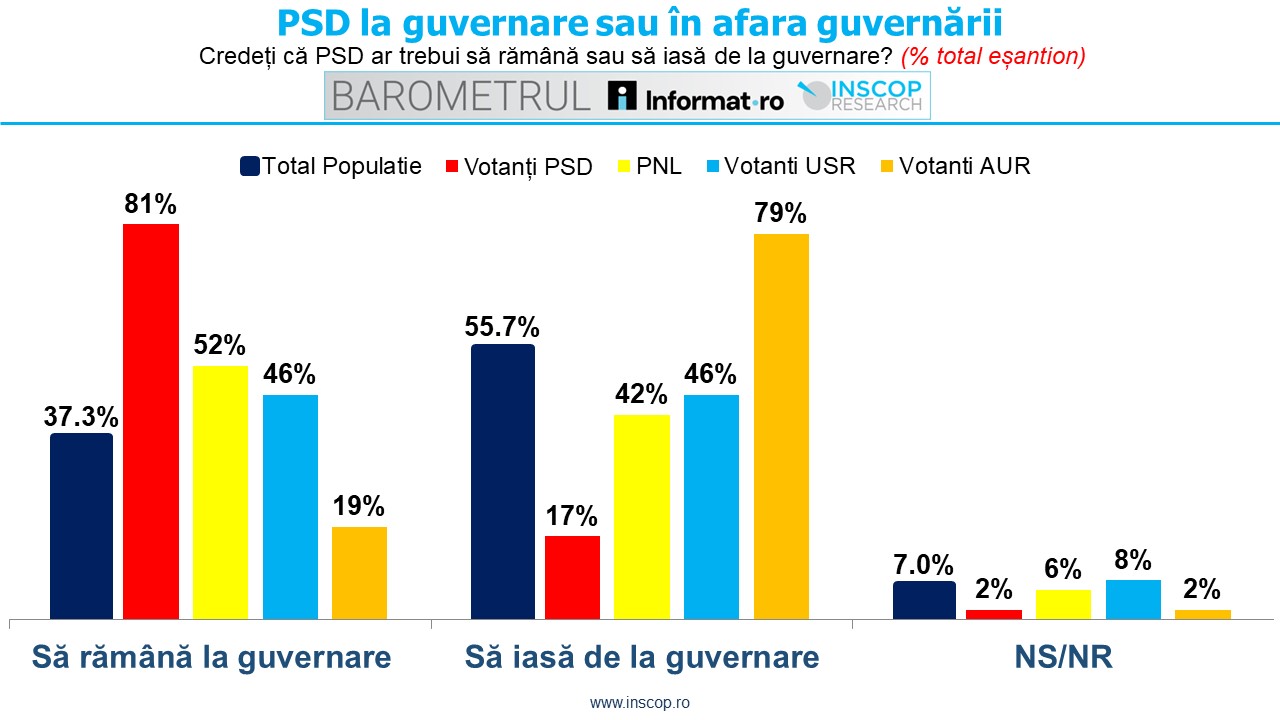
In the first row, we see a small number of non-responses, nonetheless. So people really have an opinion. The lowest percentages of non-responses appear among declared voters of PSD and AUR. So the issue is of greater interest there. If among PSD voters we can suspect that the interest comes from the hope that the party will remain in power to implement the promises (and pressures) of the last weeks, among AUR supporters we cannot speak of an evident opposition to the social measures recently proposed by PSD. It is rather a kind of vote of disapproval towards the current governing coalition.
81% of PSD voters want to remain in government, while 79% of AUR supporters want PSD to leave. Very similar figures, significant interest in both cases, but completely different reasons.
Do you remember that we have commented on various sets of INSCOP figures recently about how, on many general socio-political issues, the PSD public and that of AUR resemble (not socio-demographically, but in terms of opinion, attitudes, etc.). The figures are quite similar here as well, but they contain completely different opinion contents. Such a fissure is interesting... in a way, you could also expect that the PSD public no longer wants to be associated with a government that displeases it, especially since it feels described more by a set of attitudes it shares with today’s opposition than by the themes of the governing coalition. Is there a bit of pragmatism there? Perhaps also a bit of trust in the voted party? This is a theme to explore.
More interesting is the response of PNL and USR supporters. Very split, almost half for PSD remaining in government, half for the departure of the social democrats. Since the acceptance of the alliance with PSD was difficult for them, but justified in the tense context of the elections, it is somewhat hard to understand such a separation of opinion. With the national budget not adopted at the time of collecting this data, with challenges to the prime minister... Of course, the lack of homogeneity is a feature of pluralism; that is not the problem. But is there pluralism there, or volatility of the electorate? Because at the end of the second option, there are not many pragmatic solutions.
Latest News
22:57
22:46
22:39
22:25
21:55
See more news
NEWS ON THE SAME TOPICS




.webp)