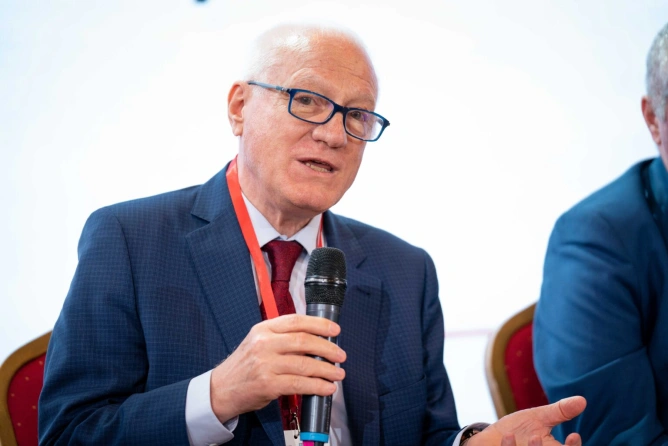
ANALYSIS on "the gray areas of Europe" and the fear of Russia: What stakes are hidden in the B9 summit hosted by Nicușor Dan in Bucharest



Always see our news on Google
The B9 Summit and the Nordic Countries in Bucharest brings to the capital of Romania, on May 13, a rare concentration of leaders from the eastern flank of NATO and Northern Europe – from Volodymyr Zelensky to Karol Nawrocki and Mark Rutte – and the central stake is strengthening deterrence against Russia and maintaining American involvement in the region, under the explicit theme "Delivering More for Transatlantic Security." At the same time, President Nicușor Dan is under the spotlight not only as a host but also for the recent change in tone towards the European Union and the cancellation of Europe Day events, raising questions about how he will calibrate the message between criticism of the EU and Romania's role as a pro-NATO and pro-Ukraine pivot state.
Who is coming to Bucharest for the B9 Summit and the Nordic Countries
According to the Presidential Administration, the summit is hosted by Nicușor Dan at the Cotroceni Palace and co-chaired together with the President of Poland, Karol Nawrocki, in the Bucharest 9 format (the eastern NATO states) expanded with the Nordic countries. The general theme – "Delivering More for Transatlantic Security" – anchors the discussions in the need to increase European contributions to defense, alongside maintaining a close link with the United States at a time when Russia's war against Ukraine enters a new phase. The announced list of participants is practically the political snapshot of the eastern flank and Northern Europe: NATO Secretary General Mark Rutte; the presidents of Lithuania (Gitanas Nausėda), Estonia (Alar Karis), the Czech Republic (Petr Pavel), Latvia (Edgars Rinkēvičs), Slovakia (Peter Pellegrini), Finland (Alexander Stubb); the Prime Minister of Denmark, Mette Frederiksen; the President of Ukraine, Volodymyr Zelensky; the U.S. representative at the undersecretary level for arms control, Thomas DiNanno; ministers and high-level representatives from Sweden, Norway, Iceland, Bulgaria, and Hungary. Zelensky's presence comes against the backdrop of an invitation made by Nicușor Dan in March and a strengthening relationship between Bucharest and Kyiv on security, energy, and infrastructure issues.
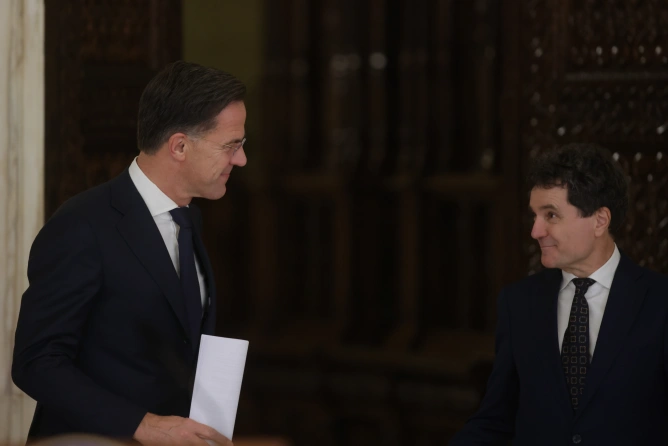
Mark Rutte arrives in Bucharest a day before the summit, on Tuesday, for a working dinner with Nicușor Dan and Karol Nawrocki, and the agenda of the preceding day also includes detailed bilateral talks with the President of Poland. Also on Tuesday, Igor Grosu, the President of the Parliament of the Republic of Moldova, is expected, signaling that Romania is using the B9 moment to anchor its immediate neighborhood in the regional security discussion.
Zelensky's presence is the result of a formal invitation extended in March by Nicușor Dan, following a series of bilateral contacts and after the Romanian president's participation in the B9 summit in Vilnius. Foreign policy analyses emphasize that the constant inclusion of Ukraine in such formats strengthens Kyiv's perception as part of the Euro-Atlantic community, even before any formal decisions regarding NATO membership.
On the eve of the summit, bilateral meetings are scheduled in Bucharest between Nicușor Dan, Mark Rutte, and Karol Nawrocki, but also discussions with representatives of the Republic of Moldova, which shows that Romania is using the B9 context to anchor Chișinău in the eastern flank security debate.
The stakes and expected decisions
The B9 format has consolidated in recent years as a platform through which states on the eastern flank try to speak "with one voice" in relation to NATO and Washington. At the previous summit in Vilnius, the press reported on an ambitious document regarding increasing defense spending to 5% of GDP in certain states, in response to Russia's aggression against Ukraine. In this context, a reconfirmation of the commitment to high defense budgets and a firm message of support for Kyiv is expected in Bucharest.
Analysts cited by Mediafax note that, for Romania, "the stake is to keep the U.S. as close as possible to the eastern flank of NATO," at a time when the global order is fluid, and American attention is divided between Europe, the Indo-Pacific, and domestic issues. In concrete terms, this means political guarantees regarding the maintenance and, ideally, strengthening of the American military presence in Romania, as well as support for strategic infrastructure projects, from modernized military bases to air and missile defense capabilities.
In the Ukrainian context, Zelensky's presence and inclusion in the final session of the summit are meant to convey a message of continuity: even though the war enters a phase of attrition and the Western political front faces public opinion fatigue, the eastern flank reaffirms solidarity and willingness to "deliver" – including in the form of ammunition, training, and financial support. For Kyiv, participation in the B9 expanded with the Nordics also means an additional anchor in a club of states that feel the direct Russian pressure, from the Black Sea to the Baltic Sea.
On the Nordic dimension, the presence of Finland, Sweden, Denmark, Norway, and Iceland adds a transregional perspective to the summit: the eastern flank is no longer just that of the Black Sea or Ukraine, but extends into the Arctic area and the Baltic Sea, where Russia is increasing its military profile. The European path emphasizes that this interconnection allows for a unified approach to threats – from critical infrastructure sabotage to hybrid operations – and offers Romania the opportunity to connect to the Nordic agenda, traditionally more influential at NATO level.
Nicușor Dan's relationship with B9 and international leaders
The B9 summit in Bucharest is the second major moment in which Nicușor Dan is positioning himself as a player in regional security policy. The first significant outing was participation in the B9 summit in Vilnius, where he supported the message "we need a stronger NATO, a stronger transatlantic connection" and had bilateral meetings with Zelensky and Baltic leaders. At that time, the press retained his profile as the president of a frontline state pushing allies towards increasing defense budgets. The relationship with Zelensky has been strengthened through several contacts, culminating in the official invitation extended to the Ukrainian president to come to Bucharest for the B9 summit. The presidential administration and European profile publications have emphasized that Romania and Ukraine are trying to leave behind specific disputes – from the Bâstroe canal to minority issues – and build a collaboration focused on security, energy, and infrastructure.
Equally important is the relationship with Poland, transformed into a kind of axis of the eastern flank. Karol Nawrocki's visit to Bucharest, tête-à-tête talks, and joint statements are described as part of a renewed strategic partnership, in which Warsaw and Bucharest are trying to shape NATO's agenda from within. In this framework, Nicușor Dan positions himself alongside leaders like Nawrocki or Stubb, in a league of eastern politicians calling for more firmness against Russia and more commitment from the EU in the field of defense.
The B9 Summit, after a critical speech by President Nicușor Dan regarding the EU
The B9 summit comes shortly after, on Europe Day, May 9, Nicușor Dan chose to forgo festivities and convey, from the Cotroceni Palace, a message in which he enumerated the "failures" of the European Union: energy dependence on Russia, underfunding of defense, and the adoption of climate objectives that he considers unrealistic in the current context. Euronews and Adevărul noted the unusually critical tone, while G4Media headlined that the president "criticizes EU policies on energy, defense, and climate, in a Europe Day speech 'with the cards on the table.'"
In the same message, Dan spoke about a "weak Romania within the EU," which does not know how to defend its interests in Brussels, and called for "talking about Europe differently than with slogans." The international press, including Le Figaro, interpreted the speech as a harsh criticism of EU strategies, but also accompanied by a reaffirmation of the partnership with the U.S., which places him rather in the eurocritical zone.
The cancellation of public events dedicated to Europe Day – at which European leaders were expected – accentuated the impression of a symbolic distancing from Brussels. Sources cited by the Romanian press spoke of a "reassessment" of ceremonial formats, but the lack of an alternative calendar and the temporal overlap with the preparation for the B9 summit fueled the interpretation that the president prefers to play his European profile through NATO and the eastern flank, not through the classic rituals of the EU.
Experts cited by Mediafax and Calea Europeană show that Romania is trying to present itself as a state that raises the alarm about certain vulnerabilities of the EU, without questioning its membership in the Union, but emphasizing at the same time the importance of NATO and the American presence. In this sense, the speech of May 9 and the summit in Bucharest can be read together: in internal terms, Dan reproaches the Union for its dependence on Russian gas and the delay in investments in armament; in external terms, he invites to Cotroceni precisely the leaders for whom these issues are priorities and tries to obtain concrete commitments in the direction of correcting them.
At the same time, invited to explain, the President of Romania, Nicușor Dan, maintains that nothing has changed in foreign policy and that in fact he, through his criticisms, has conveyed a "message of affection"
"Romania continues to have a European direction, with the United States, a correct attitude within NATO. Absolutely nothing has changed and it is not at all normal and productive to mix the internal political debate with this strategic debate. So the strategic orientation has not changed and there is no chance that in the future majority there will be anti-Western forces," said the president. However, many have commented that Nicușor Dan conveys very cryptic messages, while, when asked to explain what situations Europe has "ideologically acted," he gave only one example, namely the green energy plan.
*****Summary created with the help of a data monitoring flow provided by the media monitoring platform NewsVibe Romania. The analysis, data, and images presented have been enhanced with the help of Machine Learning and Artificial Intelligence tools.
Latest News
10:25
10:25
10:09
09:45
09:28
See more news
NEWS ON THE SAME TOPICS


.webp)