SPECIAL Informat.ro / From the Arctic to the Black Sea: why the summit in Rovaniemi matters for Romania



Always see our news on Google
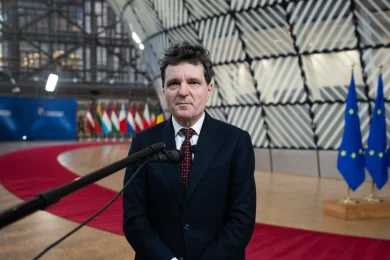
President Nicușor Dan’s participation in the European Arctic Summit in Rovaniemi places Romania in a debate that goes beyond northern geography: Europe’s security is increasingly viewed as an interconnected security space, stretching from the North Sea and the Arctic to the Baltic Sea and the Black Sea. For Bucharest, the stake is to ensure that the military, hybrid, and energy pressure exerted by Russia on the eastern flank is addressed jointly by NATO and the EU.
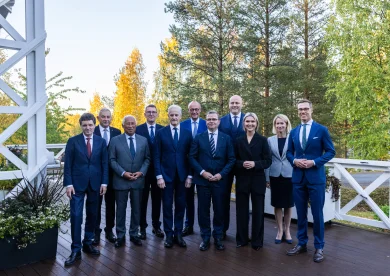
The summit organized by Finland, which began on Sunday and ends today, brings together European leaders such as German Chancellor Friedrich Merz, Polish Prime Minister Donald Tusk, and Danish Prime Minister Mette Frederiksen, alongside the President of the European Council, António Costa, and the EU High Representative, Kaja Kallas. The stated objective is to strengthen a common strategic approach by the European Union toward the Arctic, against the backdrop of the region’s growing geopolitical, economic, climate, and security importance.
A Single Strategic Map
The central message conveyed by the President of Romania is that the Arctic, the Baltic Sea, and the Black Sea can no longer be addressed as separate issues.
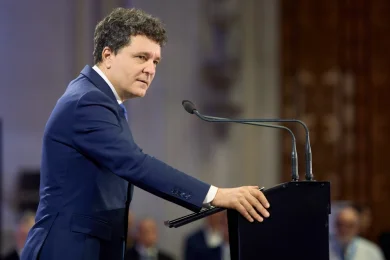
“What happens in one part of the continent has direct consequences for everyone,” Nicușor Dan said, emphasizing the increasingly evident connection between the three areas.
This perspective has both military and political logic. Following Finland and Sweden’s accession to NATO, the Alliance has a more coherent defense posture in northern Europe, but it is simultaneously facing threats along the Baltic direction, Russia’s war against Ukraine, and risks to navigation, energy infrastructure, and communications in the Black Sea. In this context, Romania seeks to ensure that southeastern Europe’s security is not overshadowed by priorities in the North or by other international crises.
For Bucharest, the idea of the “eastern flank” is not an abstract one. It includes air and maritime defense, military mobility, the protection of critical infrastructure, energy resilience, and countering hybrid actions. According to the Presidential Administration, Romania is prepared to contribute to concrete projects in these areas, both in the Black Sea region and across the broader European space.
The Signal from Lapland Air Wing
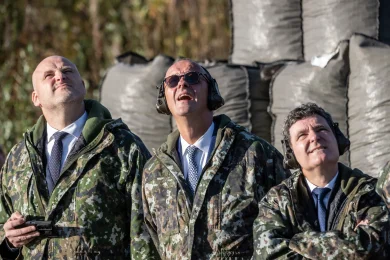
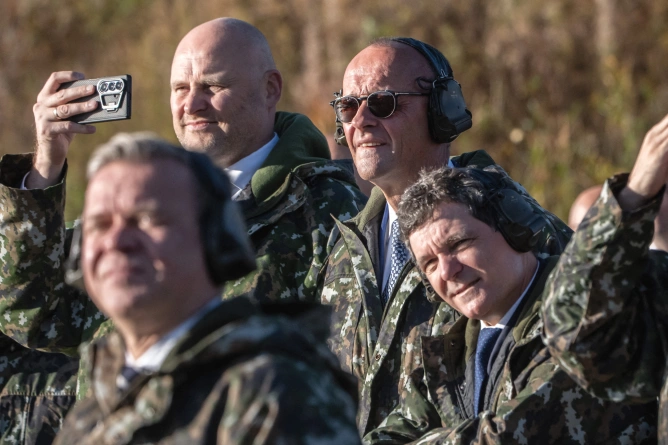
The leaders’ visit to Lapland Air Wing, one of the two operational fighter wings of the Finnish Air Force, adds a symbolic and military dimension to the summit, as the unit permanently ensures the surveillance and protection of Finland’s airspace and adjacent areas. The visit thus illustrates the emphasis placed by Helsinki and NATO on air defense in northern Europe.
For Romania, the relevance lies in the need for coherent allied coordination along the eastern flank. This need is all the more tangible in the southeast, where Romanian authorities have reported unauthorized drone incursions and four cases in which they were shot down by military aircraft.
The discussion between Nicușor Dan and Friedrich Merz on strengthening the eastern flank and drone incursions thus connects the Arctic agenda with Romania’s security concerns. Bucharest’s stake is to ensure that air defense, the protection of critical infrastructure, and the response to hybrid threats are addressed jointly by NATO and the EU, from northern Europe to the Black Sea.
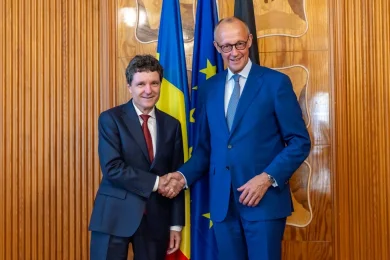
Nicușor Dan’s Meeting with Merz
The meeting between Nicușor Dan and Chancellor Friedrich Merz gave Romania an opportunity to turn its participation in the summit into a bilateral message of NATO and European relevance. The Romanian president emphasized the need to strengthen the Eastern Flank in the face of Russian threats, mentioning drone incursions into allied airspace and the potential for Romanian-German cooperation in the defense industry.
Politically, placing these issues in the dialogue with Berlin is important. Germany carries weight in European decisions concerning defense financing, the defense industry, energy policy, and the future of the EU’s multiannual budget. In the same dialogue, Nicușor Dan advocated an ambitious European budget, with a strong cohesion policy and adequate funding for agriculture, a position relevant to Romania in negotiations on the 2028–2034 financial framework.
Thus, security and funding are not parallel issues. For states on the eastern flank, investments in roads, railways, ports, energy, technology, and industry can also serve the purposes of resilience, military mobility, and response capacity in crisis situations. A coherent European approach would mean that these needs are reflected not only in strategic discourse but also in funding lines.
The Arctic, the EU’s New Test
European interest in the Arctic has grown substantially since the adoption of the EU’s most recent policy for the region in 2021. Finnish authorities argue that the security environment has changed profoundly, and the meeting in Rovaniemi takes place before Brussels presents a new Arctic strategy, expected this autumn.
The stakes extend beyond military competition. The Arctic concentrates maritime routes, critical raw materials, energy and communications infrastructure, as well as accelerating effects of climate change. For the EU, the region is simultaneously a security issue, a matter of economic competitiveness, strategic autonomy, and environmental protection.
Militarily, NATO considers that Finland and Sweden’s accession has significantly strengthened the Alliance’s posture in the region. In June 2026, NATO activated Forward Land Forces Finland, with a battlegroup in Boden, Sweden, and a multinational command element in Rovaniemi, a structure intended to contribute to the defense of the northern and eastern flanks
This development confirms Romania’s argument: Europe’s security must not be artificially divided between the “North” and the “Southeast.” A threat affecting the Alliance’s freedom of maneuver in one area may force member states to redistribute resources, political attention, and capabilities across the entire Euro-Atlantic space.
What Romania Can Gain
The summit’s importance for Romania lies, above all, in the possibility of making the Black Sea an inseparable component of the European security agenda. Participation in Rovaniemi allows Bucharest to argue that the defense of the eastern flank must be conceived as a continuous architecture: air surveillance, deterrence, protected critical infrastructure, military mobility, and defense-industrial capacity.
Secondly, Romania can leverage its relationship with Germany for defense projects that generate domestic industrial and technological effects. The presidential statement regarding Romanian-German cooperation in the defense industry opens a direction that should be pursued through concrete projects, skills transfers, the integration of Romanian companies into European production chains, and coordinated procurement.
Thirdly, Bucharest has an interest in ensuring that the EU’s future Arctic strategy does not reduce the issue to the High North. The strategy must recognize the connection between conventional threats, hybrid attacks, the security of maritime routes, subsea infrastructure, energy, and the protection of airspace. Romania can contribute its own experience as a Black Sea littoral state, the EU and NATO’s eastern border state, and a direct neighbor of the war in Ukraine.
The Rovaniemi summit is not announced as a forum for formal decisions, but the leaders are expected to adopt a joint declaration, and the meeting gives participating states an opportunity to influence the Union’s future Arctic strategy. For Romania, the meeting’s political value depends on continuity: the message about the Arctic–Baltic–Black Sea connection must be followed by diplomatic initiatives, military and industrial cooperation, and budgetary priorities articulated in European negotiations.
Analysis produced with the help of Perplexity
Latest News
07:16
07:05
23:00
22:55
22:47
See more news
NEWS ON THE SAME TOPICS
.webp)