EXCLUSIVE Romania, in the vision of the press from Russia: The top topics from the last two weeks



Always see our news on Google
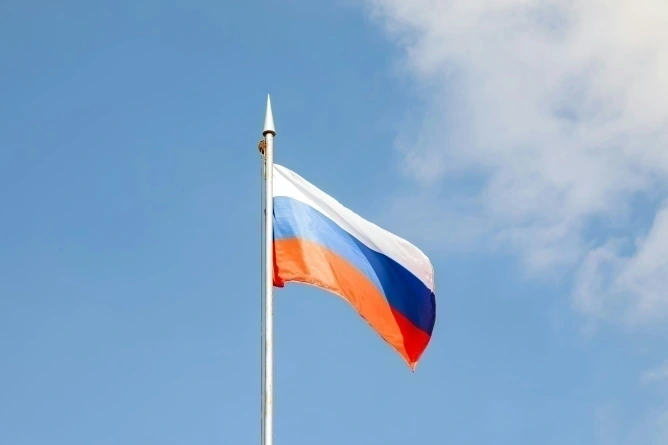
Romania has appeared in the Russian press in the last two weeks as a NATO frontier state indirectly involved in the war in Ukraine and in the security architecture of the Alliance, but also as a provider of important figures for European football in the sports press. The analysis includes a ranking of the most discussed topics based on this data, highlighting key publications such as RIA Novosti and Izvestia. The data was collected by the media monitoring platform NewsVibe, during the period from March 28 to April 10, 2026, and the report identified 437 articles published in the Russian press during this period.
The Invisible Frontier: Mobilization in Ukraine and the "Collateral" Romanians
A military story in which Romanians appear is that of forced mobilization in Ukraine, reported by the press agency RIA Novosti in a piece that cites "sources from the military structures." The article claims that, in the Ukrainian army, "the cases of forced sending to war of the disabled and homeless people have multiplied," building the image of a state at a moral limit in its mobilization effort.
In the same news, RIA Novosti notes that "under forced mobilization, foreigners have also been included, such as citizens of Poland and Romania, who worked together with the employees of the Ukrainian military offices," introducing Romanians into this narrative not as soldiers, but as auxiliary personnel involved in the activities of military commissariats. Through this formulation, Romanians are integrated into the story of the "Ukrainian mobilization machine."
The resulting image is transitively negative, as the main target of RIA Novosti's criticism is Ukraine, but Romania is associated with a system described as violent and unscrupulous, which sends vulnerable people to the front. Geopolitically, such texts reinforce the representation of Romania as a NATO member state collaborating with Kyiv beyond mere political-diplomatic statements and contributing to the Ukrainian war machine through human resources or bureaucratic expertise.
This association makes Romania not only perceived as a passive neighbor but as an actor involved in Ukraine's war effort, even if the involvement is presented more through the actions of citizens than through the official decisions of the Romanian state.
The NATO Summit in Bucharest in 2008
A second important core in which Romania appears is the debate about the future of Ukraine's relationship with NATO, directly related to the Alliance's summit in Bucharest in 2008 and reflected in the pages of the daily Izvestia. In an article dedicated to peace negotiations and the Alliance's position, Izvestia takes up statements from the current NATO Secretary General, Mark Rutte, but also reminds that "in April 2008, at the Bucharest summit, the countries of the alliance included in the final declaration a promise for Ukraine and Georgia that, at some point, they would become NATO members."
The text emphasizes that this promise remains unfulfilled and that, currently, the discussion is shifting from accession to security guarantees. Rutte is quoted as saying: "The issue of NATO membership is not on the table in the peace agreement; it is about the fact that Ukraine will be granted solid security guarantees." From Izvestia's perspective, this nuance is used to suggest that NATO is relativizing its commitments, avoiding opening the discussion about formal expansion and preferring vaguer and more flexible formulas.
Romania functions in this material as a symbol of a key moment, as Bucharest becomes the place where expectations were created that the Alliance has not subsequently fulfilled. The tone is critical of NATO, and the capital of Romania appears as the backdrop of a "deceptive promise," without the newspaper going into details regarding the actual position of the Romanian authorities at the 2008 summit.
Romanian Football
Against this tense military backdrop, Romanian football appears almost as a positive counter-narrative in the Russian press, especially in articles from RIA Novosti and in Russian sports publications that take news from Romania and from Western press. The most visible example is the death of Mircea Lucescu and the decision of the Romanian authorities to name the Dinamo Bucharest stadium "Dinamo Mircea Lucescu," a decision reported by RIA Novosti based on information provided by the Mediafax agency.
RIA Novosti headlines that "the new Dinamo Bucharest stadium will be named in honor of the former coach of Romania, Mircea Lucescu" and emphasizes that the arena will bear the name "Dinamo Mircea Lucescu," quoting the Minister of Internal Affairs Cătălin Predoiu, who officially announced the decision. At the same time, several Russian sports sites reproduce the biography of the coach, mentioning that Lucescu is "one of the most titled coaches in the history of world football."
In the area of refereeing, Russian sports publications that take from the Spanish sites "Sport.es" and "Diario Sport" announce that UEFA has decided not to delegate the Romanian referee Iștvan Kovács to matches in the current Champions League season, following a complaint from Barcelona after a match with Atletico Madrid. "Sport.es" is quoted with the phrase: "UEFA has decided that Iștvan Kovács will not officiate any of the remaining matches until the end of the Champions League this season," detailing the episode with Marc Pubill's undecided handball.
In parallel, another text reproducing a FIFA statement lists the referees appointed for the 2026 World Cup and notes that "Iștvan Kovács (Romania)" is also on the list, alongside Michael Oliver, Clément Turpin, or Felix Zwayer, which balances Kovács's image between punctual criticism and international recognition. The tone of these sports materials is, overall, positive or neutral, and the Romanian identity is associated with performance and with a constant presence in European football.
General Tone in the Russian Press
Analyzing the 437 articles published during the period from March 28 to April 10, 2026, several clear features of how Romania is represented in the Russian press emerge. Of these, 397 (91%) have a neutral tone, 34 (8%) a negative tone, and 6 (1%) a positive tone.
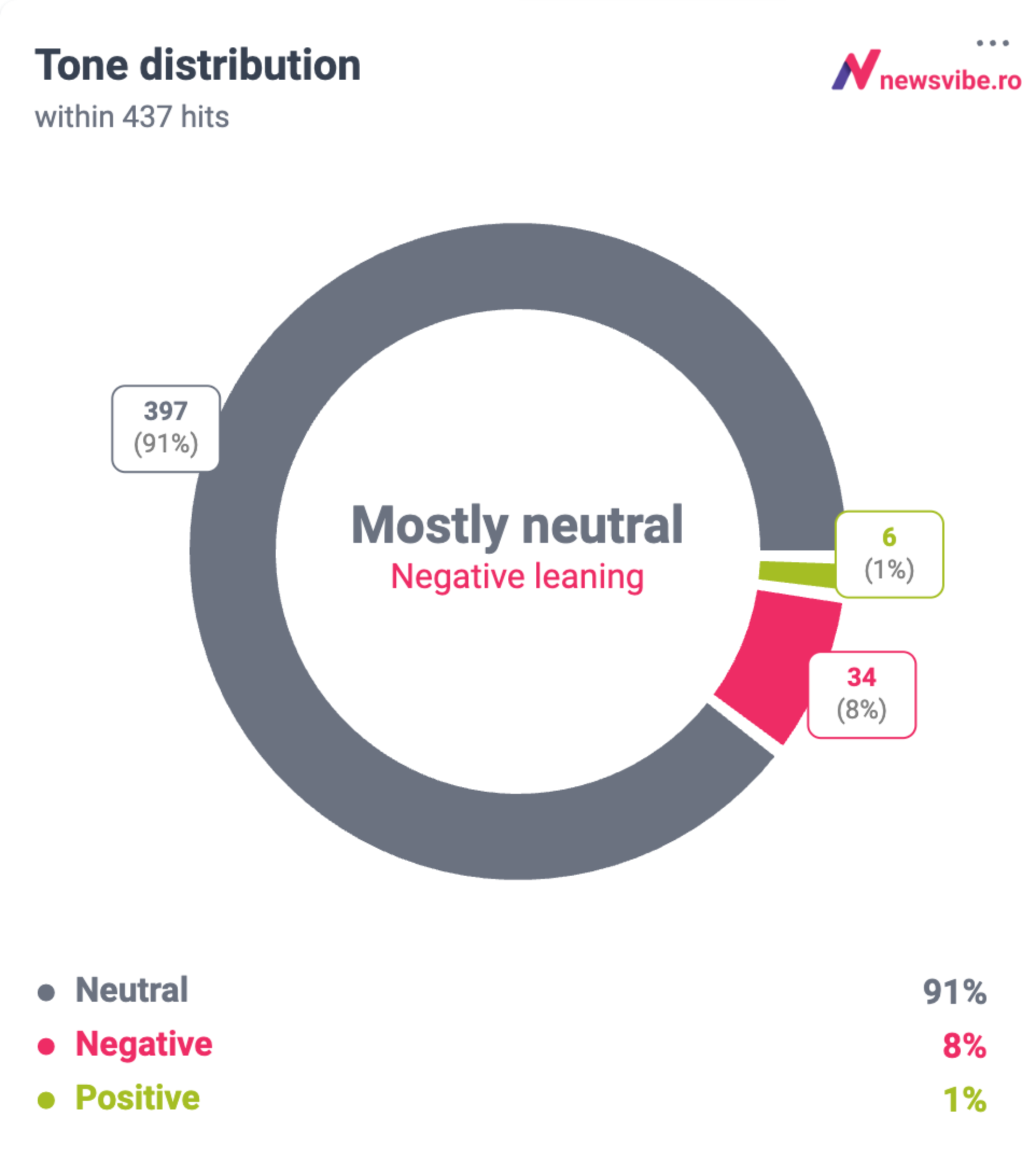 Graph: NewsVibe
*****Synthesis made with the help of a data monitoring stream provided by the media monitoring platform NewsVibe Romania. The analysis, data, and images presented have been enhanced with the help of Machine Learning and Artificial Intelligence tools.
Latest News
20:42
20:22
20:02
19:40
19:26
See more news
NEWS ON THE SAME TOPICS


.webp)