EXCLUSIVE Romania, in the vision of the press from Russia: The top topics from the last two weeks



Always see our news on Google
Romania has appeared in the Russian press in the last two weeks in security files related to the Black Sea, in the regional energy crisis, but also in several opinion pieces about the European Union and refugees, however, the negative-propagandistic accents are especially visible when related to Ukraine and the Republic of Moldova. The analysis also includes a ranking of the most discussed topics based on this data, highlighting key publications such as RIA Novosti, Izvestia, Rossiiskaia Gazeta, and others. The data was collected by the media monitoring platform NewsVibe, during the period of March 14 - 27, 2026. The report identified 337 articles published in the Russian press during this period.
Black Sea: Romania "is guilty" regarding the mines
The RIA Novosti agency and other news sites that take over official communications from the Russian Federation publish the statement of the Russian Embassy in Bucharest, which claims that all floating naval mines in the waters of the Black Sea would have exclusively Ukrainian origin and have no connection to Russia. The cited statement asserts that "the floating naval mines in the waters of the Black Sea have exclusively Ukrainian origin and have no connection to Russia, and the specialists of the Romanian Ministry of Defense are well informed in this regard," a formulation repeated in several materials. The statement is presented as a reaction to the claims of the Romanian Minister of Defense, Radu Miruță, about "Russian mines" in the Black Sea, and the Russian press emphasizes the idea that Bucharest would have contradicted its own technical data. The tone is defensive regarding Moscow's role and polemical in relation to Bucharest.
Energy crisis: Romania as an example of "Europe in crisis"
The energy crisis is covered by Kommersant, Izvestia, and Rossiiskaia Gazeta, which use Romania to illustrate the fragility of European economies in the context of the conflict surrounding Iran and sanction policies. Kommersant and economic sites note that "Bucharest has introduced fuel restrictions for a period of three months and has banned the export of gasoline and diesel, under conditions where one of the main importers was Ukraine," insisting on the impact on flows to Kiev. RIA Novosti and pro-Kremlin portals covering the ex-Soviet space focus on the chain effects on the Republic of Moldova and quote statements from Minister Dorian Junghietu about the limited import capacity from Romania and Ukraine.
The United States, Romania, and the military campaign against Iran
The foreign policy sections of RIA Novosti and Kommersant take information from Axios about Washington's plans in the Middle East and introduce Romania as a logistical base for American forces. RIA Novosti writes that "the first three Boeing KC-135 Stratotanker planes have arrived in Romania, after the country agreed to host additional American units and combat aircraft, for the continuation of Washington's military campaign against Iran," and specialized military news portals repeat this formulation almost identically. The tone is descriptive, but the editorial framing, especially the adjacent comments, reinforce the image of Romania presented as a compliant ally of the United States.
Romanians, Romania, and historical memory in relation to the Republic of Moldova
The theme of historical memory is treated aggressively by RIA Novosti and pro-Kremlin sites covering the post-Soviet space, especially through the lens of the Republic of Moldova. RIA Novosti extensively reproduces the statement of the Russian Embassy in Chișinău, which denounces the "opening of monuments in honor of the Romanian occupiers" and the "acts of vandalism against Soviet soldiers' monuments," in a register where Romanians are described as aggressors from the past. The text states that "in the republic, increasingly visible worrying signs of the resurgence of misanthropic ideologies are manifesting, evidenced by the opening of monuments to Romanian occupiers, as well as the increasing number of cases of vandalism against memorials from the Great Patriotic War," a formulation taken and commented on by pro-government sites aimed at the Russian-speaking audience in the region. Although the immediate target is the pro-European leadership in Chișinău, Romanians are explicitly portrayed as "occupiers," and Romania is associated with "misanthropic ideologies," which confirms a pronounced negative tone in this thematic area.
Laura Codruța Kövesi: Romania in the mirror of criticisms against Brussels
Rossiiskaia Gazeta and other publications of political and legal opinion in Russia evoke Laura Codruța Kövesi mainly as a symbol of the European Union's anti-corruption mechanisms, in a critical context towards Brussels. In these articles, Kövesi is presented as the European chief prosecutor who would have used the files to pressure "uncomfortable" politicians from member states, and the discussion about the EU's "double standard" is centered on community institutions, not on Romania. The texts explicitly emphasize that Laura Codruța Kövesi was born in Romania and that she led the National Anti-Corruption Directorate in Bucharest, presenting her experience in Romania as a "laboratory" for tough methods later used at the European level. Even though the tone towards the European chief prosecutor is critical, this criticism is not directed at the Romanian state or Romanians, but at the European Union and how Brussels would use anti-corruption tools to consolidate its political influence.
General Tone in the Russian Press
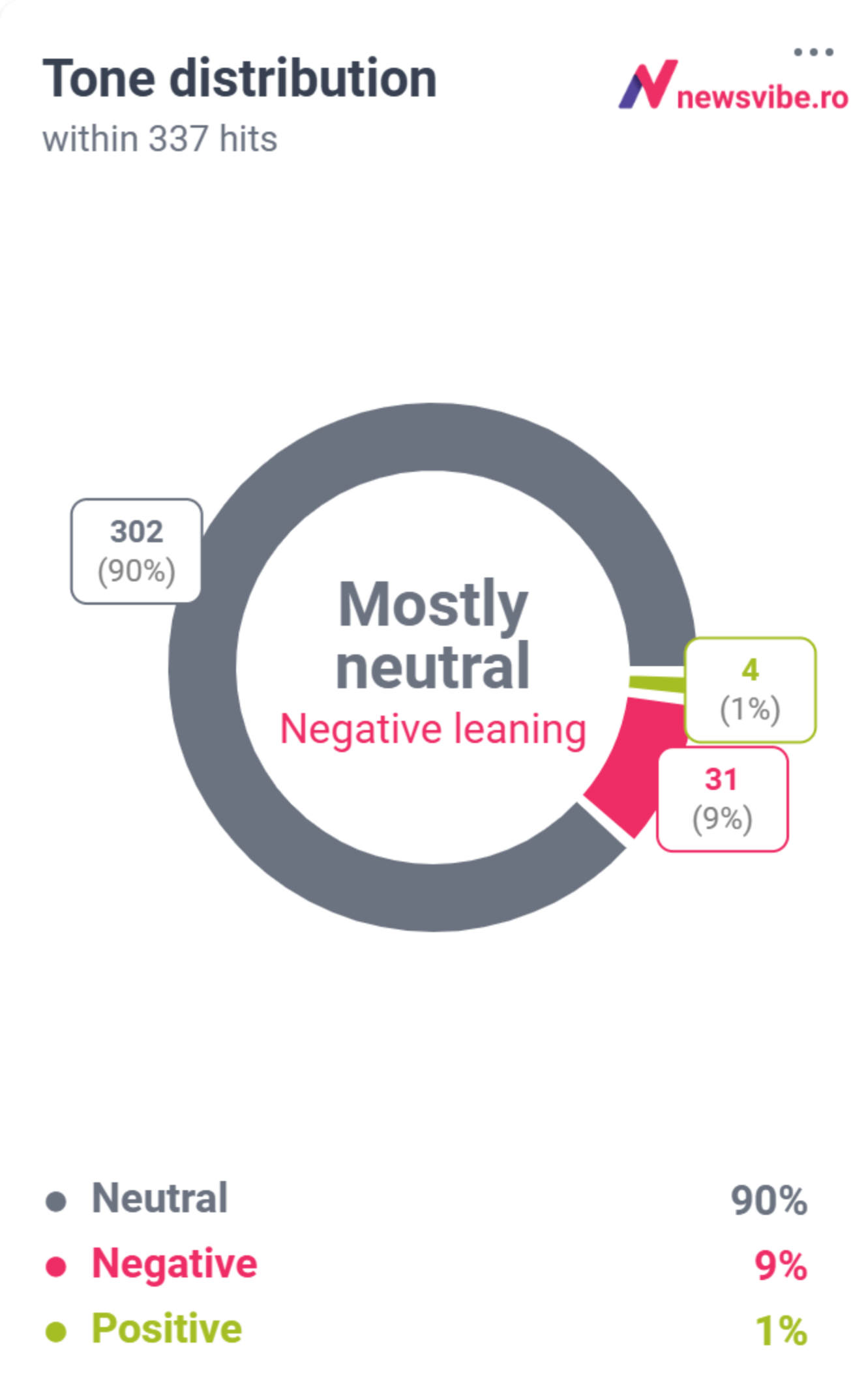
Analyzing the 337 articles published during the period of March 14-27, 2026, several clear characteristics of how Romania is represented in the Russian press emerge. Of these, 302 (90%) have a neutral tone, 31 (9%) a negative tone, and 4 (1%) a positive tone.
*****Synthesis made with the help of a data monitoring flow provided by the media monitoring platform NewsVibe Romania. The analysis, data, and images presented have been enhanced with the help of Machine Learning and Artificial Intelligence tools.
Latest News
15:45
15:40
15:39
15:38
15:29
See more news
NEWS ON THE SAME TOPICS


.webp)