ANALYSIS Under Macron's umbrella: what Romania would gain and what it would risk if it enters into the extension of French nuclear deterrence



Always see our news on Google
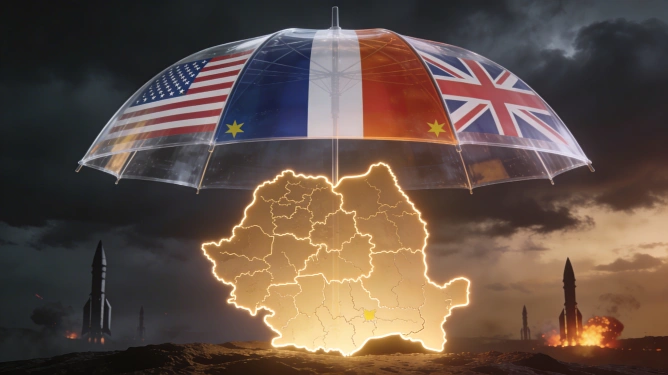
France proposes, for the first time explicitly, to transform its national nuclear force into an instrument of "advanced deterrence" for European allies, including with a temporary presence of nuclear capabilities on their territory, and Romania has confirmed that it is invited to participate and will decide in this regard in the CSAT. For Bucharest, the stakes are not just symbolic: acceptance would mean a concrete change in the national security architecture, in the relationship between US/NATO guarantees and a new European nuclear pillar, but also in Romania's profile in a conflict scenario with Russia.
What did Macron propose concretely
In his speech at the French nuclear submarines base at Île Longue, Macron announced the increase in the number of French warheads (currently ~300) and the entry into a new phase of deterrence, with a new nuclear submarine scheduled for 2036. The new strategic element is the provision of "advanced deterrence" for European allies – with joint exercises of French air nuclear forces and the possibility of temporarily deploying nuclear-capable aircraft or other infrastructure elements on the territory of partner states.
Eight states – the United Kingdom, Germany, Poland, the Netherlands, Belgium, Greece, Sweden, and Denmark – have already agreed to participate in this framework, through exercises and hosting capabilities associated with the French air strike force (force de frappe). Romania is not on the publicly announced list, but Foreign Minister Oana Ţoiu confirmed that France has invited Romania to join the group that could host elements of the "nuclear shield", with the decision to be made in the CSAT.
Important: the initiative is explicitly presented as complementary, not alternative, to the US-led NATO nuclear deterrence. France retains exclusive control over its weapons, does not enter NATO nuclear planning, and does not offer a legal "guarantee" identical to Article 5 or the American nuclear commitment, but rather a political and operational framework for additional deterrence.
What role has France had until now in NATO nuclear security
France is a nuclear-armed state recognized by the NPT, but does not participate in NATO's Nuclear Planning Group and maintains a strictly national deterrence doctrine, focused on defending its own "vital interests". Although French presidents have suggested for years that "vital interests" may include European interests, there has not been until now a formal framework through which non-nuclear states could be integrated into exercises, infrastructure, and posture directly associated with French nuclear forces.
For Romania, nuclear security has come until now under the American umbrella and, indirectly, the British one, anchored in NATO nuclear planning and in the presence of American tactical nuclear weapons deployed in several European states (but not in Romania). France has contributed to general deterrence simply by being a European nuclear power and through its conventional presence on the eastern flank, including in Romania, but without an operational role in NATO's nuclear posture.
The current proposal changes this status of "fringe benefit" – an indirect advantage – towards an arrangement in which other states become part of the French deterrence ecosystem, with exercises, infrastructure, and possible temporary deployments on their territories.
Security decisions that Bucharest must now make
For Romanian authorities, the French invitation transforms a fundamental strategic debate into a package of very concrete decisions, on at least five levels.
Does Romania accept or not to enter the framework of "advanced deterrence"?
The decision in the CSAT will determine whether Bucharest wants to be part of the group of states participating in nuclear exercises and could host French capabilities, similar to Poland or Germany.
Here, the perception of risk comes into play: Romania would move from the status of an already important NATO frontier state (missile defense, American bases) to an even more central role in a European nuclear deterrence architecture, with effects on how Moscow calculates its deterrence profile.
Hosting infrastructure and associated capabilities
Macron spoke of the possibility of temporarily deploying nuclear-capable aircraft and integrating allies into French nuclear air exercises.
For Bucharest, this means decisions regarding the modernization of some air bases, physical and cyber security regimes, command and control procedures, as well as legal agreements regarding the status of forces and the protection of classified information.
Compatibility with NATO posture and relationship with the US
Both Paris and Berlin emphasize that the new nuclear cooperation "will not replace" NATO deterrence. Romania must evaluate how a potential participation in the French architecture fits into its strategic relationship with the US, which remains the main pillar of European nuclear security, and into its own commitments within NATO (including the Aegis Ashore system at Deveselu).
Internal political framework and democratic legitimacy
A decision to host elements of a European nuclear umbrella will require a public communication effort, clarifying the advantages and assuming the risks, in a society where the memory of Chernobyl and anxieties related to the war in Ukraine are still strong.
The calibration of the political positioning will also matter – whether Romania presents itself as a promoter of European strategic autonomy or rather as a state that strengthens its pro-NATO profile using France's instruments.
National doctrine and crisis planning
Integration into an arrangement with French nuclear deterrence will require updating national strategic documents (National Defense Strategy, Military Strategy, government continuity plans) for scenarios in which Romania becomes a node in a nuclear deterrence architecture with dual anchoring: NATO/US and France.
Crisis management plans will also be necessary – from security incidents to potential Russian pressures or threats related to the status of hosting associated capabilities.
What would change in Romania's security architecture
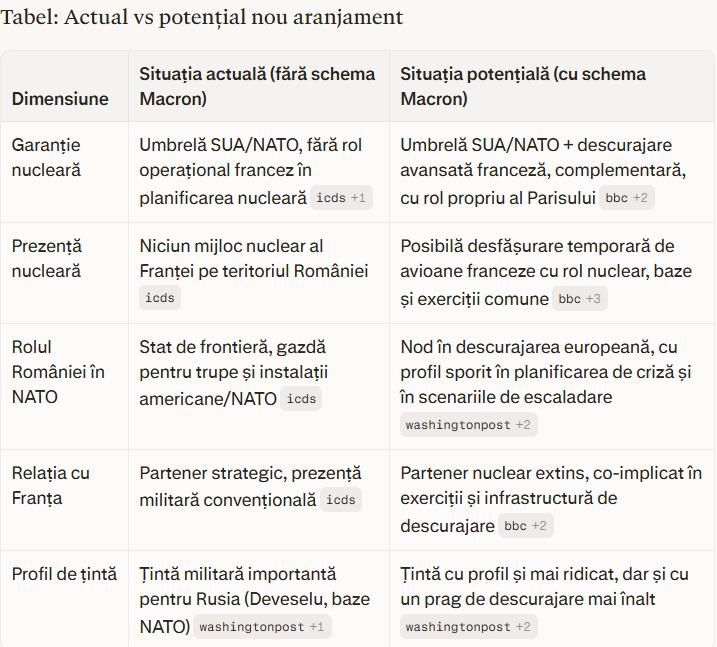
Romania's entry under France's "extended umbrella" would not create a new legal guarantee comparable to Article 5, but would practically change how adversaries perceive the costs of an attack on Romania. A potential aggressor would have to take into account not only the NATO response led by the US but also France's ability to strike nuclear and project nuclear capabilities closer to the front, on the territory of partner states – including, possibly, Romania.
The national security architecture would "thicken" on three levels:
The American-NATO pillar would remain the foundation, with collective nuclear planning and American capabilities deployed in Europe.
The European-French-British nuclear pillar would take on operational, not just political, contours through presence and exercises, which increases the degree of intra-European strategic interdependence.
The conventional pillar, already strengthened by the presence of NATO troops and equipment in Romania, would be closely linked to the new deterrence posture, with an emphasis on air defense, missile defense, and early warning.
In terms of perception, Romania would become not only a NATO frontier state but also a potentially key piece in the "inner circle" of European deterrence, which can have both positive effects (increased deterrence) and risks (prioritization as a target in an escalation scenario).
Advantages and disadvantages for Romania and NATO
For Bucharest, the main advantages of accepting the French proposal would be:
Increased deterrence: combining the American umbrella with an active posture from France creates a strategic environment in which an attack on Romania involves, practically, three Western nuclear powers (the US, UK, France), not just one.
Strengthening European strategic autonomy: participation in Macron's scheme would anchor Romania in the core of the European defense project, reducing the risk of marginalization in a potential scenario of American withdrawal or unpredictability.
Increased political weight: as a state that assumes additional risks for the security of the continent, Romania could negotiate more firmly on other issues – from strengthening the eastern flank to sanctions policy against Russia or the reconstruction of Ukraine.
The disadvantages and risks are not, however, minor:
High target profile: participation in hosting or supporting French nuclear forces could lead Russia to treat Romania as a priority target in its plans, including through rhetorical threats and hybrid operations.
Doctrinal ambiguity: although Paris suggests that France's "vital interests" may include European interests, there is no explicit commitment that any attack on Romania would trigger a French nuclear response, which may create greater political expectations than the actual guarantee.
Complicating the relationship with Washington: even if the initiative is declared complementary to NATO, a potential debate in the US about "Europeans free-riding" or duplicating structures could complicate strategic dialogue, especially in a volatile American political context.
Internal sensitivity: the nuclear issue is still emotionally charged, and internal opposition – political or societal – could exploit real or perceived risks, from accident scenarios to fears of escalation, eroding the consensus on Euro-Atlantic orientation.
For NATO, the major advantage is that a Europe that takes on more of the burden of deterrence becomes a more robust pillar of the Alliance, and French capabilities connect more visibly to collective security, even if they remain outside the actual nuclear planning structures. The risk is the emergence of perception fractures – between states participating in Macron's scheme and those that do not, or between those who see the initiative as a step towards European strategic autonomy and those who view it as a potential duplication of NATO – which will require fine political management in the North Atlantic Council.
Analysis conducted with the support of Perplexity
Latest News
08:20
08:12
08:09
08:06
08:04
See more news
NEWS ON THE SAME TOPICS