The opinion regarding the new security architecture in Europe is, most likely, still being formed



Always see our news on Google
Amid the ongoing discussion about how to keep American troops in our country (not to mention that the dilemma over their withdrawal arises precisely when they are most needed in Europe, but let’s not upset the president), let us also look toward, how could we not, our big sister. That’s what she was called, wasn’t she? France.
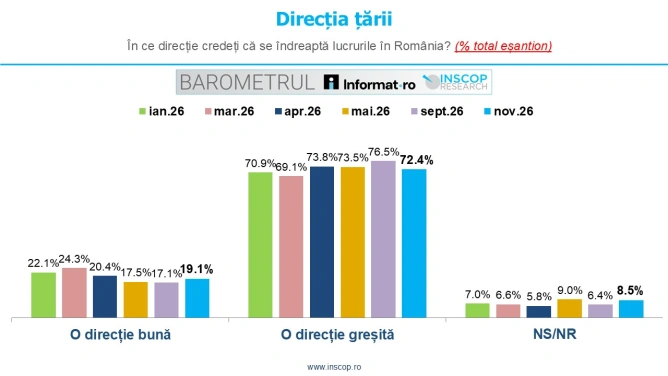
Last week, INSCOP published a concise survey conducted for the French Embassy concerning the French military presence in our country in the context of NATO’s efforts to mark the limes of the Western world. Of course, it has already been said: the first conclusion is the small paradox of the French military presence: Romanians appreciate it, but they do not really know what it is about. Attention: the study in question is nationally representative of the young population (aged 18–30), so we must calibrate the findings against what both France and the idea of European security mean for this age group. It may be that, by virtue of demographics, the 45-plus segment, for example, has a few more puzzle pieces than younger people when it comes to the security architecture preceding the current arrangements, within which, practically speaking, the very young were born.
Descriptively, 86% say that relations between Romania and France are very good or fairly good (with only 17% saying they are very good); 80% agree that France is an ally we can rely on; 64–65% say that the French military presence in Romania contributes to Romania’s security. So far, so good, and not necessarily unexpected. But when we reach the point where 50% of young people say they did not know that we have French soldiers on a mission in our country, in the context of what has happened in our region in recent years, we begin to wonder—not about public opinion, but about its weight. What are we actually debating, and how are young people connected to this debate, given that digital literacy and access to information are both better than among other age groups? Of course, we can discuss the quality of the content they access, but that would require a more complicated study.
What I am trying to say is that we study public opinion, but we must understand how different categories of the population, perhaps even different individuals taken separately, not only have different anchors for their perceptions and opinions in reality, but also have different degrees of consistency in their opinions on a given subject. Depending on their information, interests, surrounding discussions, the attention they pay, or the social mini-cultures from which they come. Issues related to foreign policy and international and regional security were almost nonexistent in public opinion 15–20 years ago. After joining NATO and the EU, the public behaved as though security issues and associated threats did not concern them and were, at most, a kind of film on TV. Also, apart from occasional minor references to the Republic of Moldova, the eastern space was completely uninteresting and unproblematic for us. Since 2015, things have begun to change; fear of a war in the region has reappeared in surveys—timidly at first, but it has become a presence. After 2022, we can no longer ignore the reconfiguration of the international system right here, next door, but we are far from understanding what NATO is and how it works. Nor does it help that over the past two years the United States has begun to challenge everything Europe knew about the collective defense of the old continent, precisely when Russia launched the first direct military challenge in the European geographical space after a long period during which it had seemed to be a rule that such a thing was not done.
In practice, we operate not so much in a space of public opinion as in one of therapy, in which behind the questions lies an implicit dialogue with the public that analyzes several facets of a reality it does not know particularly well, but which it had the feeling it knew and that had been resolved by identifying American interests in the region with the security brought by NATO. In the meantime, it has been discovered that life was not quite so happy, that deterrence is debatable, that Russia is not concerned with the EU’s comfort, and that Americans and Europeans have two different maps of the world. And the public must see how to navigate all these anxieties and whether it can get used to a different distribution of roles in this scheme of order than the one it assumed in the good old days, when some joked that we joined NATO precisely when it seemed no longer to be needed.
Latest News
11:48
11:45
11:43
11:36
11:34
See more news
NEWS ON THE SAME TOPICS
 (1).webp)
.webp)