Some clues regarding public communication



Always see our news on Google
One of the data sets published by INSCOP last week deserved, I believe, more public attention. But, caught up in the debate over the annulment of the November 2024 elections, our beautiful republic somehow missed another, at least equally provocative, debate.
In short, 80% of Romanians would agree with restricting access to certain online platforms in the event of serious threats to national security. It is an interesting figure, given the degree of Romanians’ distrust in institutions and the general level of distrust in our society… Plus a critical culture based to a very large extent on conspiracism, enormously amplified by the pandemic and by the radical political rhetoric that has gained a large market share in European politics in recent years.
Well, even with this huge proportion agreeing on the issue outlined above, let’s see where the most naysayers are found: more among men than among women, more among private-sector employees than among those in the public sector, and politically, AUR voters are rather opposed to such potential bans, but even among them, 75% agree in cases justified by national-security considerations. Otherwise, according to other criteria, there is fairly good homogeneity on this opinion among different sociodemographic categories.
This story is very interesting because, for about two years now, we have been operating on the idea that the country is divided into two large masses of public opinion, not merely ideologically or politically opposed, but also differing in how they see democracy, the political system, radicalism, etc. And that is broadly how things stand, but look: we find such pragmatic and specific scenarios that highlight some surprising points of homogeneity in public opinion.
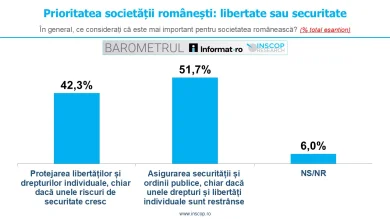
Another data set, also from last week, shows that, in the security-versus-freedom war, 51–52% of Romanians accept that security comes with restrictions on rights, while 42% place greater value on rights, even while accepting additional risks. This data set appears somewhat contradictory in relation to the one discussed above.
That is why these responses cannot, so to speak, be commented on off the cuff. They are simply facets, aspects of our public’s security culture—a topic that INSCOP studied extensively at one point, around 2018. For now, let us note that the question mentioned above (the first one we referred to here) raises a pragmatic scenario, while the second is more a matter of principle.
What do we learn from this? Not so much what these questions tell us about how the public thinks, but how the state, stakeholders, and society as a whole should communicate on such issues: pragmatically, by presenting concrete problems and measures, not in a veiled and principled manner.
Latest News
13:34
13:30
13:30
13:25
13:13
See more news
NEWS ON THE SAME TOPICS




.webp)