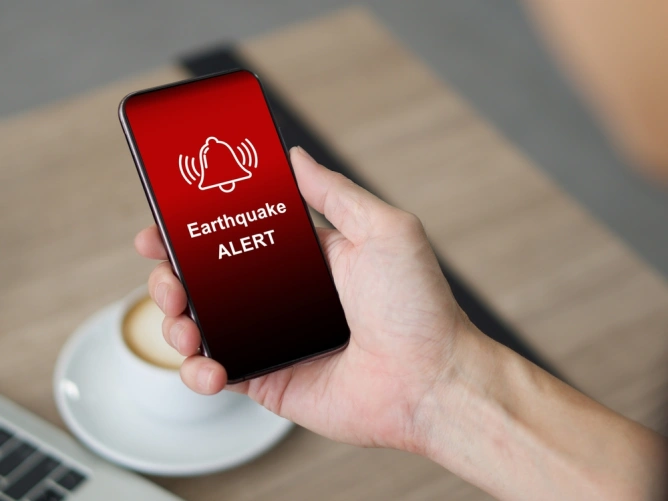
Why Google’s Android Earthquake Alerts system displayed a higher magnitude than INFP for the earthquake in Romania – Explanations from the Institute for Earth Physics



Always see our news on Google
The National Research and Development Institute for Earth Physics explained on Wednesday why, in the notifications of Google's Android Earthquake Alerts system, the magnitude displayed for Wednesday morning's earthquake was 6.5, while the values estimated by INCDFP were different.
According to the Institute of Earth Physics, the earthquake had a magnitude of 5.7 and occurred at 2:48 a.m., at a depth of 120.8 kilometers. The telluric movement was felt in Bucharest as well. The earthquake occurred near the cities of Focșani, Buzău, Sfântu-Gheorghe, Brașov, and Ploiești.
According to INFP, the early warning system initially estimated a magnitude of 5.6, with the value subsequently updated to 5.7 after analyzing data from the national seismic stations.
Nevertheless, some Android users were alerted about the earthquake in Romania before the official magnitude had been established. The message indicated an estimated magnitude of 6.5.
According to the Institute, the difference can be explained by the fact that the two systems use different technologies, data sources, and calculation methods.
Google uses the phones' accelerometers, while the institute analyzes data from seismic stations. Warning systems do not predict earthquakes; they detect them after they occur.
“The Android Earthquake Alerts system uses the accelerometers integrated into mobile phones to identify movements that may be associated with an earthquake. Data collected from multiple mobile phones are automatically processed to detect the seismic event and rapidly estimate its parameters. The accelerometers installed in these devices are less capable than INDCFP's monitoring equipment.
INCDFP uses data recorded by stations in the National Seismic Network to determine earthquake parameters through specific seismological methods. The first estimates are obtained automatically from a certain number of stations, within a very short interval, and are subsequently revised and manually analyzed by specialists based on data received from all seismic stations that recorded the seismic event,” the Institute of Earth Physics explained in a Facebook post.
The intensity of an earthquake can vary depending on the distance from the epicenter, the terrain, and buildings
The Institute explained that the intensity felt varies depending on the earthquake's depth, the distance from the focus, the nature of the soil, the type of building, and the floor on which people are located. Intermediate-depth Vrancea earthquakes can propagate across wide areas.
“Magnitude expresses the size of an earthquake and is directly related to the energy released during its occurrence, while intensity describes the effects of seismic movement in a particular location and may vary from one locality to another, depending on the distance from the epicenter, the earthquake's depth, the geological characteristics of the terrain, and the behavior of buildings. Thus, the same earthquake can be felt with different intensities, even in localities located at relatively close distances”.
How early warning systems work and what their role is
The Institute of Earth Physics also explained the role of early warning systems during an earthquake, in the context in which RO-Alert did not sound and the head of the Department for Emergency Situations said that the population was not alerted so as not to cause panic.
“These systems do not predict the occurrence of earthquakes; they identify events after they have begun, using the first available information to estimate their parameters. In this context, initial magnitude estimates may be updated as new data become available. The main purpose of early warning is to transmit as quickly as possible information that may enable the population and infrastructure operators to adopt protective measures,” INDCFP emphasized.
INFP did not specify the duration of the earthquake.
Read also:
Sources


Latest News
15:24
15:08
14:50
14:44
14:40
See more news
NEWS ON THE SAME TOPICS

.webp)
.webp)