ANALYSIS The romantic rumor is not the problem. Rather, it is Natalie Harp's access to Trump.



Always see our news on Google
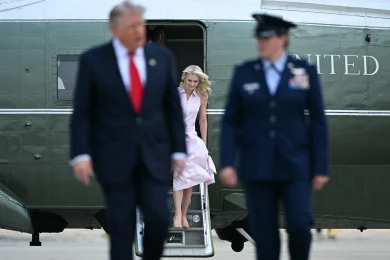
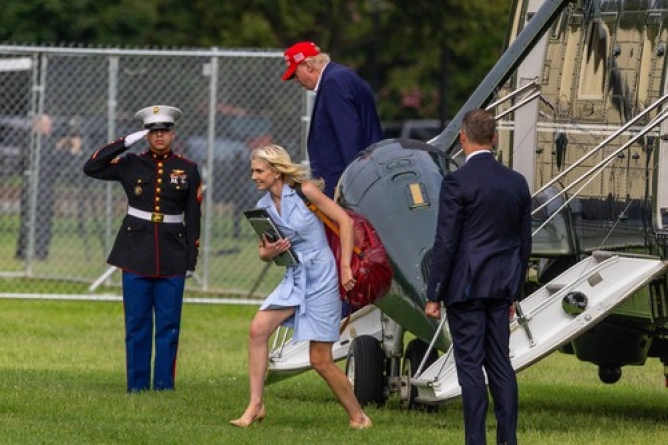
Natalie Harp, an executive assistant who unusually often accompanies Donald Trump and has direct access to the president, has found herself at the center of a mini-Washington scandal. So far, there is no public evidence that there is a romantic relationship between the two. However, there is enough proximity, opacity, and political tension for the question to become relevant: not so much "are they or aren't they together?" but "who has access to the president and through what filter does power pass?".
Where the story began
The discussion about Natalie Harp and Donald Trump did not start with a direct revelation about an affair, but through the accumulation of observations about her role around the president. Harp is described as a constant collaborator on trips, at the golf club, on the plane, and at times when access to Trump is strictly controlled. CNN reported that she has become an important channel between the president and the outside world, and public attention intensified after Democratic Senator Jon Ossoff mentioned her in a now-viral speech.
In this type of administration, the frequency of presence is not a neutral detail. A person who is constantly near the president can influence what information reaches him, what messages are published, and who gets access. The New York Times described Harp as a "filter" and a communication conduit that operates largely outside the usual chain of command.
Thus, the origin of the scandal is primarily institutional: an employee seemingly subordinate administratively, but extremely close to the decision-making center. Intimate speculations came later, fueled by the ambiguity of this position.
Who is Natalie Harp
Harp, at about 35 years old, is a former presenter at One America News Network, a conservative network close to Trump's media universe. She has worked in Trump's circle for several years and holds positions that give her direct access: executive assistant and special advisor to the president.
In practice, reports about her attribute more activities than her title of assistant suggests. Harp is said to manage or contribute to Trump's posts on Truth Social, provide him with printed materials about public reactions, and act as an intermediary between the president and the rest of the team. Some publications have referred to her, in a suggestive phrasing, as Trump's "human printer," precisely because she is known to frequently bring him prints and messages.
Her importance, therefore, does not derive solely from how much time she spends with the president, but also from the nature of her access. In a leader who reacts intensely to the press, polls, and personal loyalty, the person who selects the information can become almost as important as the official spokesperson.
What Jon Ossoff said
The story gained an explicit political dimension when Jon Ossoff, a Democratic senator from Georgia, publicly attacked the proximity relationship between Trump and Harp. His reference was not an investigation and did not present evidence of an affair; it was a rhetorical weapon in a broader confrontation with the White House.
The administration's response was, however, disproportionately aggressive in relation to the seemingly minor status of the subject. The dispute between Ossoff and the White House turned Harp's name into a symbol of the struggle for access, transparency, and control of the president, according to reports about the conflict published by The Hill and other publications.
Here lies one of the keys to the mini-scandal: if Harp had been just an ordinary employee, Ossoff's attack could have been ignored. The fact that the administration reacted harshly implicitly conveyed that the subject touches on a sensitive area—even if it does not demonstrate anything about the personal nature of the relationship.
What is fact and what is speculation
Public data allows for a few relatively solid assertions:
Harp works in the immediate proximity of the president.
She also frequently accompanies him and has unusually broad access.
She is involved in transmitting Trump's messages and in his social media ecosystem.
She has become the target of a public political dispute following Ossoff's statements.
The White House has not provided a complete and transparent explanation regarding the extent of her role.
In contrast, the claim that Trump and Harp have a romantic relationship remains unconfirmed. Available checks describe the rumor as based on hearsay, interpretations, and anonymous sources, without independent evidence to demonstrate an affair.
Neither physical proximity, extreme loyalty, nor personal letters constitute, alone, proof of a sexual relationship. They may indicate a relationship of professional dependence, personal admiration, a strategy for access, or a combination of these elements. Responsible media must maintain this distinction, especially when discussing the reputation of a person who is not officially accused of any illegal act.
The letter that changed the tone
One element that fueled speculation is the existence of personal messages attributed to Harp. Forbes reported on a phrasing from a letter sent to Trump—"I want things to always be good between us"—presented as part of an exchange with an affectionate and extremely loyal tone.
The problem is that such a message can be read in multiple ways. It may reflect a collaborator's commitment to a leader on whom they depend professionally; it may express a real personal closeness; or it may be taken out of a broader context and later loaded with a significance that the text does not prove.
In the absence of complete documents, verifiable direct testimonies, or confirmation from those involved, the letter is at most an indication of the intensity of the relationship, not about its intimate nature.
The role of security
Another source of concern is the questions regarding Harp's access to sensitive information and spaces. The Guardian reported on controversies regarding her authorization or level of access to classified information, in the context of her closeness to the president.
This dimension is more serious than the romantic rumor. In a presidential administration, access to the president can mean access to confidential discussions, foreign policy decisions, and information about national security. The relevant question is not whether Harp likes Trump or whether Trump likes Harp, but whether her function, training, and authorizations correspond to the actual level of influence she exerts.
If there is a discrepancy between the official title, actual access, and security procedures, then the subject becomes one of governance. The personal relationship is merely the spectacular backdrop of a much more concrete administrative question.
Why the scandal does not fit Trump's image
At first glance, it seems paradoxical that Trump would be disturbed by speculation about a romantic relationship. He has built a significant part of his notoriety on marriages, divorces, affairs, and controversial sexual statements. His personal life has been, for decades, part of his public brand, and the case of Stormy Daniels—the adult film actress with whom he denied having a sexual relationship—has become a major political and legal issue.
The difference is that Trump has always preferred to control the story about his own sexuality. He can turn a relationship into a demonstration of success, power, or virility when he is the author of the narrative. A rumor emerging from the outside, related to a subordinate employee and the functioning of the White House, takes control over the framing.
Moreover, the Harp scandal does not just place him in the position of a man with a controversial romantic life. It places him in the position of a president who might favor a collaborator, might depend on her, or might allow someone from his inner circle to influence access to the presidential institution.
Four reasons why it might disturb him
Loss of control
Trump manages his image like a political product. A rumor about an affair is dangerous not only because of its content but because it is hard to control: every photo, message, or public appearance can be reinterpreted.
Political vulnerability
A relationship with an employee would raise questions about favoritism, abuse of power, and conflicts of interest. In this case, the scandal could be used by opponents to suggest that access to the president is obtained through personal loyalty, not through function or competence.
Perception of weakness
Trump tolerates attacks that present him as dominant and offensive. He can be disturbed, however, by images that suggest dependence, isolation, or manipulation. If Harp is perceived as the person who filters his world, the question becomes who is actually leading him at certain moments.
Confusion between personal and official
When a close collaborator appears in security zones, on sensitive trips, and in the flow of presidential communication, personal life can no longer be completely separated from public function. It is precisely this overlap that transforms a mundane rumor into a political issue.
Why the story catches on so easily
The scandal brings together several ingredients that, in contemporary American politics, instantly produce attention: Trump, a young and omnipresent woman, personal messages, photos from the president's proximity, access to information, and a confrontation with a Democratic senator.
There is also a media logic. Complex professional relationships are hard to explain in a video fragment or in a viral post; the suspicion of an affair is easy to understand and distribute. Thus, the question "what exactly does Harp do?" risks being replaced by the question "is there something between Harp and Trump?" even though the former is more important for the functioning of the administration.
The public does not only react to the possibility of an intimate relationship but to the feeling that they are seeing a hidden area of power. In an administration built around personal loyalty, physical proximity becomes a form of status.
A mini-scandal, not yet a major crisis
In its current form, the Harp case is not a proven Watergate-type scandal nor evidence that the president has broken the law. There is no independent confirmation of an affair between Trump and his assistant in the available public information.
Its importance is more subtle and lies in three areas:
Transparency: The White House must explain what duties Harp has and how broad her access is.
Security: authorizations and procedures must correspond to the information she can access.
Institutions: the public has the right to know whether the president's decisions and communication go through official channels or through an informal personal circle.
In this light, the romantic component may be a distraction. It attracts the public, but the underlying issue is the architecture of access to Trump.
What remains unproven
Several questions remain open:
What exactly is Harp's job description?
What level of security clearance does she hold?
Does she participate in classified meetings or discussions?
What role does she play in drafting and publishing Trump's messages?
How much of their closeness is dictated by work and how much by a personal relationship?
Has there been any behavior that would officially justify an investigation?
Until these questions receive verifiable answers, any conclusion about an affair would be premature. The fact that the rumor is repeated by multiple publications does not automatically turn it into fact; sometimes, the repetition of speculation only produces the illusion of confirmation.
The real stakes
The Harp mini-scandal matters because it shows how little separate the official power can be from personal trust relationships around Trump. A president who runs his administration through proximity, loyalty, and selective access inevitably raises questions about the people who stand between him and institutions.
Therefore, public interest should not focus on the romantic insinuation in itself. So far, this remains speculation. The solid journalistic question is whether Natalie Harp has a role, an access, and an influence proportional to her function—and whether the public can verify this without being forced to deduce everything from photographs, letters, and the White House's furious reactions.
Trump can withstand scandals about his romantic past when he turns them into his own legend. What may disturb him now is something else: that an unclear relationship from the present could become a metaphor for a presidency in which access, information, and loyalty blend into an increasingly hard-to-see circle from the outside.
Analysis conducted with the support of Perplexity
Latest News
22:52
22:34
22:28
21:56
21:29
See more news
NEWS ON THE SAME TOPICS