EEAS withdraws its logo from a disinformation conference after disagreements over how the programme was worded



Always see our news on Google
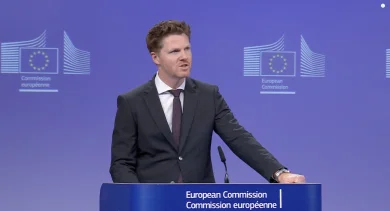
The European External Action Service requested the removal of its logo from the materials for the #Disinfo2026 conference in Vilnius, stating that some discussions had been framed in a way that did not correspond to the EU’s official positions. The program included a session on the United States as a possible source of information manipulation and interference. Pressed to say whether the decision followed US démarches, spokesperson Christian Wigand declined to comment on diplomatic exchanges and did not confirm this link.
The European External Action Service, EEAS, requested the removal of its logo from the materials for the #Disinfo2026 conference held in Vilnius, after considering that some of the discussions on the program had been framed in a manner incompatible with the official positions of the European Union. The confirmation came from Christian Wigand, the EU spokesperson for foreign affairs, after the withdrawal of the EEAS’s visible support prompted questions about the relationship between European institutions and independent organizations researching disinformation.
The officially confirmed decision is the removal of the logo from the conference materials. The EEAS has not announced the cancellation of the event, has not said that it is ending all relations with the organizers, and has not publicly confirmed that any funding associated with the conference was withdrawn.
In brief
The EEAS requested the removal of its logo from the #Disinfo2026 materials because of the way the organizers framed some discussions.
The institution has not publicly specified which session or specific statement prompted the decision.
The program included a debate entitled “USA as a FIMI threat: acknowledge, adapt, push back”, about the United States as a possible source of information manipulation and interference.
Pressed to say whether the decision followed contacts with the US administration, Christian Wigand declined to comment on diplomatic exchanges.
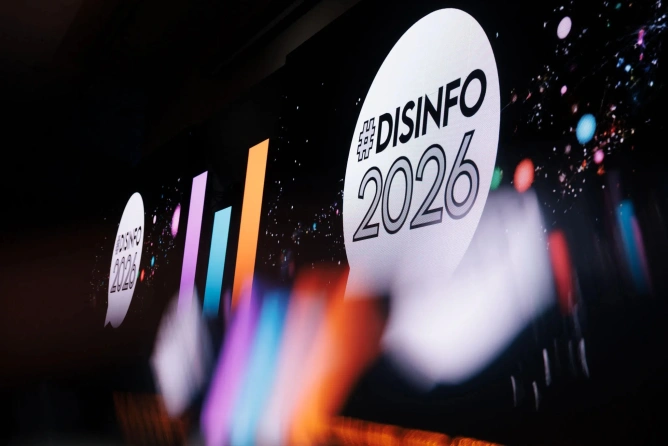
The conference organized by EU DisinfoLab in Vilnius continued during 7–8 October.
The controversy is unusual because the EEAS is precisely the European institution that developed much of the EU methodology concerning FIMI, Foreign Information Manipulation and Interference, a term used for coordinated operations to manipulate the information space. The European diplomatic service cooperates in this area with member states, international institutions, researchers, journalists, fact-checkers, and civil society organizations.
Wigand insisted on this cooperation when explaining the decision. He reaffirmed that the EU considers foreign information manipulation and interference a serious threat and that support for civil society remains a component of the European response.
The issue, according to the official explanation, was the specific program of the event in Vilnius. The organizers were responsible for the conference’s content, and the EEAS considered that some discussions had been framed in a way that did not correspond to the positions officially adopted by the Union.
However, the spokesperson did not identify those discussions. Repeatedly asked to provide a concrete example, Wigand returned to the wording concerning the “framing” of certain debates and did not indicate a session, speaker, or precise statement that would have crossed the line acceptable to the institution.
The conference program nevertheless provides context for the controversy. One of the sessions announced for 7 October was entitled “USA as a FIMI threat: acknowledge, adapt, push back” and proposed discussing how the European community that combats information manipulation should analyze developments in the United States.
The organizers had published the program before the conference. EU DisinfoLab had announced as early as April that it wanted to include more developments from the United States in the 2026 edition, after observing that very few of the more than 350 proposals received for the conference addressed this subject. The organization said at the time that avoiding major geopolitical topics could produce a form of self-censorship in the community studying disinformation.
This approach is broader than the EEAS’s current practice. In its own assessments concerning FIMI, the European diplomatic service primarily addresses operations attributed to Russia and China and the infrastructures used by foreign actors to manipulate the European information space.
The annual EEAS report published in 2026 shows that, of the 540 FIMI incidents analyzed for 2025, 29% were attributed to Russia and 6% to China. The remaining 65% remained unattributed, although the EEAS identified indicators in many cases of coordination with infrastructures associated with Russian or Chinese actors.
The #Disinfo2026 program, however, applied the concept of information interference to developments related to the United States as well. This is where the difference arises between the freedom of an independent conference to formulate questions and the need for a diplomatic institution to decide whether its name and logo may be interpreted as endorsing that framing.
The controversy took on a transatlantic dimension after Reuters and other publications reported that the US State Department had contacted allies to express its dissatisfaction with the conference, particularly with the panel devoted to the United States. Canada and Lithuania also reduced or withdrew forms of support associated with the event.
The EEAS’s official position, however, is more limited than these reports. Asked whether the institution had been contacted by the US side before the logo was withdrawn, Wigand neither confirmed nor denied the existence of such discussions. He said that, as a matter of principle, the service does not comment on diplomatic exchanges.
Asked subsequently whether he could explicitly deny that the decision had been made under US pressure, the spokesperson did not do so. He repeated that the reason for the decision was discomfort with the way some discussions had been framed and again declined to elaborate on diplomatic contacts.
This distinction is important. There are journalistic reports about the US administration’s démarches, but the European institution has not confirmed that they prompted the removal of the logo. There is therefore no basis for presenting US pressure as the officially established cause of the EEAS decision.
Lithuania also cited differences between certain elements of the program and the official position of its government, while Canada pointed to changes in the wording of some discussions when it reviewed its participation. The conference nevertheless continued according to the main program in Vilnius.
EU DisinfoLab is an independent Brussels-based organization that annually organizes conferences for researchers, journalists, non-governmental organizations, authorities, and technology specialists working on disinformation issues. The 2026 edition focused on practical responses, from law enforcement and platform accountability to open-source investigations, artificial intelligence, and the financial infrastructure that can support manipulation operations.
The Vilnius case thus raises an issue that goes beyond a logo removed from an event’s materials. The EU relies on independent organizations to research and expose information manipulation operations, and the EEAS explicitly states that responding to FIMI requires cooperation with civil society. At the same time, European institutions seek to avoid situations in which their participation or visual identity could be interpreted as endorsing positions that have not been politically adopted by the Union.
The lack of a more precise explanation nevertheless leaves open the question of where the EEAS considered this limit to have been crossed. So far, the European diplomatic service has explained why it withdrew its logo in general terms, but it has not publicly identified the exact wording it considered incompatible with EU positions, nor clarified the role of any diplomatic contacts in the decision-making process.
Latest News
18:51
18:45
18:35
18:25
18:14
See more news
NEWS ON THE SAME TOPICS