Commission withdraws its logo from Ventotene conference attended by Taiwan’s vice president, without clarifying Taiwan’s role in the participation



Always see our news on Google
The European Commission explains the withdrawal of its logo from the communications about the conference in Ventotene by saying that it had been used on materials it had neither seen nor approved. Asked whether the decision had been influenced by the participation of Taiwan’s vice president, Hsiao Bi-khim, the Commission did not provide an explicit answer, although it confirmed that its representation in Rome had contributed financially to the event.
In brief
1. The Commission attributes the logo’s withdrawal to its use in social media communications without validation of the content. It did not identify the materials concerned.
2. The European Parliament Office in Italy organized the conference, while the Commission’s representation in Rome contributed financially. The briefing did not announce the withdrawal of funding.
3. Taiwan’s vice president, Hsiao Bi-khim, participated at the organizers’ invitation. Questions about whether her presence influenced the Commission’s decision remained without an explicit answer.
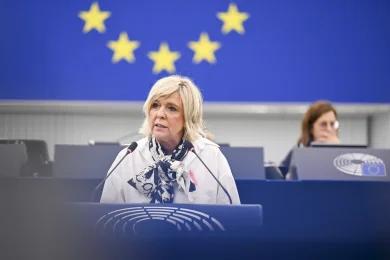
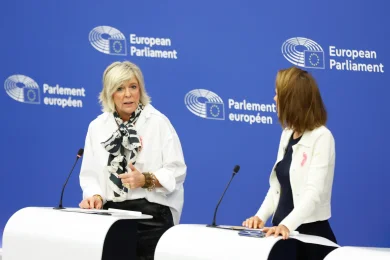
The European Conference for Freedom and Democracy took place on the Italian island of Ventotene between September 10 and 12. Now in its second edition, the event was initiated by European Parliament Vice President Pina Picierno and organized by the Parliament’s office in Italy. The announced program brought together dissidents, activists, representatives of institutions, and journalists for debates on freedom and democracy.
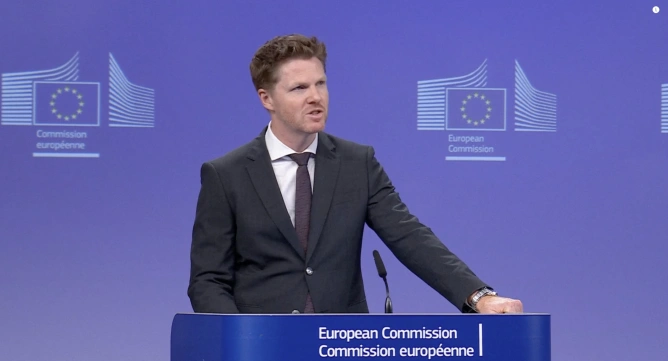
At the Brussels briefing on September 14, Christian Wigand, the spokesperson responsible for foreign affairs and security policy, stated that the Commission’s representation in Rome had provided a financial contribution. He said that democracy is a subject for which the Commission frequently supports events, but that, in this case, the social media communications had used the logo without prior validation of the content. This was the explanation given for the withdrawal.
Journalists returned twice to the participation of Taiwan’s representative, asking whether it was part of the content that had prompted the decision. Wigand declined to comment on the Taiwanese official’s travel and contacts with European lawmakers. Olof Gill, the Commission’s deputy chief spokesperson, ended the exchange by saying that he had no further details. The Commission did not identify the posts concerned or the specific element of the content that it had not approved.
Hsiao’s participation took place at the joint invitation of Pina Picierno and Carlo Corazza, director of the European Parliament Office in Italy, according to Taiwan’s presidency. Hsiao explained that the trip had not been announced before departure in order to avoid unnecessary interference and allow her to arrive safely. Referring to Taiwan and Ventotene, she said that both islands “deserve to have their own voice and to be respected.”
Beijing protested the visit to Italy and the European Union, according to Reuters. China claims Taiwan, while the government in Taipei maintains that only the island’s inhabitants can decide its future. This diplomatic dispute does not, in itself, establish the reason for the Commission’s decision regarding the logo.
The Commission’s public rules require third parties to obtain permission before using the logo and prohibit uses that would suggest an endorsement the Commission did not intend to grant. These conditions explain the role of approval for communications materials, but they do not show what specifically prompted the intervention in the case of the Ventotene conference.
The responses from Brussels confirmed the financial contribution and cited the issue of validating the communications, without announcing the withdrawal of funding. Nor did the claim by a journalist that a Commission official had been asked not to attend receive explicit confirmation. The public explanation therefore remains limited to the use of the logo; the possible influence of the Taiwanese vice president’s presence on the decision was not clarified.

Latest News
22:58
22:44
22:41
22:21
22:08
See more news
NEWS ON THE SAME TOPICS