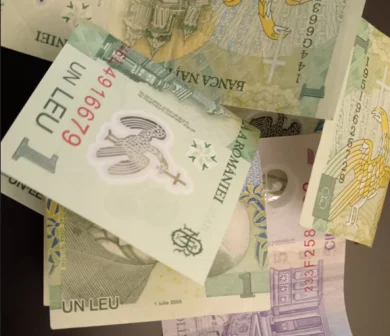
ANALYSIS How political chaos turned the leu into a currency under siege




Always see our news on Google
The national currency capitulated in the face of uncertainty in Bucharest, setting a new historic low of 5.2788 lei to the euro. While rating agencies and foreign investors are harshly penalizing government paralysis, the bill paid out of Romanians’ pockets is growing by the day through a chain of price increases and “junk” interest rates
What is happening to the Romanian leu, and why?
The Romanian leu is undergoing an accelerated process of structural depreciation, definitively leaving the zone of relative stability below the 5-leu threshold. This decline is not merely an accident along the way or a normal seasonal fluctuation. It represents the correction of a currency that has been “forcibly stabilized” by the National Bank of Romania (BNR) in recent years through massive interventions in the foreign exchange market.
The mechanism behind the fall has two drivers:
The inflation differential: The Romanian economy is operating with significantly higher inflation than the euro area average, which, according to economic laws, naturally erodes the leu’s purchasing power relative to the single currency.
The exhaustion of the BNR “shield”: In order not to let the exchange rate explode, the BNR has used considerable amounts of its foreign exchange reserves. Against the backdrop of the current lack of confidence, the market is testing the limits of this controlled-floating strategy, and the central bank is being forced to let the leu weaken gradually so as not to deplete the country’s reserves.
What does this decline mean for the economy?
The effects of depreciation are transferred instantly from traders’ offices directly into the real economy. Romanians and companies pay this bill through three main channels:
Direct import of inflation: Romania is deeply dependent on imports (from food to technology). A more expensive euro means more expensive goods on store shelves.
Rising basic service costs: Telephone bills, internet subscriptions, rents, and installments on loans taken out in euros automatically increase in lei equivalent.
The explosion of financing costs: To compensate for currency and country risk, lenders demand much higher interest rates. This means that the Romanian state borrows at enormous costs, suffocating the public budget and reducing room for investment.
The umbilical link to the political crisis
The current shipwreck of the leu is the direct effect of successive government crises, culminating in the dismissal of the government led by Ilie Bolojan through a motion of no confidence. In a global economy, capital is extremely timid, and money has no political orientation, only a safety agenda.
When a government falls and there is no clear majority, the fiscal reform process freezes. The administrative deadlock directly jeopardizes the attraction of funds from the National Recovery and Resilience Plan (PNRR). Without these billions of euros injected by the European Union, Romania’s massive current account deficit remains completely exposed, forcing the depreciation of the national currency as an economic safety valve.
What do creditors and international partners criticize?
International creditors, commercial banks, and rating agencies (such as S&P) criticize Bucharest for a short but extremely serious list of vulnerabilities:
The deficit spiraling out of control: Romania has the largest budget and current account deficits in the region. We spend far more than we produce and import far more than we export.
Lack of fiscal predictability: The postponement of structural reforms (pensions, the unified pay law, the elimination of unfair tax incentives) for purely electoral reasons.
The risk of losing European funds: Political instability blocks payment requests under the PNRR, the country’s only real anchor for modernization.
What solutions does Bucharest have to overcome the crisis?
To stop the currency bleeding and regain market confidence, decision-makers in Bucharest have no quick fixes or magic solutions, only the path of tough reforms:
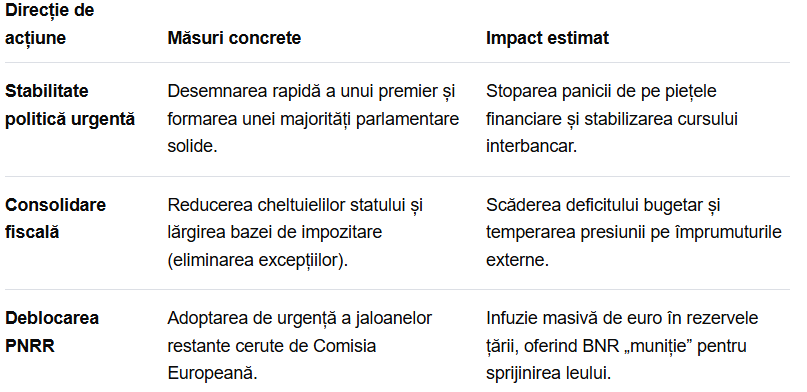
Without the rapid adoption of these structural measures, the BNR’s mere intervention behind the scenes will only postpone the inevitable, turning today’s gradual correction into a full-scale currency crisis tomorrow.
Latest News
15:27
15:25
15:25
15:24
15:12
See more news
NEWS ON THE SAME TOPICS


.webp)