SPECIAL Informat.ro / When marriage is not final, but negotiable: kalash women and the freedom to choose their destiny



Always see our news on Google
In the Kalash community in northern Pakistan, women have the right to choose their partner and, under certain conditions, to separate from their husband and rebuild their lives, a rare social model in a region dominated by strict patriarchal norms.
The isolated valleys of northwestern Pakistan are home to the Kalash people, a community that lives with ancient rituals and a cultural identity that has resisted the pressures of the Muslim majority. Known for their seasonal festivals, colorful clothing, and unusual social rules, the Kalash remain one of the most distinct ethno-religious groups in South Asia.
A small community, a large identity
The Kalash are considered the smallest ethno-religious group in Pakistan and live primarily in the Chitral region, in the Kalash valley, near the border with Afghanistan. Consulted sources describe them as a distinct Indo-Aryan people, with an animist and polytheistic religion, different from the dominant Islamic context around them.
The size of the community is small, and this fragility has become part of their contemporary story. Over time, many Kalash have been culturally assimilated or converted, which has fueled constant fears regarding the disappearance of their traditions.
Beliefs and rituals
The religious life of the Kalash is structured around a very strict relationship between "pure" and "impure" , and these categories influence daily gestures, social status, and rites of passage. The consulted sources also mention the idea that they worship multiple deities, and nature plays a central spiritual role in the life of the community.
A frequently mentioned element is the sacrifice of animals, practiced in ritual contexts, alongside festivals that mark the agricultural cycle and the changing of the seasons. The most important celebrations are associated with winter, spring, and summer, and the community experiences them as moments of reaffirmation of collective identity.
Seasonal festivals
Chilam Joshi, the spring festival, is described in international sources as one of the most important moments of the year for the Kalash. For several days, the valleys become a space of song, dance, and processions, and the celebration has both an agricultural and an identity function.
Uchal, the summer festival, is linked to the harvest and gratitude for the yield obtained, while other celebrations mark winter and the transition to a new cycle of life. For such a small community, these festivities are not just ethnographic spectacles but mechanisms of cultural survival.
Women, marriage, and freedom
The most commented feature of Kalash society is the freedom of women to choose their partners and to leave a marriage if they wish to do so. The consulted sources show that marriage is not usually dictated by parents, and women can even elope with a man of their choice, especially during festivals.
An even more unusual detail for the general public is that if a married woman leaves her husband and remarries, the new partner must pay a compensation greater than that paid by the first husband. In the cited sources, the rule is explained as a form of compensation for the loss of the wife and the initial sum offered at marriage.
Intimacy and separation
In contrast to the image of a very permissive community, the Kalash also maintain quite strict ritual separation rules. Women who are menstruating are sent to a separate building, called bashaleni, where they stay until the end of the period considered impure, and there they give birth and can keep small children.
This practice shows one of the internal tensions of the community: on one hand, women have an unusual marital autonomy for the region, while on the other hand, their lives are regulated by very precise ritual norms. The Kalash are not a "modern" community in the Western sense, but one that combines specific social freedoms with a very ancient religious system.
Clothing and daily life
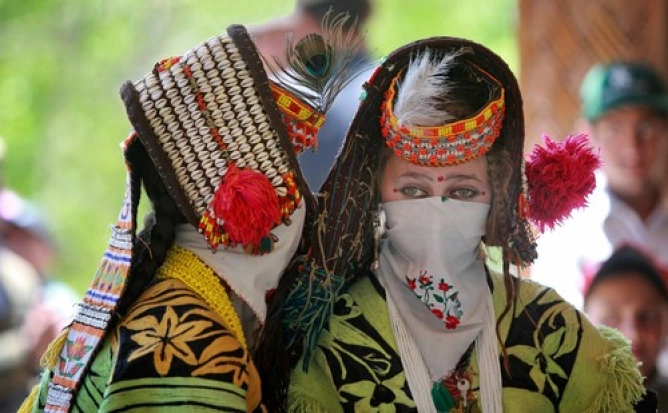
Kalash women are easily recognized by their traditional clothing, with long black garments, colorful embroidery, elaborate hairstyles, and bead jewelry. Some descriptions also mention small facial tattoos, kept as a sign of cultural identity.
Men, on the other hand, often adopt clothing more in line with the widely spread regional model in Pakistan. It is precisely this visual difference that makes Kalash women the most frequently invoked in reports, although the culture of the community is not limited to their aesthetics, but to a whole system of relationships, rituals, and belonging.
Origins and myths
Part of the popular literature links the Kalash to the soldiers of Alexander the Great, a hypothesis that recurs in reports and press materials, although there is no simple scientific consensus. Beyond this legend, academic and synthesis sources describe them more soberly as an ancient Indo-Aryan people, with a distinct cultural heritage in the Hindukush area.
The fact that the Macedonian origin myth always reappears in narratives about them says a lot about how they are viewed from the outside: as a "different" community, almost exotic. In reality, the Kalash are more interesting precisely because of their local continuity than any imperial descent legend.
A culture under pressure
Recent sources emphasize that this community lives in a fragile balance, caught between tourism, cultural preservation, and the pressure of the surrounding majority. With a small population and a strong identity, the Kalash depend on their ability to pass on their language, rituals, and customs.
Their true story is not just that of "bizarre customs," but of a culture that has survived precisely through difference. In a corner of the world where religious and social uniformity has been the rule, the Kalash continue to show that tradition can survive not just as a relic, but as a way of life.
Documentary made with the support of Perplexity
Latest News
11:41
11:41
11:34
11:28
11:26
See more news
NEWS ON THE SAME TOPICS