ANALYSIS The increasingly hot summers of Europe: When the new climate reality crosses the danger threshold



Always see our news on Google
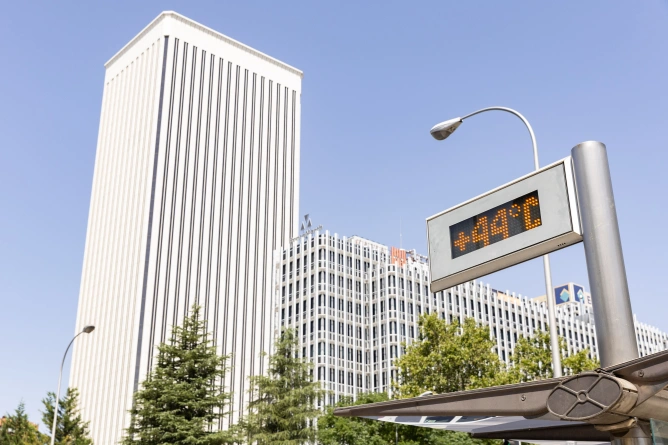
Summer temperatures in Europe are clearly, rapidly, and systematically rising, and the transition from "normality" to "danger" is no longer just a matter of occasional peaks, but of duration, frequency, and social context, especially beyond the threshold of 35°C and especially around and above 40°C, where European authorities are already openly discussing major risks to health and infrastructure.
European Summer: A New Climate
The European Copernicus Service has shown that the summer of 2024 was the hottest recorded in Europe, with an anomaly of +1.54°C compared to the 1991–2020 average, surpassing the previous record from 2022. The summer of 2025 was the fourth hottest, with approximately +0.9°C above the average of the same period, confirming that we are not talking about an isolated episode, but about a new climatic normality.
Today, Europe is the continent that is warming the fastest, with an average temperature increase of approximately 2.2–2.6°C compared to the pre-industrial period, nearly double the global average. The European Commission emphasizes in its documents regarding the consequences of climate change that heatwaves are becoming more frequent, longer, and more intense, which amplifies risks to health, agriculture, energy, and infrastructure.
In 2025, 95% of the territory of Europe recorded above-average temperatures, and the year broke records regarding wildfires, indicating a continent caught in a repeated sequence of extreme summers. In practical terms, for the population and for economic systems, the "normal summer" statistically described in the period 1961–1990 no longer exists as an operational benchmark.
What Fuels the Rise in Summer Temperatures
The rise in summer temperatures in Europe is primarily determined by global warming caused by human activities, locally amplified by the climatic specifics of the continent and natural factors that can temporarily accentuate the trend. The main cause of the increase in global temperatures in the industrial era is human activity, especially the burning of fossil fuels (coal, oil, gas), which increases the concentrations of greenhouse gases such as carbon dioxide and methane, as synthesized by the Intergovernmental Panel on Climate Change (IPCC).
The European Commission explains that this "climate crisis" has led to an increase in the global average temperature and to the multiplication of heatwave periods, including in Europe, where droughts, heatwaves, and wildfires are already more frequent and severe. At the regional level, climatologists show that Europe is in a zone of "amplification" of warming: temperate latitudes, the influence of the Atlantic, and changes in air mass circulation mean that a significant part of the global heat surplus manifests here through longer and more intense summers.
The North Atlantic Current, changes in the regime of anticyclones (Azores, Siberian, Greenland) and the expansion of urban areas, with a heat island effect, contribute to higher temperatures especially in Western and Southern Europe, but also to episodes of severe heat in the center and east of the continent. In recent years, natural phenomena such as El Niño have added a temporary boost of heat over the underlying trend determined by human activity: the European Copernicus service explained that the temperature records of 2023–2024 were amplified by a strong El Niño episode, which further warmed the surface of seas and oceans and, implicitly, the atmosphere.
Thus, in Europe, the rise in summer temperatures results from the overlap of long-term anthropogenic warming, confirmed by the IPCC and the European Commission, with regional climatic specifics and natural episodes such as El Niño, which can transform an already upward trend into a succession of record summers.
From "Warm" to "Dangerous": Where is the Threshold Drawn
The discussion about the threshold between normality and danger is not limited to a single number, but there are several benchmarks that authorities and experts use. Around the value of 30–32°C, public health systems speak of heightened thermal discomfort, especially in dense and polluted cities. In the range of 35–38°C, the risk of sunstroke, heat exhaustion, and exacerbation of cardiovascular and respiratory diseases increases significantly, especially for the elderly, children, and people with comorbidities.
Beyond 40°C, the WHO and European health agencies generally classify the situation as "severe heat level" or "extreme," which requires dedicated intervention plans, scheduled interruptions of certain activities, and urgent public messages. The European Commission shows that not only the absolute value matters, but also the duration: prolonged periods above 35°C, repeated for several days in a row, can make otherwise normal temperatures in the south of the continent become lethal in the north or east, where housing and infrastructure have not been designed for these extremes.
In many cities, the effect of "urban heat island" can add 3–5°C over the officially measured values, quickly pushing the situation beyond safety thresholds. From a public health perspective, the danger threshold is reached when the combination of maximum temperatures, lack of nighttime cooling, and social vulnerability leads to visible increases in heat-related hospitalizations and mortality.
Europe, a "Climate Hotspot"
According to the European Environment Agency and analyses synthesized in the press, Europe is warming nearly twice as fast as the global average, reaching approximately 2.2°C above pre-industrial levels. Other assessments already indicate an average increase of about 2.6°C for the European continent as a whole, which turns it into a true "climate hotspot".
Reports from the Copernicus service, also picked up by international press, show that the three hottest years recorded in Europe are all after 2020, and the ten hottest years have been recorded starting from 2007. This string of annual records compresses into a single generation changes that, naturally, would have occurred over centuries.
Synthesized data from publications such as Euronews or Digi24, based on climatological studies, speak of the possibility that the warm season could extend by up to 42 days by 2100, in the absence of emission reductions, and in pessimistic scenarios, Europe could experience up to eight months a year under conditions specific to the current summer. This extension of the warm season means not only more days with high temperatures but also the expansion of the period in which droughts, wildfires, and pressure on energy networks occur.
Illustration: Summers 2024–2025
The summer of 2024, the hottest recorded in Europe, had an average temperature 1.54°C above the climatological average 1991–2020, surpassing the record from 2022, which was 1.34°C above average. The summer of 2025, although slightly "milder" at the global statistical level, was still the fourth hottest in the European series, with +0.9°C above average, confirming a trend and not a climatic accident.
In parallel, 2025 was the year in which almost all of Europe recorded temperatures above the climatological average, and wildfires affected record areas, a fact noted both by climate reports and by major international press agencies. This combination of average warming, extension of the warm season, recurring heatwaves, and associated extreme events defines the new background against which the notion of "danger" must be understood.
Public Health: When Does Heat Become an Emergency
European public health institutions and the WHO warn that heatwaves are already, in some states, the deadliest natural disasters in terms of direct and indirect mortality. The impact is not uniform: the same wave of 35–37°C has very different consequences depending on the degree of urbanization, access to air conditioning, housing quality, and the existence of green spaces.
Key factors that transform a "very hot" summer into a health risk are: the number of consecutive days with maximum temperatures above 35°C, high nighttime minimum temperatures that no longer allow the body to recover, humidity levels that affect the ability to cool through sweating, and air pollution, which exacerbates thermal stress for vulnerable individuals.
In major European cities, climate adaptation plans foresee cooling zones, early warnings for the population, and the revision of outdoor work programs during heatwaves. Health officials emphasize that not only peaks above 40°C but also prolonged periods at 34–36°C can have significant effects on mortality, especially among the elderly and people with chronic conditions.
Economy, Energy, and Infrastructure Under Pressure
Recent reports from the European Environment Agency show that the energy sector is among the most vulnerable to climate change. An EEA briefing estimates annual investment needs for adaptation of 53–137 billion euros by 2050 for agriculture, energy, and transport, a sum that could rise to 59–173 billion euros annually in the second half of the century.
Summer heatwaves simultaneously increase electricity consumption for cooling and reduce the efficiency of power plants, transmission lines, and distribution infrastructure. In agriculture, high temperatures associated with drought affect the yields of staple crops, and in transport, heatwaves can damage railways, roads, and airport infrastructure.
The European Commission, in its assessments regarding the consequences of climate change, warns that adapting critical infrastructure to new temperature extremes is not an option but a necessity for maintaining the functioning of the European economy. In parallel, officials from the Commission have announced the development of a legislative package dedicated to climate change adaptation, which will require member states to integrate extreme temperature risks into all relevant policies, from urban planning to health and transport.
From Warning to Transition: The Role of Political Decisions
In the face of this dynamic, European leaders and climate experts insist on two directions: reducing emissions and accelerated adaptation. The European Commission emphasizes that, in the absence of rapid reductions in greenhouse gas emissions, every tenth of a degree increase will amplify the frequency and intensity of summer heatwaves, with direct effects on health and the economy.
In parallel, the adaptation package that the European executive is preparing to finalize aims to introduce clear obligations for states regarding the assessment and management of climate risk, including heatwaves. In European public debates, climate change is increasingly presented not only as a crisis but also as an economic opportunity, through investments in energy-efficient technologies, urban cooling solutions, and resilient infrastructure.
Thus, the transition from "normality" to "danger" in European summers is today read less in one-day records and more in the sum of very hot days, in the increasing stress on health, energy, and agricultural systems, and in the rising costs of adaptation. From the perspective of decision-makers, the critical threshold is no longer just the 40°C mark on thermometers, but also the threshold at which European societies assume the necessary policies to reduce the risks associated with these increasingly hot summers.
**** The analysis and data presented have been enhanced with the help of Machine Learning and Artificial Intelligence tools.
Latest News
19:25
19:07
19:00
18:55
18:44
See more news
NEWS ON THE SAME TOPICS