EXCLUSIVE Romania, in the vision of the press from Russia: The top topics from the last two weeks


Always see our news on Google
Romania has appeared in the Russian press in the last two weeks mainly as a wobbly ally of Ukraine, caught between an internal political crisis, energy vulnerabilities, and sensitive issues in the neighborhood, from the Black Sea to the Republic of Moldova. The analysis also includes a ranking of the most discussed topics based on this data, highlighting key publications such as RIA Novosti, Komsomolskaia Pravda, and Gazeta.ru. The data was collected by the media monitoring platform NewsVibe, during the period from April 25 to May 8, 2026. The report identified 355 articles published in the Russian press during this period.
Political Crisis and Government Collapse
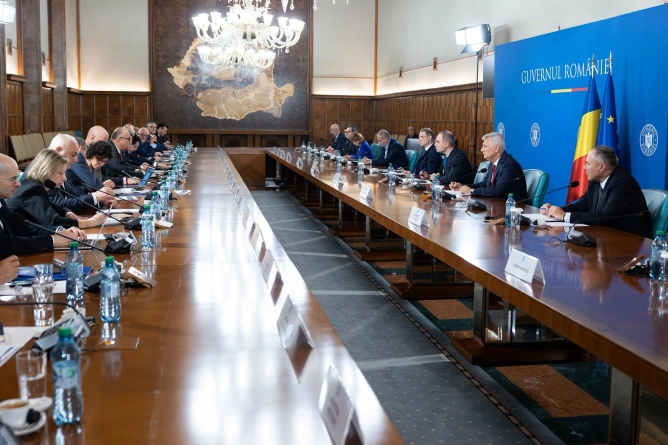
The strongest political subject in which Romania appears is presented in an analysis by RIA Novosti about the collapse of the government in Bucharest and the possible consequences for Ukraine, presented under the idea of a "stab in the back" for Kiev, which risks losing an ally. The article describes how the Romanian Parliament dismissed the government after the Social Democratic Party (PSD), led by Sorin Grindeanu, broke the governmental alliance and voted together with the "Alliance for the Union of Romanians" (AUR), led by George Simion, an alliance that the text presents as an initially imposed construction by the pressure of the European Union.
The President of Romania, Nicușor Dan, is presented as the actor who initiated consultations for the formation of a new cabinet and who rejected the idea of early elections, insisting on the continuity of pro-Western policies. He states that, after the completion of constitutional procedures, Romania will have a pro-Western government and that the country will overcome this crisis without problems. However, the article explains that there is skepticism in Romania regarding the president's ability to rebuild a viable coalition in a parliament where parties are described as incompatible with each other.
The text emphasizes that the breaking point between political forces was represented by the package of reforms demanded by the European Union, reforms that would have fueled internal conflict and would have been felt as additional pressure on the Romanian political system. Romania is presented as an important ally for Ukraine, and the political instability in Bucharest is interpreted as a potential "stab in the back" for Kiev, in the sense that the eastern flank of support for Ukraine becomes more fragile. Through the title and the selection of translated quotes, the Russian press constructs the image of an insecure and politically fractured Romania, used as an example of a pro-Western state in decline.
Romanian politicians mentioned directly in this context are Sorin Grindeanu, leader of the PSD, George Simion, leader of the AUR, and Nicușor Dan, the President of Romania. Their names appear in the context of a coalition presented as artificial, broken under the pressure of European reforms, which reinforces the narrative of a "forced" Romania to follow the line of Brussels. The tone of the text is negative and instrumental, as Romania is used to suggest that the pro-Kiev camp is losing an important actor and that instability is on the side of the ally, not Russia.
The Russian press does not limit itself to technically describing the fall of the Bolojan Government, but transforms it into a symbolic moment, in which Romania appears as a laboratory for a possible political shift, between a regime "imposed by the EU" and the prospect of installing a leader labeled as "pro-Russian." The publication Komsomolskaia Pravda explicitly opens the discussion with the question "Has the Romanian government collapsed? Is a pro-Russian politician next?" in a text that links the motion of censure not only to the internal games in Bucharest but especially to the cancellation of the 2024 elections and the removal from the race of figures considered "unwelcome" by Brussels, such as Călin Georgescu.
The analysis insists that the power system built around Ilie Bolojan would have been "planted" in Bucharest by the European Union, "with evident violations of democratic principles," precisely because Romania is an essential corridor for military supplies to Kiev, and this would justify, in the logic of Russian commentators, the "sacrifice of democracy" in favor of "politicians loyal to Brussels." In this context, the pro-Kremlin press not only rejoices at the record score of the PSD-AUR motion, presented as a "revenge" of Parliament against a pro-EU executive, but explicitly raises the question of whether the next step will be the installation of a government led by figures like George Simion or Călin Georgescu, a scenario presented with a mix of hope and speculation, against the backdrop of a Romania described as an increasingly unpredictable ally of Ukraine.
Energy Vulnerability: Shutdown of the Cernavodă Nuclear Power Plant
A second important subject is also covered by RIA Novosti, about the temporary shutdown of Romania's only nuclear power plant, located in Cernavodă, which will cease to produce electricity starting May 10. The article notes that the second reactor was already shut down on May 4 due to a transformer failure, and the company Nuclearelectrica announced that repairs will take longer than initially estimated. The text explains that, starting May 10, the first block will enter planned maintenance, according to a schedule approved two years ago, so the plant will completely cease to supply the national grid.
RIA Novosti mentions that Nuclearelectrica confirms the shutdown of the first block "according to the approved shutdown schedule," but without indicating a clear deadline for resuming energy production, which fuels a sense of uncertainty. Although the wording of the news is predominantly neutral and technical, the editorial assembly immediately introduces, in the same text, a reference to the nuclear power plant "Rooppur" in Bangladesh, built based on a Russian project. The material recalls that, at the end of April, the first block reactor of the "Rooppur" plant was loaded with nuclear fuel, at an event attended by Rosatom's head, Alexei Likhachev, and the Minister of Science and Technology of Bangladesh.
This juxtaposition, operated by RIA Novosti, creates an implicit contrast between Romania's energy vulnerability, which is temporarily shutting down its only nuclear power plant, and the progress of the Russian nuclear project in Bangladesh. Romania becomes a counterexample in a narrative suggesting that states dependent on non-Russian energy face setbacks and risks, while Russian projects advance. The overall tone remains apparently neutral, but the comparative subtext imparts a depreciative nuance, in which Romania is associated with vulnerability and energy insecurity.
Romania on the Invisible Front of the War
Another set of materials from RIA Novosti places Romania at the center of narratives related to NATO military activity and clandestine operations against Russian energy infrastructure. An article from the agency about a Swedish reconnaissance plane Gulfstream IV, belonging to the Swedish air force, reports that it was observed over the neutral waters of the Black Sea after taking off from Bucharest. The news mentions that the plane crossed areas controlled by Romanian and Bulgarian air traffic controllers before entering the flight zone over the Black Sea.
RIA Novosti quotes a source from the European Union air traffic services explaining that the aircraft, which can be used for conducting radio-technical reconnaissance missions, took off from Bucharest, passed through areas controlled by Romanian and Bulgarian controllers, and then entered flight over the waters of the Black Sea. The material emphasizes the regularity of these reconnaissance missions and also recalls other NATO aviation flights. Romania is explicitly presented as a departure hub for reconnaissance missions operating in proximity to Russian airspace, which implicitly introduces the idea of an active role for Bucharest in the military surveillance of Russia.
In another material, Gazeta.ru, reiterating information also presented by RIA Novosti, analyzes the book by journalist Bojan Panchevski regarding the sabotage of the Nord Stream and TurkStream pipelines, and Romania appears in the context of an operation attributed to Ukraine. The article explains that Ukraine would not have succeeded in simultaneously sabotaging TurkStream and Nord Stream due to planning errors. The news shows that the crew of the yacht "Santa-Lucia," which the Ukrainians rented in Romania, failed in the end due to poor planning and, more seriously, apparently confused the TurkStream pipelines with a smaller pipeline that supplies three gas fields off the coast of Bulgaria, near the border with Romania.
In this case, Romania appears indirectly, by the fact that the yacht used in the alleged operation was rented from Romanian territory and by referring to the pipelines near the border with Romania. The country is part of the logistical infrastructure used by Russia's adversaries, even if it is not directly accused of involvement in sabotage. The tone is negative through the associations it makes between Ukraine, the saboteurs of Russian infrastructure, and Romanian territory, which contributes to shaping an image of a state placed on the axis of anti-Russian operations.
Romanian Football
The Russian sports press has repeatedly mentioned Romania in the last two weeks, and these references have generally had a neutral or positive tone. In football, an article from RIA Novosti reports the spectacular goal scored by 19-year-old left-back Alin Țăruș in the match between Sepsi and Steaua, in the Romanian League 2.
Another material, published by RIA Novosti Sport, recalls the final of the European Champions Cup in 1986, when Steaua Bucharest defeated Barcelona in Seville. The article emphasizes that, four decades ago, the Barcelona players failed to score either in 120 minutes or in the penalty shootout, in front of the Romanian goalkeeper Helmut Duckadam, who saved all four penalties. The text describes Romania in the 1980s as a poor socialist country, whose supporters could not easily afford to travel to Seville, but which produced a performance considered one of the biggest surprises in the history of the competition.
The Romanian Language in the Republic of Moldova
Another article, with a pronounced political profile, published by RIA Novosti, addresses the legislative changes in the Republic of Moldova regarding the status of the Russian language in Parliament. The text explains that deputies in Chișinău adopted in the first reading a code that eliminates the obligation to translate normative acts into Russian and prohibits parliamentary debates in Russian, establishing that the official language in Parliament will be Romanian. The wording in the text is clear: the official language of Parliament will become Romanian, which means the marginalization of the use of the Russian language in the legislative body.
The RIA Novosti material quotes Marina Tauber, a former deputy in the Moldovan Parliament, who qualifies this change as "segregation on political and cultural grounds." In the same context, the article mentions the campaign of the authorities in Chișinău to block certain media outlets, pressures on the Russian Orthodox Church, and controversies related to the memory of World War II. Romania, as a state, is not the main subject of the news, but "the Romanian language" is associated with an initiative presented as discriminatory against the Russian-speaking community.
The Russian press thus constructs, through the RIA Novosti article, an indirect link between the expansion of the Romanian language space and what it calls "segregation policies" in Moldova. The tone is accentuated negatively, and the Romanian element appears at the center of a narrative about the marginalization of the Russian language in the region and about Chișinău's distancing from "the Russian world."
Economic Themes
In the lifestyle and economic curiosities register, an article reports on the acquisition of the company that manages "Dracula's Castle" in Romania by an American businessman. The title of the news, translated, shows that an American investor has bought the company that manages Dracula's castle in Romania, suggesting international interest in this landmark. The text presents the transaction as a business news story with an emphasis on the international appeal of the Dracula brand and the tourism potential of the area. Romania appears here as a tourist space, and the tone is neutral, focused on the economic dimension of the transaction and the cultural mythology associated with the castle.
In the economic area, a material published by RIA Novosti about the evolution of the number of very wealthy people in the world cites the Knight Frank report "The Wealth Report" and includes Romania in the list of countries with the fastest growth rate of ultra-wealthy individuals. The article indicates that Russia has 8,400 individuals with fortunes over 30 million dollars, a number that is 7% higher than in 2021, while globally, the growth was 29%. The text specifies that the indicator regarding the number of ultra-wealthy individuals has grown the fastest in Poland, Qatar, Turkey, Romania, and Greece, with Romania experiencing a growth of 93%.
Overall Tone in the Russian Press
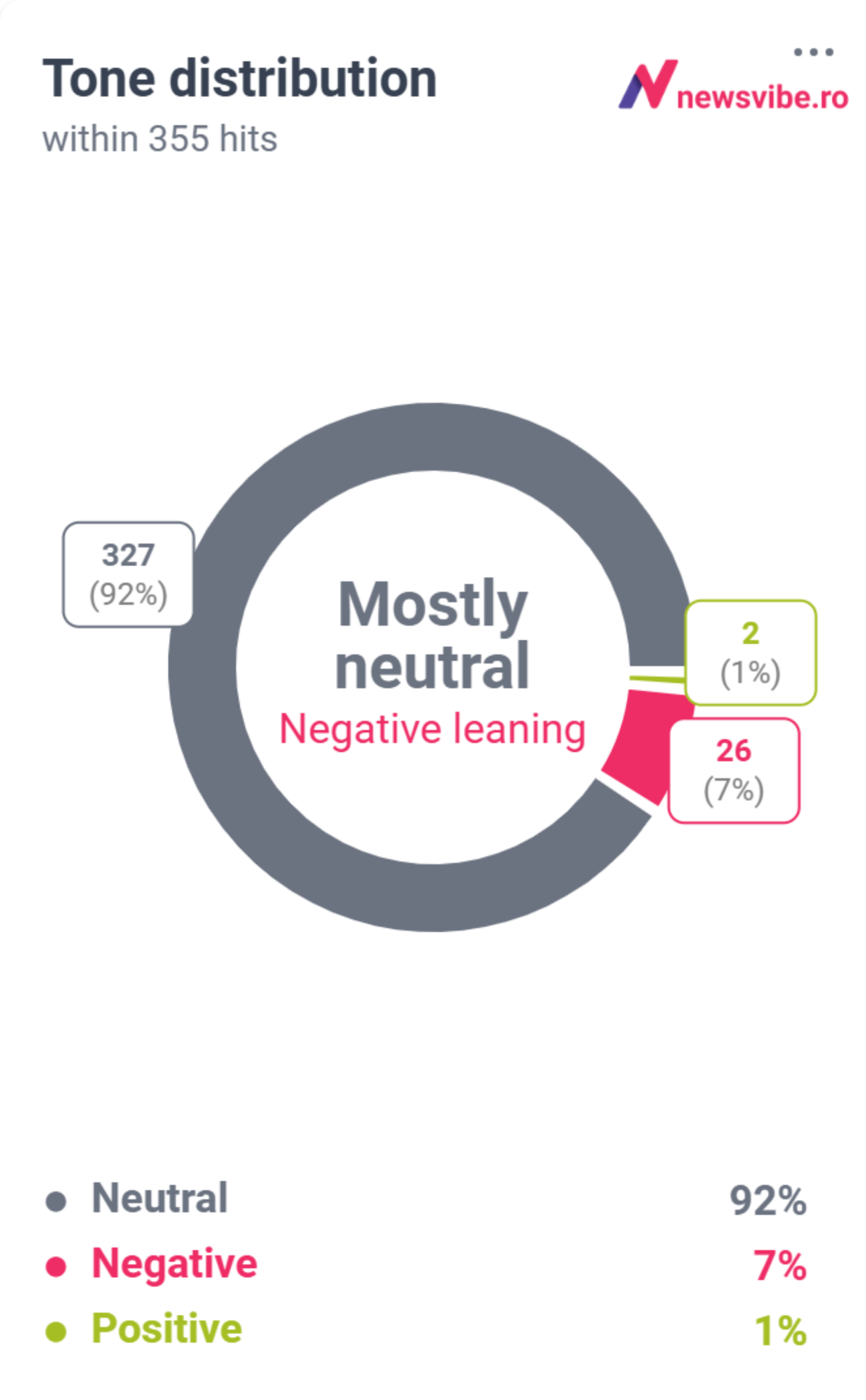
Analyzing the 355 articles published during the period from April 25 to May 8, 2026, several clear features emerge regarding how Romania is represented in the Russian press. Of these, 327 (92%) have a neutral tone, 26 (7%) a negative tone, and 2 (1%) a positive tone.
*****Synthesis made with the help of a data monitoring stream provided by the media monitoring platform NewsVibe Romania. The analysis, data, and images presented have been enhanced with the help of Machine Learning and Artificial Intelligence tools.
Latest News
19:14
19:12
18:53
18:47
18:30
See more news
NEWS ON THE SAME TOPICS


.webp)