ANALYSIS / Brexit, ten years later: the event that rekindled the European dream of the British



Always see our news on Google
A decade after the referendum that took the United Kingdom out of the European Union, the country is counting its losses: economic growth below potential, suffocating bureaucracy for businesses, social fractures, and a weaker geopolitical position than in the pre-Brexit era. Against this backdrop, more and more Britons and voices from the establishment are openly discussing resetting the relationship with Brussels and, in some cases, even reversing Brexit, a complex but not impossible political and legal process.
Why is there increasing discussion about "returning" to the EU?
The new intensity of discussions about returning to the EU is linked to three main factors: growing dissatisfaction with the effects of Brexit, generational change in the electorate, and the strategic reorientation of the Labour government towards Europe.
Recent evaluations in the British press describe Brexit as "an absolute nightmare, total chaos," phrases that reflect the widespread perception that leaving the EU has put the economy at a competitive disadvantage and generated political instability in series.
Polls cited by the European press indicate that a clear majority would prefer, if given the choice, a closer form of relationship with the EU, and re-admission appears as the most popular option in a hypothetical set of scenarios.
The recently resigned Labour Prime Minister, Keir Starmer, promised to "restore ties" and place the United Kingdom "at the center of Europe," marking a change in tone from the conservative governments that treated Brexit as an irreversible ideological project.
Symbolically, London is rediscovering that, in a fragmented and competitive world, market proximity and structural alliances – especially with the EU – matter at least as much as the "sovereignty" regained.
Is there a pro-reversal current? Who supports it, who opposes it?
The pro-reintegration current exists, but it expresses itself in stages: from alignment with the single market and customs union to the frank idea of re-admission.
Supporters
Part of the Labour establishment and local: the Mayor of London, Sadiq Khan, has explicitly called for the cancellation of Brexit, suggesting re-entry into the customs union and single market "during this legislature," followed by pressures for complete return to the EU.
Pro-European civil society, think tanks, and the academic environment document the economic and political costs of Brexit and advocate for strategic re-framing in the EU.
A significant part of public opinion: polls mention over 50% support for the idea of re-admission, under conditions where only a small segment wishes to maintain the current status of a country outside with limited ties.
Opponents
The current Labour leadership, at least at the declarative level: Keir Starmer's spokesperson reiterated that the government does not intend to "cancel Brexit," respecting the promises made in the electoral program.
The conservative parties and nationalist political forces, for whom Brexit remains a symbol of regained sovereignty and control over immigration.
The "Leave hardliners" segment of the electorate, sensitive to the argument that re-admission would mean relinquishing control over legislation, borders, and trade policies.
The current political picture is, therefore, paradoxical: there is an increasingly visible pro-reintegration current in society and at the local level, but the government, although pro-European in tone, hesitates to explicitly assume the goal of reversing Brexit.
The economic, social, and political effects of Brexit on the UK and the EU
Economy: growth below potential and trade barriers
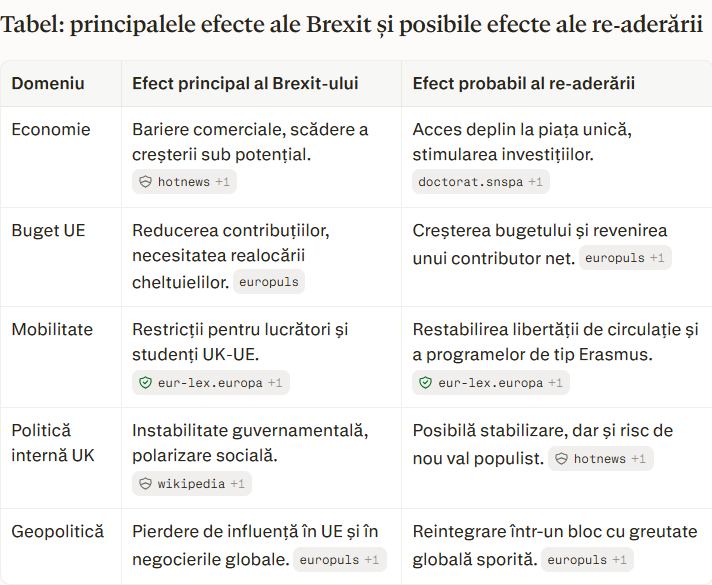
Brexit meant losing automatic access to the single market and customs union, introducing new trade barriers – from customs checks to regulatory divergences – between the UK and the EU.
For the UK, these barriers translated into additional costs for exports and imports, logistical delays, and legal uncertainty for companies.
Economic analyses show a reduction in economic growth compared to "Remain" scenarios, plus the migration of some investments and jobs to the EU space.
For the EU, the loss of the British contribution has reduced the overall budget of the Union and forced reallocations in spending and priorities. At the same time, some continental economies have benefited from the relocation of financial and industrial activities from London.
Social impact: reduced mobility, identity tensions
Brexit has limited the freedom of movement of citizens, directly affecting millions of Britons and Europeans who worked, studied, or lived across the border.
EU citizens in the UK faced new residency procedures, and European students lost easy access to British universities and reduced fees.
Within British society, Brexit has accentuated the lines of demarcation between generations, regions (London vs the rest of England, Scotland vs England), and social classes, fueling a prolonged climate of political polarization.
Political and geopolitical: loss of influence, reconfiguration in the EU
Politically, Brexit triggered a period of instability: rapid changes of leaders (from Cameron to May, Johnson, Truss, Sunak, until recently Starmer and now Andy Burnham), parliamentary crises, and open conflicts between the "hard" and "soft Brexit" camps.
For the EU, the UK's exit meant:
Elimination of a major actor, traditionally pro-free trade, from the internal balance game, allowing other states – especially France and Germany – to consolidate their influence.
The need to build a new framework of relations with a "third state" strategic, materialized in the Withdrawal Agreement and the Trade and Cooperation Agreement.
How could the reversal of Brexit be technically achieved? Reversing Brexit is not a simple "undo," but a re-admission process, based on Article 49 of the Treaty on European Union.
The steps, in a realistic scenario, would look like this:
Triggering the internal political process in the UK
Government decision to pursue re-admission or, most likely, to organize a new referendum with a clear question regarding returning to the EU.
Firm parliamentary mandate for negotiations, to avoid ambiguities that marked the negotiation of the Withdrawal Agreement.
Official application for membership
The United Kingdom would address a formal request for membership to the European Council, invoking Article 49 TFEU.
The EU would need to accept, unanimously, the opening of negotiations, assessing the political, economic, and legal compatibility of the UK with the acquis communautaire.
Negotiating the conditions of re-admission
Although the UK was a member for 47 years, the exit changed the power relations; re-admission would not guarantee the automatic recovery of the old opt-outs (for example, non-participation in the euro or certain policies).
Budgetary contribution, position in institutions, possible transition periods, and how to integrate existing post-Brexit agreements would be discussed.
Ratification and implementation
The accession agreement would need to be ratified by all member states and the European Parliament.
Internally, the UK would need to adapt national legislation to the acquis, reintegrate the jurisdiction of the Court of Justice, and reconfigure trade policy, abandoning agreements negotiated as a third state.
An interesting detail is that Starmer's former cabinet has already experienced a "dynamic alignment" with the single market rules through secondary legislation – using the so-called "Henry VIII powers" – which would technically ease subsequent reintegration. The closer British regulations are to European ones, the shorter the legal process of re-admission would be.
What consequences would a re-admission scenario have?
A potential "reverse Brexit" would have profound effects, both for the UK and for the EU.
For Great Britain
Economic relaunch through access to the single market: British companies would regain barrier-free access to the largest trading bloc in the world, reducing costs and stimulating investments.
Reconfiguration of sovereignty: the UK would have to accept again the direct application of part of European legislation and the role of the CJEU, relinquishing some of the freedom gained through Brexit.
Partial healing of social fractures: for the "Remain" camp, re-admission would be a repair of a "historic wrong"; for the "Leave" camp, it could be perceived as a betrayal, generating a new wave of populism.
For the European Union
Recovery of a major actor: the return of the UK would strengthen the EU's capacity in areas such as security, defense, intelligence, and finance, especially in the context of global tensions and wars on the periphery of Europe.
Internal rebalancing: a new member with a liberal-economic profile would rebalance the power relations against the Franco-German axis, but would again bring into discussion institutional reforms and questions about federalization.
Ambivalent political message: on one hand, re-admission would demonstrate the "magnetism" of the European project; on the other hand, it would validate the idea that exit is not definitive, which could encourage other states to use the exit threat as a negotiation tool.
Implicit conclusion
The return of Great Britain to the EU is no longer a fanciful scenario, but a credible debate horizon fueled by the tangible costs of Brexit and the changing climate in British society. However, the road from dissatisfaction to re-admission goes through difficult steps: rebuilding internal consensus, complicated political negotiations with Brussels, and managing the consequences for a democracy that has already been, once, split in two on this issue.
Analysis conducted with the support of Perplexity
Latest News
23:04
22:36
22:16
22:01
21:44
See more news
NEWS ON THE SAME TOPICS
.webp)