ANALYSIS How Russian mass media distorts the crash of a Russian drone on a building in Galați



Always see our news on Google
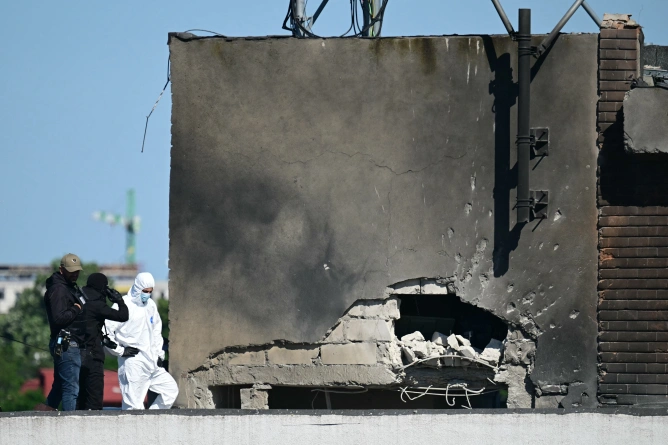
On the night of May 29, 2026, an unmanned aerial vehicle struck the roof of an apartment building in Galați, injuring two people and triggering a diplomatic crisis between Bucharest and Moscow. The incident immediately rose to the top of the Russian media agenda, where it received extensive coverage, largely politically oriented. An analysis of the main publications and news agencies in Russia reveals two dominant editorial directions: constructing a narrative that questions the origin of the drone and presenting Romania's and the West's reaction as exaggerated, unfounded, and politically instrumentalized.
The publication URA.RU uses an explicit headline: "In Romania, an unmanned aerial vehicle collided with an apartment building: the government urgently buys missiles." In the text, the site specifies that, according to the Romanian Ministry of Defense, in the city of Galați, which is located about 20 kilometers from the border with Ukraine, an unmanned aerial vehicle collided with an apartment building, resulting in two injuries. The Ministry of Defense is quoted explaining that the drone was detected using radar systems, the alarm was raised, aviation was scrambled, but preventing the continuation of the flight was no longer possible, allowing the aircraft to strike the roof of the building.
The TASS agency publishes two materials about the incident. The first is a short breaking news item taken from the Romanian agency Mediafax, titled "Mediafax: In Romania, an unmanned aerial vehicle crashed into an apartment building," which appeared at 07:07. The second is a more extensive article published at 09:46, titled "Two injured. What is known about the crash of the unmanned aerial vehicle on an apartment building in Romania," whose subtitle is significant: "The Ministry of Defense of the country did not specify the origin of the unmanned aerial vehicle." In the body of the text, TASS writes that "an unmanned aerial vehicle, whose origin is unclear, struck the roof of an apartment building in the city of Galați on the night of May 29, as reported by the Romanian Ministry of Defense," adding that "the Ministry of Defense of Romania did not specify the origin of the unmanned aerial vehicle." This deliberate phrasing, in which TASS emphasizes the absence of an official attribution from the Ministry of National Defense, ignoring statements from the Ministry of Foreign Affairs and Minister Radu Miruță, who had already confirmed the Russian origin, contrasts sharply with the official positions of Bucharest and represents a clear example of how the Russian state agency constructs a narrative of ambiguity where Romanian authorities have already spoken of certainties.
Bucharest's Reaction in the Mirror of the Russian Press
Gazeta.ru publishes an article titled "The Romanian Ministry of Foreign Affairs summoned the Russian ambassador Lipayev after the incident with the crash of the unmanned aerial vehicle," in which the emphasis is placed on Romania's diplomatic reaction. The newspaper notes that, in the city of Galați, the unmanned aerial vehicle fell on the roof of an apartment building, injuring two people, and emphasizes that Romanian authorities "rushed" to accuse Russia for what happened. According to Gazeta.ru's report, the Romanian side claims that the drone was flying towards Ukraine to carry out strikes, and Bucharest announced that it would take diplomatic measures against Moscow. The publication mentions that the Russian Ministry of Defense has not yet officially commented on the incident, but points out that in the State Duma, questions have been raised regarding the Romanian version.
Vesti.ru and the Rossia 1 channel's website insist on the diplomatic component and report that the Romanian Ministry of Foreign Affairs summoned the Russian ambassador to Bucharest, Vladimir Lipaev, regarding the incident in Galați. In these materials, Foreign Minister Oana Ţoiu is quoted, stating on social media that the Ministry of Foreign Affairs received confirmation from the Ministry of Defense that the unmanned aerial vehicle that struck the apartment building in Galați was of Russian origin. Russian sites also mention that the Romanian minister explained to the ambassador what the consequences of the Russian party's irresponsibility would be on bilateral diplomatic relations and that she discussed with the head of European diplomacy about accelerating a new package of sanctions against Russia.
Lenta.ru and URA.RU emphasize how the incident is followed by political and military measures in Romania. URA.RU writes that the President of Romania, Nicușor Dan, convened a meeting of the Supreme Council for National Defense and that Romania is preparing to sign an agreement regarding the acquisition of new air defense systems. In the same news item, it is reported that a second unidentified unmanned aerial vehicle was found in the north of the country and that the Romanian Ministry of Foreign Affairs summoned the Russian ambassador to Bucharest. URA.RU adds that, according to repeated statements from the Kremlin, numerous European politicians accuse Russia without presenting evidence regarding the "strange incidents with unmanned aerial vehicles."
Coverage of Reactions from European Leaders
RIA Novosti, URA.RU, and Gazeta.ru pay special attention to the reactions of leaders from Slovakia and Hungary. RIA Novosti notes that the Prime Minister of Slovakia, Robert Fico, after the drone incident in Romania, called for the immediate opening of dialogue between the European Union and Russia. The agency reproduces his message in which he expresses solidarity with the Romanian government, urges restraint in statements, and calls for the urgent resumption of dialogue between the EU and Russia, emphasizing that such incidents can lead to an escalation that Europe will not be able to manage. URA.RU publishes the article "In Europe, an alarm has been sounded due to the unmanned aerial vehicle in Romania and an immediate discussion with Russia has been requested," highlighting that Fico directly links the incident to the need for a change in the European approach towards Moscow.
Lenta.ru and URA.RU also present Viktor Orbán's reaction. Lenta.ru notes that the former Prime Minister of Hungary addressed the new government led by Peter Magyar with a call to maintain neutrality in the conflict in Ukraine, using the incident in Galați as a pretext. Orbán expressed his compassion for the victims of the drone attack on Romania and stated that this incident confirms that the war poses a direct threat to neighboring countries, which is why he urges the Hungarian government not to take any steps towards a "pro-war Europe."
Rossiiskaia Gazeta and Aif.ru also report on Prime Minister Peter Magyar's message, who, in a post on X, emphasizes that the unity of Europe and NATO is more important than ever, condemning any attack that threatens civilian populations and violates the territory and airspace of a sovereign state, a member of the EU and NATO. In these materials, it is also mentioned that Magyar accused Russia of the incident without presenting evidence, but called for a complete and thorough investigation, which is still ongoing.
The publication Kommersant notes that NATO countries are discussing the nighttime strike with the unmanned aerial vehicle on the apartment building in Romania, information attributed to the President of Finland, Alexander Stubb, who wrote about it on social media without providing further details. The newspaper then quotes NATO Secretary General Mark Rutte, who states that the Alliance is ready to defend "every inch of allied territory" and asserts that "Russia's reckless behavior poses a danger to all of us."
InoSMI, the Russian platform that monitors and comments on foreign press, picks up a post from Ursula von der Leyen and comments on it in a text with an ironic tone. In the quote attributed to the President of the European Commission, she states that, following the attack with an unmanned aerial vehicle in a densely populated area of Romania, civilians suffered on the territory of the European Union, expressing full solidarity with Romania and the Romanian people and promising continued strengthening of security, especially at the EU's eastern border. InoSMI summarizes the European leader's reaction with the phrase "Russia has crossed yet another red line" and parallels it with hostile or ironic comments from Western social media, suggesting that the discourse from Brussels is marked by hysteria and Russophobia.
Moscow's Counter-Narrative
Lenta.ru and Gazeta.ru develop the Russian counter-narrative in several materials published throughout the day on May 29, 2026. Both publications give central space to statements from deputies in the State Duma, who contest the accusations made by Romanian authorities. Lenta.ru publishes the text "In Russia, a response was given to Romania's accusations regarding the drone crash on an apartment building," where Andrei Kolesnik, a member of the Defense Committee of the Duma, is quoted. The site notes that, in his opinion, the accusations from the Romanian Ministry of Foreign Affairs, made after the unmanned aerial vehicle crashed on a building in Galați, represent "a challenge without evidence." Kolesnik states that "no one bothers to provide evidence that a Russian aircraft fell in Romania" and argues that, in Western countries, "the presumption of innocence has long been absent." He laments that the West could "hit its own head against the wall" and then declare that "the spirit of Russia" is to blame, considering the episode in Galați a new attempt to create a frightening image of Russia to be used later for political gain.
Gazeta.ru also published the material "We will take proportional measures. Romania accused Russia of the drone crash on the roof of a building in Galați," in which the Russian counter-narrative takes on a high-ranking military voice. The newspaper quotes Lieutenant General Viktor Sobolev, a member of the State Duma Defense Committee, who directly tells the editorial office: "We have already seen repeatedly how EU countries use the subject of unmanned aerial vehicles for provocations against Russia. I am convinced that the story that took place in Romania is exactly the same type of provocation." Sobolev further adds, explicitly contesting the accusations from Bucharest: "I am not at all sure that it was a Russian unmanned aerial vehicle. They should present evidence first, and only then make accusations."
Taken together, these materials show that the incident in Galați quickly rose to the top of the Russian media agenda, reappearing in the streams of RIA Novosti, Lenta.ru, Gazeta.ru, URA.RU, Kommersant, Rossiiskaia Gazeta, Aif.ru, and InoSMI. The overall tone is tense and, in many cases, critical of the Romanian authorities, who are presented either as exaggerating and accusing Russia "without evidence," or as part of a broader Western front of "demonization" of Moscow.
*****Synthesis made with the help of a data monitoring stream provided by the media monitoring platform NewsVibe Romania. The analysis, data, and images presented have been enhanced with the help of Machine Learning and Artificial Intelligence tools.
Latest News
17:42
17:41
17:36
17:27
17:26
See more news