Von der Leyen supports protecting energy infrastructure and food supplies in the war in Ukraine, while the EU prepares new military aid



Always see our news on Google
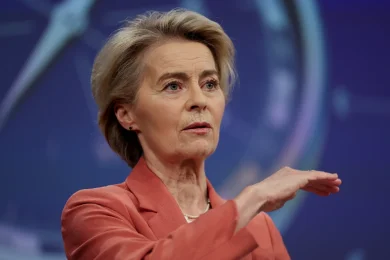
European Commission President Ursula von der Leyen announced support for Ukrainian President Volodymyr Zelenskyy’s proposal to protect energy infrastructure in Ukraine and Russia, as well as global food supplies, from further attacks, following a conversation between the two on October 11. The message comes alongside preparations for new European support for drones and missiles and the prospect of another step in Ukraine’s EU accession negotiations.
However, the statements do not confirm that an energy truce has already been agreed and implemented. Zelenskyy says Ukraine is prepared to refrain from striking Russian energy infrastructure and expects reciprocity, as well as clearer information about discussions between the United States and Russia. The available sources therefore describe a proposal and political willingness, not a verified agreement on the ground.
In short, Ursula von der Leyen endorsed Volodymyr Zelenskyy’s call for a halt to strikes that would protect global food supplies and energy infrastructure in Ukraine and Russia. The Commission says the EU will provide additional funding during the week for drones and missiles intended to defend Ukraine, without specifying the amount in its October 11 statement. The Ukrainian presidency separately says the support amounts to approximately EUR 3 billion in military aid. The figure remains attributed to the Ukrainian side until the mechanism and payment are confirmed by the EU. Von der Leyen also announced the prospect of opening two new clusters in the accession negotiations. Their opening has not yet been presented as a finalized legal decision. Support for Ukraine, funding and enlargement will return to the agenda of European leaders at the European Council on October 15–16.
The wording used by von der Leyen concerns two categories of infrastructure with a direct civilian and economic impact. In the case of energy, halting attacks would limit the risk of disruptions to electricity, heating and other essential services. In the case of food supplies, the stakes extend beyond Ukrainian territory, since the operation of transport, storage and infrastructure needed for exports affects markets and consumers outside the war zone.
However, the proposal does not represent a general ceasefire. Von der Leyen refers to a cessation that would protect food supplies and energy infrastructure, while Zelenskyy says Ukraine is prepared not to strike Russian energy infrastructure if there is reciprocity. Neither the Commission’s statement nor the official Ukrainian messages reviewed describes an agreed verification mechanism, an effective date or obligations accepted by all parties.
Zelenskyy linked this willingness to ongoing discussions between Washington and Moscow and said he was awaiting clearer details. At the same time, the Ukrainian side continues to report Russian attacks, meaning that political statements about protecting infrastructure cannot be turned into a claim that strikes have already stopped.
In parallel, the EU is preparing to continue its military support. Von der Leyen said the Union would provide additional funding during the week for drones and missiles intended to strengthen Ukraine’s defenses and protect its airspace. The Commission’s statement does not specify the value of this support or the exact mechanism through which it will be provided.
The Ukrainian presidency provides additional information, saying that during the conversation Zelenskyy thanked von der Leyen for confirming approximately EUR 3 billion in military support for the following week. This figure must be retained with its exact attribution. Until a decision, financial statement or payment from the EU is published, the amount cannot be presented as a tranche that has already been transferred.
The distinction is also important to avoid duplicating previously announced funding. The EU has previously made payments for Ukraine’s defense, including drones and missiles, and 2EU has already reported on a EUR 1.24 billion tranche and preparations for funding for 2027. These amounts do not become new funding merely because they are mentioned again in the political discussion on October 11.
The broader financial instrument is the Ukraine Support Loan, which the Commission describes as having a capacity of EUR 90 billion for 2026–2027. Of this amount, EUR 60 billion is earmarked for defense and EUR 30 billion for budgetary support. The two components serve different functions: one finances defense capabilities and products, while the other contributes to the operation of the Ukrainian state.
On September 18, the Commission announced a separate EUR 3.3 billion payment for defense, including drones and missiles. That tranche is a previous operation and must not be confused with the additional support announced on October 11. The similarity between the amounts does not mean that they refer to the same payment or that the value of the earlier tranche can automatically be applied to the new announcement.
The von der Leyen–Zelenskyy conversation also covered Ukraine’s negotiations to join the European Union. The Commission president says that two new clusters of chapters are expected to be opened. The statement does not identify them and does not present this development as having already been formalized through an accession conference.
Ukraine’s negotiations were officially opened in June 2024. In the accession process, chapters covering European legislation and policies are grouped into clusters, and opening a cluster allows the process to move to a more advanced stage of negotiation, reform and assessment. It does not mean that the relevant chapters have been closed, nor does it automatically indicate a specific accession date.
In 2026, the Council documented the opening of Cluster 1, dedicated to the fundamentals of the accession process, and Cluster 6, concerning external relations. Von der Leyen’s announcement indicates an intention to advance the process with two additional groups of chapters, but the next formal step requires the procedures specific to accession negotiations and the necessary agreements at the level of the member states.
The three components of the conversation—protecting civilian infrastructure, financing defense and advancing accession—will return to the European discussion in the coming days. Von der Leyen said Ukraine would occupy a central place at the European Council on October 15–16, where leaders are expected to discuss funding needs for the following year and ways to mobilize additional international support.
The meeting has not yet taken place, and its agenda must not be confused with the decisions that will result from it. It nevertheless provides the next test for the October 11 announcements: whether support for protecting energy infrastructure will receive a more precise diplomatic form, whether additional funding for Ukraine’s defense will be confirmed with an amount and mechanism, and whether the two accession clusters will move from political intention to a formal stage of the negotiations.

Latest News
19:46
19:46
19:28
19:26
19:18
See more news
NEWS ON THE SAME TOPICS
.webp)