The European Commission demands Bulgaria to implement anti-corruption reforms for the release of suspended funds.



Always see our news on Google
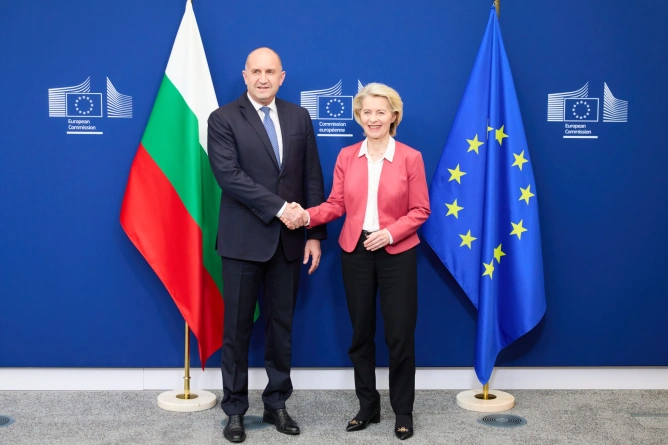
Ursula von der Leyen said, after meeting with Bulgarian Prime Minister Rumen Radev, that Bulgaria has made progress in unlocking nearly 370 million euros from suspended funds, but must maintain the pace of reforms, especially in combating corruption. The European Commission also indicated 1.2 billion euros for investments in clean energy and 3.2 billion euros available through the SAFE instrument for defense.
The European Commission calls on Bulgaria to continue anti-corruption reforms to unlock suspended European funds and to timely utilize the resources available through the Recovery and Resilience Plan.
European Commission President Ursula von der Leyen said on Thursday, after meeting with Bulgarian Prime Minister Rumen Radev in Brussels, that Sofia has made progress in two reforms considered essential: the establishment of an independent anti-corruption commission and the reorganization of the prosecutor general's office. Together, these reforms would allow the unlocking of nearly 370 million euros from suspended funds for Bulgaria.
In short
Ursula von der Leyen says that Bulgaria has already received nearly 3.3 billion euros through NextGenerationEU, but must maintain the pace of reforms before the deadline in August 2026.
The European Commission believes that anti-corruption reforms can unlock nearly 370 million euros from suspended funds.
Rumen Radev says that the Recovery and Resilience Plan is not just a source of funding, but a tool for substantial reforms.
Bulgaria wants to use European and national funds for clean energy projects, including a large pumped hydroelectric power plant for energy storage.
Sofia wants to fully utilize the SAFE instrument to enhance defense capabilities, and the Commission says Bulgaria can access over 3.2 billion euros.
Ursula von der Leyen said that Bulgaria has had an important year, including the transition to the euro, which would benefit citizens and companies through simpler payments and travel and better access to the single market. She stated that two out of three Bulgarians believe that the transition to the euro has been "smooth and efficient".
In the area of European funds, the Commission's message was direct: Bulgaria has already received nearly 3.3 billion euros through the NextGenerationEU program, but must fulfill outstanding reforms before the deadline in August 2026. Von der Leyen said the goal is to unlock resources by then.
The most important political condition remains the fight against corruption. The Commission President welcomed progress regarding the anti-corruption commission but insisted that the institution must be able to act independently. She also mentioned the reorganization of the prosecutor general's office, aimed at strengthening the capacity to investigate corruption cases.
Rumen Radev tried to present the new Bulgarian government as a stable and reform-oriented partner. He said that Bulgaria has gone through five years of political instability, with governance and rule of law issues that have prevented the full use of the country's potential. According to the Prime Minister, Sofia now has a "stable, reform-oriented" government, with an agenda for budget stabilization, sustainable economic growth, strengthening the rule of law, and combating corruption.
The Bulgarian Prime Minister said that the Recovery and Resilience Plan is not viewed by Sofia merely as a source of money, but as a tool for reforms. Radev acknowledged that Bulgaria has accumulated delays in the last three years but stated that the government has the ambition to catch up and meet all deadlines by the end of August.
He stated that the legislative acts regarding the anti-corruption commission and the prosecutor general have already been adopted in the first reading in the Bulgarian Parliament. Radev presented the unlocking of the first tranche of funds as an important contribution to Bulgaria's budget and benefits for citizens.
Energy was the second major topic of the meeting. Von der Leyen said that the reform of the Bulgarian energy system aims to strengthen the profitable share of the state energy holding, especially the component that produces clean energy. The European Commission is expected to support Bulgaria and the region through the Just Transition Fund, and there is a plan for a total of 1.2 billion euros for investments in clean energy.
Radev said that the Bulgarian energy system plays an important role for the stability of the entire Southeast European region. He linked the energy transition to the creation of new industrial zones and jobs but also insisted on competitiveness. The Bulgarian Prime Minister stated that the European emissions trading system must provide a certain degree of flexibility to protect competitiveness during a difficult period for European energy.
A project explicitly mentioned by Radev is a large pumped hydroelectric power plant, presented as a green energy storage project with regional impact. The Prime Minister said that after the Commission's commitment to finalize the environmental file, Bulgaria can advance using European and national funds for the construction of this infrastructure.
The discussion also addressed the future multiannual budget of the European Union. Von der Leyen said that the EU needs a modern and flexible budget that supports regions, farmers, and the security of citizens, and a comprehensive agreement on the multiannual financial framework must be reached before the end of the year. Radev said that the future budget must find a balance between investments in defense, security, and competitiveness and maintaining cohesion and agricultural policies, which he called pillars of European unity.
Defense was another central point. Von der Leyen said that threats at the eastern border, from air alerts to Russia's hybrid attacks, test Europe as a whole, and Bulgaria has an important role in collective defense, including in the Eastern Flank Watch initiative. The Commission is ready to sign the loan agreement with Bulgaria through SAFE at any time, an instrument through which Sofia could receive over 3.2 billion euros.
Radev said that Bulgaria will fully utilize the SAFE instrument as a mechanism for enhancing defense capabilities. He presented Bulgaria's security as part of European security and stated that Sofia has the responsibility to contribute to regional and European defense.
The meeting also included discussions about Ukraine and the Middle East. Von der Leyen said that both parties share a commitment to a diplomatic and sustainable solution in the Middle East, and regarding Ukraine, she placed the discussion in the context of Russia's aggression war and the security challenges at the Union's borders.
Bulgaria is at a politically important moment after a long period of instability. Rumen Radev tried to convey to Brussels that the new government can provide administrative stability, reforms, and European predictability. For the Commission, the immediate test is whether Sofia can turn commitments regarding the rule of law, anti-corruption, energy, and defense into concrete decisions before the established deadlines.
For the European Union, the Bulgarian file focuses on several themes at the center of the European agenda: conditioning funds on reforms, energy transition, competitiveness, defense of the eastern flank, and the future multiannual budget. Therefore, the meeting was not only bilateral but also a signal of how the Commission wants to combine financial support with clear political and institutional requirements.
Latest News
07:35
22:52
22:34
22:28
21:56
See more news
NEWS ON THE SAME TOPICS