The EU sanctions 16 individuals and seven entities for the deportation of Ukrainian children to Russia.



Always see our news on Google
The EU Council has adopted new sanctions against actors involved in the deportation, forced transfer, assimilation, and militarization of Ukrainian children, on the same day as the international meeting dedicated to their return to Ukraine.
The Council of the European Union has sanctioned 16 individuals and seven entities involved in the deportation, forced transfer, assimilation, and militarization of Ukrainian children taken to Russia or to temporarily occupied territories.
In short
The EU Council has adopted sanctions against 16 individuals and seven entities involved in the deportation and forced transfer of Ukrainian children.
The measures target actors responsible for forced assimilation, indoctrination, militarized education, illegal adoptions, and the relocation of children to Russia or within occupied territories.
The EU estimates that Russia has deported or forcibly transferred nearly 20,500 Ukrainian children since the beginning of the aggression war.
The sanctioned individuals and entities are subject to asset freezes, and EU citizens and companies are prohibited from making funds or economic resources available to them.
Eight countries, including Albania, Moldova, Norway, and Ukraine, have separately aligned with a Council decision regarding sanctions against individuals involved in the atrocities in Bucha.
The Council of the European Union adopted new restrictive measures on Monday against 16 individuals and seven entities responsible for actions that undermine or threaten the territorial integrity, sovereignty, and independence of Ukraine.
The decision targets individuals and structures involved in systematic illegal deportation, forced transfer, forced assimilation, indoctrination, and militarized education of Ukrainian minors. The Council also includes illegal adoptions and the relocation of children to the Russian Federation or within temporarily occupied Ukrainian territories in the same category.
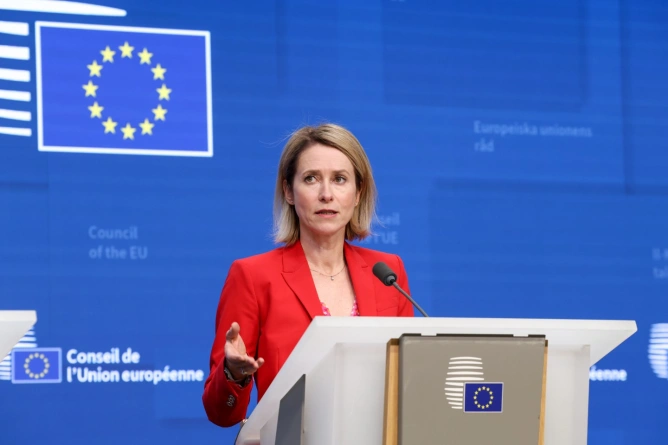
The measures were adopted on the day of the high-level meeting of the International Coalition for the Return of Ukrainian Children. On the same day, the EU High Representative, Kaja Kallas, announced before the Foreign Affairs Council that ministers were to advance sanctions against individuals involved in the management of deported Ukrainian children.
"We will also advance with sanctions targeting those individuals who assist in working with the Ukrainian children they have deported from Ukraine," Kallas said upon arriving at the foreign ministers' meeting.
The Council states that since the beginning of Russia's aggression war against Ukraine, Russia has allegedly deported and forcibly transferred nearly 20,500 Ukrainian children. According to the Council, these actions constitute serious violations of international law and fundamental children's rights and aim to erase Ukrainian identity and affect future generations of Ukraine.
The sanctioned entities include federal state institutions linked to the Ministry of Education of Russia, such as the children's centers Orlyonok, Scarlet Sails, and Smena. The Council states that these organize, in coordination with the occupying authorities, programs for Ukrainian children in which minors are subjected to pro-Russian indoctrination, including through patriotic events, ideological education, and military-oriented activities.
Other listed entities host Ukrainian minors transferred from the occupied territories of Ukraine and expose them to programs aligned with the policies of the Russian state, including political indoctrination and activities compatible with educational frameworks designed for basic military training.
The Council mentions DOSAAF Centers in Sevastopol, Nakhimov Naval School, and the military-patriotic club "Patriot" in Crimea as structures involved in the re-education, ideological indoctrination, and militarization of minors, with the aim of cultivating loyalty to Russia and undermining Ukrainian national identity.
The list also includes officials and politicians from territories illegally occupied by Russia, as well as heads of youth camps, military-patriotic clubs, and organizations. According to the Council, they are responsible for promoting patriotic and military education among youth, through ideological indoctrination, exposure to Russian military culture, paramilitary training, and participation in events that glorify Russia's aggression war.
The sanctioned individuals and entities are subject to asset freezes. EU citizens and companies are prohibited from making funds, financial assets, or economic resources available to them. Individuals included on the list are also subject to a travel ban, preventing them from entering or transiting through the territory of the European Union.
Kallas stated that the return of deported children is more difficult than prisoner exchanges, as Ukraine has not deported Russian children that could be exchanged.
"Because Ukraine has not deported Russian children, you cannot really exchange children for children. That is why it is much more difficult," she said.
The High Representative stated that the EU is discussing several options and proposals for negotiations with Russia regarding the return of children and that international support is needed, including from states that have closer relations with Moscow.
In this context, Kallas criticized Russia's proposal for a ceasefire related to the parade in Moscow. She stated that the ceasefire requested by Vladimir Putin was "very cynical" to protect the parade while Russia continues to attack civilians in Ukraine. Kallas noted that Ukraine respected the ceasefire, as it did with other previous proposals for unconditional ceasefires.
Kallas also rejected the idea that Russia could appoint a negotiator on behalf of the European Union. Responding to a proposal regarding former German Chancellor Gerhard Schröder, she stated that he was a high-level lobbyist for Russian state companies.
"I believe that Gerhard Schröder was a high-level lobbyist for Russian state companies. That is why it is clear why Putin wants him as a person, because he would actually sit on both sides of the table," Kallas said.
Separately, the High Representative issued, on behalf of the EU, a statement regarding the alignment of several countries with a Council decision adopted on March 16, 2026. The decision imposes restrictive measures against nine individuals responsible for actions that undermine or threaten the territorial integrity, sovereignty, and independence of Ukraine, particularly due to their involvement in the atrocities in Bucha, classified in the document as crimes against humanity and war crimes.
Albania, Bosnia and Herzegovina, Iceland, Moldova, Montenegro, North Macedonia, Norway, and Ukraine have aligned with this Council decision and will ensure that their national policies comply with it. The European Union has taken note of the commitment of these countries and welcomed it.
The sanctions adopted on Monday are part of the EU's regime of restrictive measures regarding actions that undermine or threaten the territorial integrity, sovereignty, and independence of Ukraine.
In the conclusions of December 19, 2024, the European Council condemned again Russia's aggression war against Ukraine and reaffirmed support for Ukraine's independence, sovereignty, and territorial integrity within its internationally recognized borders.
In the text supported by 25 heads of state or government at the European Council on March 13, 2026, European leaders urgently called on Russia and Belarus to ensure the safe and unconditional return to Ukraine of all Ukrainian children and other deported or illegally transferred civilians.
Latest News
22:52
22:34
22:28
21:56
21:29
See more news
NEWS ON THE SAME TOPICS
.webp)
.webp)