Members of the European Parliament call for lower taxes and a longer transition for the new European tobacco taxation.




Always see our news on Google
The Committee on Economic and Monetary Affairs of the European Parliament has adopted recommendations regarding the revision of European taxation on tobacco and nicotine products, proposing lower increases in excise duties than those required by the European Commission and longer transition periods. The texts cover cigarettes, cigars, rolling tobacco, heated tobacco, liquids for electronic cigarettes, nicotine pouches, and other new products that were not adequately covered by the legislative framework from 2011.
The Committee on Economic and Monetary Affairs of the European Parliament has adopted recommendations regarding the revision of European taxation on tobacco, proposing lower excise duties and longer transition periods than those put forward by the European Commission.
The two texts address the general framework of excise duties for tobacco and related products, as well as the structure and levels of excise duties applied to these products. Both were adopted with 32 votes in favor, 21 against, and 2 abstentions.
In brief
The ECON Committee of the European Parliament recommends more moderate increases in excise duties on tobacco and nicotine products.
For cigarettes, MEPs will maintain the minimum excise duty threshold at 60% of the retail price, rather than increasing it to 63% as proposed by the Commission.
The recommendations include, for the first time, products such as liquids for electronic cigarettes, heated tobacco, and nicotine pouches.
Parliamentarians propose extended transition periods until 2033 or 2034 for several categories of products.
The vote in the plenary session of the European Parliament is expected on June 17, and the Council will then need to adopt the updated rules.
For cigarettes, MEPs accept an increase in excise duties, but at a lower level than that proposed by the European Commission. The European executive proposed that the excise duty should represent at least 63% of the retail price of a pack, compared to the current level of 60%. The ECON Committee recommends maintaining the 60% threshold.
Regarding the minimum amount, MEPs propose that the excise duty should not be less than 200 euros for 1,000 cigarettes, instead of 215 euros as proposed by the Commission. The current level is 94 euros. The changes would apply from January 1, 2028, a deadline retained from the Commission's proposal.
For other tobacco and nicotine products, the recommendations go in the same direction: including more products in the common excise regime, but with lower levels and longer deadlines than those initially provided by the Commission.
In the case of cigars and cigarillos, MEPs propose that by 2034 the excise duty should reach at least 15% of the weighted average selling price or 54 euros for 1,000 pieces or per kilogram. Currently, the levels are 5% or 12 euros, while the Commission had proposed 40% or 143 euros by 2032.
For liquids for electronic cigarettes, where there are currently no harmonized excise duties at the EU level, the recommendation is that by 2033 the excise duty should reach 30% or 0.30 euros per milliliter. The Commission proposed a differentiated system, 20% or 0.12 euros per milliliter for liquids with 0 to 15 mg of nicotine per milliliter and 40% or 0.36 euros per milliliter for liquids with more than 15 mg of nicotine per milliliter, by 2032.
For fine-cut tobacco intended for rolling cigarettes, MEPs recommend that by 2034 the excise duty should reach 55% or 143 euros per kilogram. The current level is 40% or 40 euros, while the Commission proposed 62% or 215 euros by 2032.
For shisha tobacco, where there are currently no harmonized rates, the recommendation is 40% or 80 euros per kilogram by 2034. The Commission proposed 50% and 107 euros by 2032.
For other types of smoking tobacco, MEPs propose 35% or 110 euros per kilogram by 2034, compared to the current level of 20% or 22 euros and compared to the Commission's proposal of 50% or 143 euros by 2032.
Heated tobacco would be taxed by 2034 at 35% or 80 euros for 1,000 pieces or 200 euros per kilogram. Currently, there are no harmonized rates for this category, and the Commission proposed 55% or 108 euros for 1,000 pieces or 155 euros per kilogram by 2032.
For nicotine pouches, another new category, MEPs recommend 28% or 50 euros per kilogram by 2033. The Commission proposed 50% or 143 euros by 2032.
For other nicotine products, the recommendation is 35% or 35 euros per kilogram or 0.25 euros per milliliter by 2033, while the Commission proposed 50% by 2032.
An important element of the revision is the introduction of an indexing mechanism, through which excise duties could be automatically adjusted based on inflation. MEPs support the mechanism but propose that it should not include energy and unprocessed food in the inflation calculation.
The ECON Committee also recommends postponing the application of the indexing mechanism until 2036, instead of 2028, as proposed by the European Commission. Additionally, parliamentarians recommend that the EU rate used to calculate the minimum tax level for a product should not be adjusted by more than 9%.
This part of the file is relevant because inflation has eroded the real effect of excise duties in recent years. The Commission argues that the old framework allowed for large price differences between member states, with incentives for cross-border shopping and distortions in the internal market.
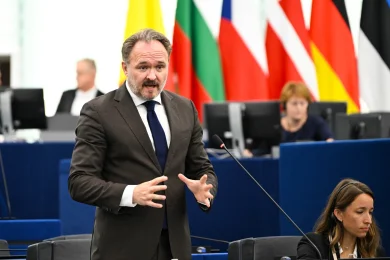
MEPs accept the need for an update but try to slow the pace and scale of increases. Rapporteur Tomáš Kubín, from the Patriots for Europe group, said that his goal was a modern and coherent framework, but realistic, proportional, and applicable.
"My goal was to support a modern and more coherent framework, ensuring at the same time that the rules remain realistic, proportional, and applicable," said Kubín.
The context of the revision is the rapid change in the tobacco and nicotine market. The legal framework from 2011, last revised in 2014, has become outdated as it does not adequately cover alternative products that have massively increased in recent years.
Liquids for electronic cigarettes, heated tobacco, and nicotine pouches either did not exist or had a marginal presence when the old directive was constructed. Because these products did not clearly fall within the definition of manufactured tobacco, member states began to develop different national tax regimes.
This fragmentation has created problems for the internal market and for public health protection. Some products have been taxed differently from one country to another, and large price differences have fueled cross-border shopping and potential incentives for fraud.
The political objective of the revision is to use taxes to reduce smoking rates, especially to prevent vaping or smoking among adolescents. The file is linked to the EU's goal of achieving a "tobacco-free generation" by 2040.
At the same time, the file puts pressure on public health, state budget revenues, tax proportionality, the risk of illegal markets, and differences between products. The position of the ECON Committee tries to maintain the objective of updating, but with differentiated treatment based on product, risk profile, and usage pattern.
Kubín stated that differentiated treatment of products, based on specificities, usage patterns, and risk profiles, is essential. He argued that a more gradual implementation can provide more predictability for national authorities.
"It's not about weakening the Commission's objectives. It's about making the directive functional in practice, protecting public health, ensuring national revenues, reducing incentives for fraud, and ensuring that EU rules are based on proportionality and evidence, not on a one-size-fits-all approach," said the rapporteur.
The next step is the vote in the plenary session of the European Parliament, expected on June 17. After the Parliament's position, the Council will follow to adopt the updated rules.
The legislation will enter into force 20 days after publication. Member states will have until December 31, 2027, to publish the national acts necessary for the application of most provisions.
For the European Union, the file is important as it updates tobacco taxation in a market where nicotine products have diversified rapidly. For member states, the stakes are the balance between tax revenues, combating fraud, protecting health, and avoiding too rapid shocks to the market.
For consumers, the final effect will depend on the position of the Council and the final form of the directive: excise duties will increase, but the institutional debate will decide how quickly, how much, and how differently between cigarettes, vaping, heated tobacco, and nicotine pouches.
Latest News
07:45
07:39
07:27
07:20
22:57
See more news
NEWS ON THE SAME TOPICS

.webp)