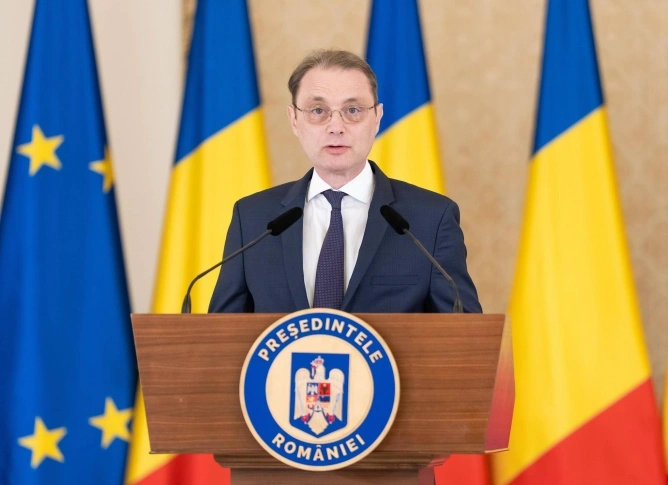
Moldova is gradually extending VAT and excise duties to goods brought in by operators from Transnistria as part of its economic reintegration strategy


.webp)

Always see our news on Google
The Republic of Moldova is gradually applying the national tax regime to goods introduced by economic operators from the Transnistrian region, in a process that should lead to the harmonization of rules by 2030. Prime Minister Vasile Tofan says that taxation is part of a broader economic reintegration strategy and links the resulting revenues to expanding the population’s access to healthcare, social protection, and pensions, although the available documentation does not yet allow verification of the amounts collected or how they were spent.
The Republic of Moldova is gradually extending VAT and excise duties to certain categories of goods brought into the country by economic operators from the Transnistrian region, while the Government presents the process as part of a broader economic reintegration strategy. Prime Minister Vasile Tofan explained in a discussion organized by Bruegel that fiscal alignment must be carried out gradually to avoid destabilization and linked increased taxation to expanding residents’ access to services such as healthcare, social protection, and pensions. However, the tax schedule had been decided before his intervention and provides for successive stages until the regime is harmonized in 2030.
In brief
1. On 1 September 2026, the Republic of Moldova began applying VAT and excise duties to certain non-essential and luxury goods introduced by economic operators from the Transnistrian region.
2. From the beginning of 2027, the regime is to be extended to other categories, including petroleum products, while natural gas and electricity are also covered from April 2027.
3. The Government’s objective is the gradual harmonization of the tax and customs regime by 1 January 2030.
4. Tofan says that taxation is part of the region’s economic reintegration and that the resulting revenues should largely return to the population through public services.
5. The available documentation does not yet show what amounts have actually been collected through the new measures or how much has specifically been directed toward healthcare, social protection, or pensions.
In August, the Government of the Republic of Moldova approved the gradual application of VAT and excise duties to certain categories of goods introduced into the country by economic operators headquartered in the Transnistrian region. The measure seeks to bring the tax and customs regimes on the two banks of the Dniester closer together and gradually eliminate the different treatment applied to companies depending on where they are registered. The authorities justified the gradual pace by the need to give the business community time to adapt and to limit the impact on prices and consumers.
The first stage entered into force on 1 September and concerns certain non-essential and luxury goods. The approved schedule provides for the regime to be extended after 1 January 2027 to other categories, including petroleum products and certain raw materials, and from 1 April 2027 to natural gas and electricity. The stated objective is that by 1 January 2030, operators from the Transnistrian region will operate, for these imports, under a tax regime uniform with that applied to economic agents in the rest of the Republic of Moldova. 2EU-20261005-CJUE-COM_dosar_v03…
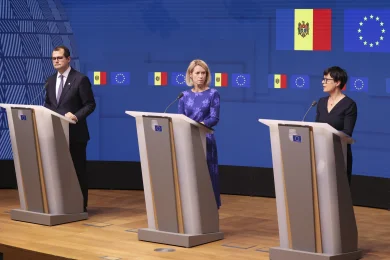
In his intervention at Bruegel, Tofan presented these measures as a component of broader economic integration and emphasized the gradual nature of the process. The Prime Minister said he preferred successive steps to reduce the risk of destabilization and linked taxation to bringing the region’s population and companies closer to the Republic of Moldova’s administrative and financial systems. In the same explanation, he mentioned population documentation, access to bank accounts, and the use of public services as elements of a reintegration advancing through sectoral measures rather than a single decision.
Tofan also linked tax collection to the services provided to the region’s population. According to the transcript of the discussion, the Prime Minister said that expanding taxation enables economic integration “step by step” and that the resulting revenues should largely be returned to people through healthcare, social protection, and pension services. The statement explains the Government’s political rationale, but does not by itself constitute evidence of a budgetary mechanism through which every leu collected in the region is directed toward these services. 2EU-20261005-CJUE-COM_dosar_v03…
The available documentation does not yet contain data from the Customs Service on revenues actually collected after the first stage entered into force, nor an accounting of the amounts subsequently transferred to healthcare, the pension system, or social protection. For this reason, the claim that revenues are returned to the population must be attributed to the Prime Minister and not presented as an already demonstrated financial flow. The same applies to the measure’s concrete effect on companies and consumers, which can be assessed only after tax and commercial data become available.
The tax process is nevertheless concrete and has already begun. The authorities in Chișinău organized information sessions for economic operators from the region and discussed the mechanism in the economy working groups between the two banks. The Government describes the phased implementation as a method by which companies can gradually be brought under the same VAT, excise, and customs-rules framework, without fully and immediately changing the regime at a single moment.
Tax harmonization is also linked to the broader objective of creating a single economic space. For the Moldovan authorities, the existence of different tax treatments for companies operating in the same territory creates competitive distortions and maintains administrative separation. Applying the same rules should, in the Government’s view, reduce these differences and integrate companies from the region more fully into the national tax and customs system.
This economic integration must not, however, be confused with a political settlement of the Transnistrian conflict. The extension of VAT and excise duties, access to public services, and use of the banking system are sectoral measures through which Chișinău is attempting to bring the two banks closer together economically and administratively. They do not in themselves constitute a political settlement of the conflict and do not establish the final conditions for territorial reintegration.
The Government is also working in parallel with the Convergence Fund, created to reduce economic and social differences between the two banks of the Dniester and to support reintegration projects. In the official autumn documentation, the authorities link this instrument to the provision of public services and the reduction of disparities, but the Convergence Fund and the VAT and excise mechanism are distinct instruments. Their inclusion in the same strategy does not mean that all tax revenues collected are automatically transferred to the Fund.
Another component cited by Tofan is the financial integration of residents. The Prime Minister spoke about the use of Moldovan documents, access to bank accounts, and the population’s increasingly strong connection to national services. However, the dossier does not contain sufficient statistical series to turn claims about the scale of these developments into independent percentages, so they must be retained as the Prime Minister’s political explanation rather than as a complete measurement of the degree of reintegration.
The same principle applies to trade relations. Tofan argued that the economy of the Transnistrian region is increasingly linked to the European market, but the current documentation does not provide the comparable trade series needed to establish the exact proportions and their evolution over time. Fiscal reintegration may facilitate alignment with the economic rules applied on the right bank, but its effects on exports, competitiveness, and prices must be assessed separately.
The schedule through 2030 gives the Government room for gradual integration. The stages in September 2026, early 2027, and April 2027 gradually expand the number of categories of goods covered, while the 2030 deadline is presented as the point at which tax treatment should be fully harmonized. This structure allows the authorities to test the impact of successive measures and economic operators to adapt to the new obligations.
For residents, the stake Tofan places at the center of the strategy is that fiscal integration should be accompanied by concrete benefits through services. He argues that paying taxes and integration into the national economic system must be associated with access to healthcare, social protection, and pensions, which would transform taxation from a simple expansion of obligations into a closer relationship with the state. Effective verification of this promise, however, will depend on data concerning revenues collected, beneficiaries’ access, and expenditure incurred.
The novelty of the intervention at Bruegel is therefore not the VAT and excise-duty schedule, which had already been established and communicated in August. The new element is the political explanation offered by the Prime Minister of how the Government sees the link between taxation, services, and economic reintegration. The next step in evaluating this strategy will be the publication of data showing how much the state has collected, what effect the change has had on operators, and the extent to which services for the region’s population have actually been expanded.
Latest News
08:12
08:04
07:54
07:33
07:27
See more news
NEWS ON THE SAME TOPICS