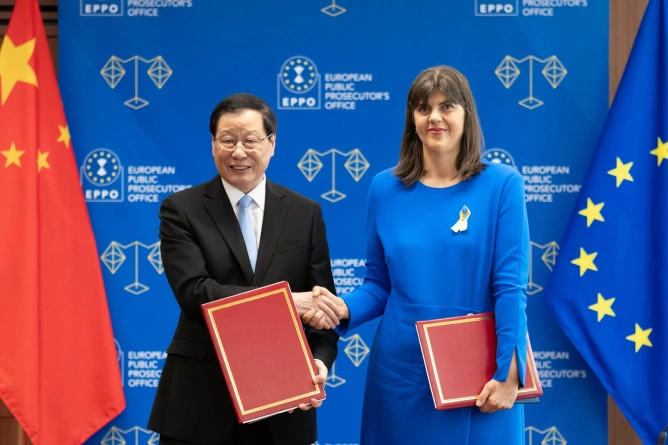
The European Public Prosecutor’s Office, led by Laura Kovesi, and China’s Supreme People’s Procuratorate establish cooperation in cases affecting the EU budget
2eu.brussels


EU
Foto: facebook.com/EUProsecutor

Always see our news on Google
The European Public Prosecutor’s Office and China’s Supreme People’s Procuratorate have established a practical framework for cooperation in investigations into organised crime affecting the European Union’s financial interests, money laundering and corruption. The agreement, signed in Luxembourg by European Chief Prosecutor Laura Kövesi and Ying Yong, the chief prosecutor of the Chinese authority, also includes cooperation to identify and recover criminal assets more efficiently.
In brief, EPPO and China’s Supreme People’s Procuratorate signed a working arrangement on 4 September concerning judicial cooperation between the two authorities. The cooperation focuses in particular on organised crime groups affecting the EU’s financial interests, money laundering and corruption. The recovery of criminal assets is mentioned separately as an area in which the two authorities want to improve the efficiency of cooperation. An action plan for 2026–2028 will be used to develop cooperation practices between EPPO and the Chinese authority. The statement does not announce specific joint investigations and provides no details about cases, individuals or the value of the assets concerned.
The agreement establishes a direct working relationship between the European Public Prosecutor’s Office and the authority that leads China’s prosecution system at a time when investigations into fraud involving European funds and cross-border fraud may involve companies, intermediaries, assets and financial flows located outside the European Union. EPPO states that the cooperation arrangements will operate within the applicable legal framework of each party.
One of the explicitly stated objectives is to combat organised crime groups whose activities harm the EU’s financial interests. EPPO’s mandate covers offences against the Union’s budget, including fraud involving European funds and, under certain conditions, serious cross-border VAT fraud.
The agreement also covers money laundering when it is connected to areas in which the authorities can cooperate. In cross-border financial investigations, the trail of money and assets may extend beyond the jurisdiction where the initial fraud was committed, making cooperation with authorities in countries where relevant accounts, companies or property are located necessary.
Corruption is the third area explicitly identified. The EPPO statement does not describe the types of cases that led to its inclusion, nor does it announce specific investigations in which the European and Chinese authorities are already working together.
Asset recovery receives separate attention in the agreement. The two authorities aim to make cooperation more effective regarding property and funds derived from crime, a stage distinct from merely identifying and prosecuting the individuals involved.
The signing of the agreement does not mean that EPPO receives investigative powers in China or that the Chinese authority acquires powers in the European Union. Each institution will continue to act within the scope of its applicable powers and procedures, while the document sets out how the two parties can cooperate.
The statement does not specify what types of information may be exchanged, what procedures will be used for requests related to evidence or assets, or the response deadlines. These aspects are to be developed through the cooperation practices between the two authorities.
For the 2026–2028 period, EPPO and the Supreme People’s Procuratorate have also agreed on an action plan. Its role is to turn the general agreement into operational cooperation in the identified areas, although the public announcement does not yet provide a list of specific measures or a detailed timetable.
The relationship is relevant to EPPO because offences against the EU’s financial interests may have a commercial and financial dimension that extends beyond the Union’s borders. Cases involving imports, VAT, procurement, European funds or the laundering of proceeds from fraud may require information to be obtained and assets to be located in third-country jurisdictions.
EPPO has already investigated cases in Europe in which the goods, companies or individuals involved had links to China. However, the new agreement should not automatically be interpreted as being connected to any of these cases, since the 4 September statement does not identify a particular investigation as the reason for the cooperation.
The European Public Prosecutor’s Office is an independent EU authority that investigates, prosecutes and brings to trial offences affecting the Union’s financial interests. Investigations are conducted through EPPO’s structure and the European Delegated Prosecutors from participating states, while criminal proceedings are resolved by the competent national courts.
The agreement with the Chinese authority therefore expands the network of external relations needed for investigations that may cross jurisdictions, without changing EPPO’s legal mandate. The practical results of the cooperation will depend on how the 2026–2028 plan is implemented and on the specific requests that arise in future investigations.{"slug":"eppo-china-cooperation-eu-budget-cases"}
In brief, EPPO and China’s Supreme People’s Procuratorate signed a working arrangement on 4 September concerning judicial cooperation between the two authorities. The cooperation focuses in particular on organised crime groups affecting the EU’s financial interests, money laundering and corruption. The recovery of criminal assets is mentioned separately as an area in which the two authorities want to improve the efficiency of cooperation. An action plan for 2026–2028 will be used to develop cooperation practices between EPPO and the Chinese authority. The statement does not announce specific joint investigations and provides no details about cases, individuals or the value of the assets concerned.
The agreement establishes a direct working relationship between the European Public Prosecutor’s Office and the authority that leads China’s prosecution system at a time when investigations into fraud involving European funds and cross-border fraud may involve companies, intermediaries, assets and financial flows located outside the European Union. EPPO states that the cooperation arrangements will operate within the applicable legal framework of each party.
One of the explicitly stated objectives is to combat organised crime groups whose activities harm the EU’s financial interests. EPPO’s mandate covers offences against the Union’s budget, including fraud involving European funds and, under certain conditions, serious cross-border VAT fraud.
The agreement also covers money laundering when it is connected to areas in which the authorities can cooperate. In cross-border financial investigations, the trail of money and assets may extend beyond the jurisdiction where the initial fraud was committed, making cooperation with authorities in countries where relevant accounts, companies or property are located necessary.
Corruption is the third area explicitly identified. The EPPO statement does not describe the types of cases that led to its inclusion, nor does it announce specific investigations in which the European and Chinese authorities are already working together.
Asset recovery receives separate attention in the agreement. The two authorities aim to make cooperation more effective regarding property and funds derived from crime, a stage distinct from merely identifying and prosecuting the individuals involved.
The signing of the agreement does not mean that EPPO receives investigative powers in China or that the Chinese authority acquires powers in the European Union. Each institution will continue to act within the scope of its applicable powers and procedures, while the document sets out how the two parties can cooperate.
The statement does not specify what types of information may be exchanged, what procedures will be used for requests related to evidence or assets, or the response deadlines. These aspects are to be developed through the cooperation practices between the two authorities.
For the 2026–2028 period, EPPO and the Supreme People’s Procuratorate have also agreed on an action plan. Its role is to turn the general agreement into operational cooperation in the identified areas, although the public announcement does not yet provide a list of specific measures or a detailed timetable.
The relationship is relevant to EPPO because offences against the EU’s financial interests may have a commercial and financial dimension that extends beyond the Union’s borders. Cases involving imports, VAT, procurement, European funds or the laundering of proceeds from fraud may require information to be obtained and assets to be located in third-country jurisdictions.
EPPO has already investigated cases in Europe in which the goods, companies or individuals involved had links to China. However, the new agreement should not automatically be interpreted as being connected to any of these cases, since the 4 September statement does not identify a particular investigation as the reason for the cooperation.
The European Public Prosecutor’s Office is an independent EU authority that investigates, prosecutes and brings to trial offences affecting the Union’s financial interests. Investigations are conducted through EPPO’s structure and the European Delegated Prosecutors from participating states, while criminal proceedings are resolved by the competent national courts.
The agreement with the Chinese authority therefore expands the network of external relations needed for investigations that may cross jurisdictions, without changing EPPO’s legal mandate. The practical results of the cooperation will depend on how the 2026–2028 plan is implemented and on the specific requests that arise in future investigations.{"slug":"eppo-china-cooperation-eu-budget-cases"}

Latest News
18:26
Romsilva approved a budget forecasting a profit of 105 million lei and providing 5,300 body cameras for forestry personnel
18:23
CNAIR announces that Lot 3 of the A7 Bacău–Pașcani Motorway has surpassed 55% physical completion
18:22
Andrei Cornea: The Gerontocrats. Putin, Xi, Trump
18:19
Organizații din Țările de Jos și Portugalia cer Comisiei Europene să intervină împotriva tratatelor care permit investitorilor să conteste sancțiunile și politicile publice
18:11
The Government launches the STEP UP program for NEET youth, with monthly bonuses of up to 1,200 lei and a budget of 855 million lei
See more news
NEWS ON THE SAME TOPICS

.webp)


.webp)

Personalized news feed, AI-powered search, and notifications in a more interactive experience.