



The Council of Europe is preparing a new Democratic Pact and a possible legal instrument against foreign information manipulation and interference




Always see our news on Google
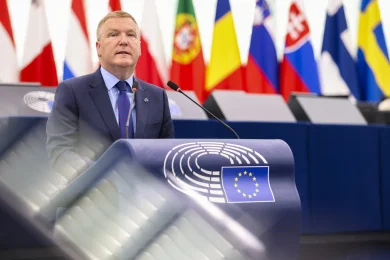
Alain Berset, Secretary General of the Council of Europe, presented a New Democratic Pact for Europe to the European Parliament, designed to complement the EU’s European Democracy Shield and extend cooperation to the Council of Europe’s 46 member states. The organization is also separately working on a possible legal instrument addressing foreign information manipulation and interference, but its form has not yet been determined. Consultation on the Pact will continue until the end of December, and publication is scheduled for April 2027.
The Council of Europe is preparing a New Democratic Pact for Europe that would complement the European Democracy Shield developed by the European Union and extend cooperation on protecting democracy to the organization’s 46 member states. Alain Berset, Secretary General of the Council of Europe, said in the European Parliament’s Special Committee on the European Democracy Shield (EUDS) that the project aims both to defend democracies against external interference and information manipulation and to address deeper problems such as declining trust in institutions, polarization and weakening democratic participation.
In brief
1. The Council of Europe is preparing a New Democratic Pact for Europe, which would complement the EU’s European Democracy Shield and cover the organization’s 46 member states.
2. The Pact is built around five values presented by Alain Berset: accountability, dignity, truthfulness, equality and responsibility.
3. Separately, the Council of Europe is working on a possible legal instrument concerning foreign information manipulation and interference, or FIMI. The instrument’s legal form remains open.
4. Berset stressed that measures against interference must not become a pretext for censoring civil society, legitimate opinions or pluralism.
5. Consultation on the Pact is scheduled to run until the end of December 2026, with the final document to be published in April 2027. The Council of Europe’s member states would then decide on the next steps at the ministerial session in May 2027.
Berset presented the Pact by distinguishing between protecting democracy from external threats and strengthening the mechanisms that make it resilient from within. In this logic, a “shield” can limit cyberattacks, foreign interference or attempts to manipulate elections, but it cannot by itself resolve declining public trust, social polarization or the weakening relationship between institutions and the population.
The Secretary General linked the initiative to the Council of Europe’s broader architecture, built around the European Convention on Human Rights, the case law of the European Court of Human Rights and the work of the Venice Commission. He also recalled that the leaders of the 46 member states agreed in Reykjavik in 2023 on principles for democracy, which the new Pact now seeks to turn into a more concrete framework for the conditions in which democratic systems can function in a changing environment.
Berset described five values underlying the project: accountability, dignity, truthfulness, equality and responsibility. In this context, accountability concerns the liability of institutions and public actors and the possibility of holding them to account, while responsibility refers to assuming responsibility in the functioning of democracy.
The Pact is not presented as a new legal definition of democracy. Berset describes it as a shared commitment to the conditions necessary for democracy to function in a context marked by artificial intelligence, information manipulation, external interference, fragmentation of the public sphere and declining trust in institutions.
One advantage invoked by the Council of Europe is its geographical coverage. The European Democracy Shield concerns the European Union and its 27 member states, while the Council of Europe includes 46 states. For threats that do not stop at EU borders, Berset argues that the response must be able to operate on a pan-European scale.
He identified Moldova, Ukraine, Armenia, Georgia and the Western Balkans as areas where the European Union and the Council of Europe are already running joint programmes. The Pact’s idea is to use this broader network without duplicating EU instruments, instead providing them with a complementary framework based on Council of Europe standards.
The second dimension is normative. The Council of Europe brings to this cooperation the European Convention on Human Rights, the case law of the Strasbourg Court, the opinions of the Venice Commission and other legal instruments developed within the organization. Berset also cited the Council of Europe Framework Convention on Artificial Intelligence as an example of an area in which pan-European standards can be developed in parallel and in cooperation with the EU.
The most concrete legal development presented in Parliament concerns foreign information manipulation and interference, known by the acronym FIMI. Berset said that the Council of Europe’s ministers had given the green light to work on a legal instrument dedicated to this issue.
However, the instrument’s form has not been determined. The Secretary General’s remarks do not indicate that the states have already decided to adopt a binding international convention or another specific type of legal act. Berset explicitly said that the form remains open, and the article cannot present the project as an already negotiated convention.
The ambition is for the instrument to operate beyond the EU’s borders and to be coherent from the outset with existing European mechanisms. If the process moves in this direction, the Council of Europe could create common FIMI rules for all its member states, providing an additional pan-European level alongside instruments applicable exclusively within the EU.
This geographical expansion nevertheless comes with a condition that Berset repeated in his remarks: combating interference must not undermine the democratic principles that the measures seek to protect. Human rights, pluralism, freedom of expression and the rule of law must remain limits on any mechanism built against manipulation and interference.
Berset explicitly warned of the risk that legislation concerning foreign influence could be used to silence civil society. From the Council of Europe’s perspective, a rule against interference must be accessible, foreseeable and subject to oversight, while the fact that an opinion is offensive, shocking or disturbing is not sufficient to remove it from the protection of freedom of expression.
This is precisely where the Pact seeks to differ from an exclusively security-based approach. Democracy-protection instruments must be able to identify operations of interference and coordinated manipulation without turning political disagreement, institutional criticism or minority opinions into security issues.
The EUDS discussion also addressed issues such as the transparency of digital platforms, the identity of media owners, the role of fact-checkers and how algorithms can influence the distribution of political content. These elements show that democratic resilience is being treated as an issue involving the information infrastructure, electoral rules and trust in institutions at the same time.
Berset presents the relationship between the Pact and the European Democracy Shield as one of complementarity. The EU Shield and the Council of Europe Pact address some similar threats, such as foreign interference, disinformation and attacks on elections, but the Pact would add broader geographical coverage and legal standards developed within the Council of Europe system.
This distinction is also institutionally important. The Council of Europe is not an institution of the European Union. It is a separate international organization with 46 member states, and the European Convention on Human Rights and the European Court of Human Rights form part of its system. Therefore, the New Democratic Pact is not a component of EU legislation and must not be confused with the European Democracy Shield or the European Centre for Democratic Resilience mentioned by the Irish Presidency of the Council of the EU at the same meeting.
The timetable presented by Berset is relatively precise, but it concerns the drafting process, not the adoption of legislation that has already been agreed. Consultation on the Pact is expected to continue until the end of December 2026, with the final version to be published in April 2027.
The Council of Europe’s member states would then discuss the next steps at the ministerial session in May 2027. Berset did not announce that a binding instrument would automatically be adopted at that meeting. The decision may concern the continuation of the process, the political or legal form of the Pact and the steps needed to develop the associated instruments.
The process is also open to public participation. Berset called on Members of the European Parliament to contribute to the consultation and bring citizens’ views into the discussion, including those of groups that are less frequently represented in institutional debate. This component reflects the Pact’s central idea that democratic resilience cannot be built exclusively through rules for institutions, platforms or elections, but also depends on rebuilding trust between citizens and political systems.
For the EU, the project’s significance lies in the emergence of a second level of cooperation around protecting democracy. The European Democracy Shield can develop instruments within the Union’s legal framework, while the Council of Europe can provide standards and mechanisms with pan-European coverage, including for states that are not EU members.
The exact form of this architecture is still under construction. The Pact remains under consultation, and the legal instrument on FIMI does not yet have a final form. The novelty announced by Berset is the institutional direction, the timetable and the intention to build common rules beyond the EU, not the existence of a convention or legal obligations that have already been adopted.
Latest News
18:19
18:05
17:54
17:48
17:35
See more news
NEWS ON THE SAME TOPICS




















.webp)


