EIB signs a €150 million loan with Fugro for up to 25 unmanned maritime vessels



Always see our news on Google
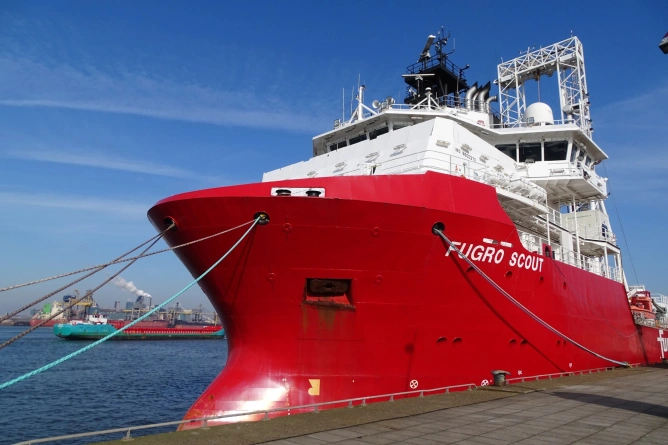
The European Investment Bank has signed a €150 million credit facility with Fugro to expand remotely operated maritime operations and develop a new generation of uncrewed surface vessels. The programme may include up to 25 long-range vessels, as well as research into advanced sensors and underwater robotics used for seafloor mapping, cable inspection and offshore infrastructure monitoring.
The European Investment Bank (EIB) has signed a €150 million financing facility with Fugro to expand the Dutch company’s remotely operated maritime technologies. The programme may support the introduction of up to 25 medium-sized, longer-range uncrewed surface vessels, as well as research and development activities in remote sensing, sensors and underwater robotics. This is a long-term loan, not a grant, and signing the agreement does not mean that the full €150 million has already been paid out or that all 25 vessels have already been ordered or built.
In brief
1.The EIB has signed a €150 million credit facility with Fugro for remotely operated maritime technologies.
2.The programme may include up to 25 new uncrewed vessels, together with sensors, underwater robotics and other data-collection technologies.
3.The vessels are intended for seafloor mapping, offshore site assessment and the inspection of cables, pipelines and other marine assets.
4.The facility covers eligible expenditure incurred between 1 January 2025 and 31 December 2031, and drawdowns may have maturities of up to ten years.
5.The EIB and Fugro state that these vessels can reduce fuel consumption by up to 90% compared with conventional survey vessels; the percentage is a technological comparison, not a reduction guaranteed for every mission.
Fugro provides the geotechnical, geophysical and monitoring data needed before marine projects are built and throughout their operation. In the case of an offshore wind farm, for example, developers need information about the structure of the seabed to select sites and design foundations, while submarine cables must be mapped, inspected and monitored after installation. The same technologies are used for electrical interconnections, pipelines and other critical infrastructure located on or beneath the seabed. The EIB financing is not linked to the construction of a single wind farm or cable, but to expanding Fugro’s capacity to provide these services for different projects.
The new generation of uncrewed vessels is changing how these operations are carried out. Instead of a conventional vessel carrying the crew and specialists required for measurements, the platforms can be controlled from shore-based centres and can transmit data in real time. Some can work together with remotely operated underwater vehicles that inspect infrastructure below the water. The EIB states that the funded programme includes a generation of vessels with greater performance and autonomy, alongside research into remote-sensing and robotics technologies. The aim is for a larger share of survey and inspection operations to be conducted without a team being present aboard the main vessel.
The expansion would be significant compared with the capacity Fugro had already developed before the agreement. In its 2025 reporting, the company indicated a fleet of ten uncrewed surface vessels, seven of which were being used commercially for hydrographic surveys and asset inspection. The EIB financing is intended for a phased expansion towards larger vessels with greater autonomy, adapted also to operations farther from the coast and the use of electric underwater vehicles. This means that the figure of up to 25 vessels describes the size of the programme that the financing may support, not the number of units delivered when the contract was signed.
The financial terms allow the programme to be carried out over several years. Fugro says that the loan is an unsecured facility and may finance eligible expenditure incurred between 1 January 2025 and 31 December 2031. Individual drawdowns may have maturities of up to ten years. The company has not announced a schedule under which the entire facility would be used immediately and says that investments will be made gradually, depending on market developments and the programme’s needs. Therefore, the €150 million represents the financing made available under the agreement, not evidence of a full payment made at signing.
The EIB agreement is separate from the bank refinancing that Fugro announced on the same day. The company also obtained a two-year extension, until December 2031, of its existing unsecured debt facilities, consisting of a €400 million revolving credit facility and a €100 million term loan. The two transactions have different functions: the EIB financing is dedicated to eligible investments under the technology programme, while the extension of the other facilities concerns the company’s broader financing structure.
One of the arguments for switching to uncrewed vessels is the reduction in platform size and fuel consumption. The EIB indicates a reduction of up to 90% compared with traditional survey vessels, while Fugro’s documentation on its autonomous operations shows that 12-metre vessels can consume much less fuel than the conventional vessels they replace. In specific projects, the company has reported different reductions depending on the mission. The 90% figure should therefore be understood as the possible comparative performance of this type of operation, not as an automatic 90% reduction in Fugro’s total emissions or in the emissions of every project in which these vessels will be used.
Moving operations to shore-based command centres also has a safety component. Smaller vessels do not need to carry the personnel required on a conventional survey vessel, reducing the number of people exposed to offshore conditions. Data can be monitored and processed by specialists based at operating centres, who can participate in different projects without spending long periods at sea. Fugro presents this combination of uncrewed platforms, remote communications and underwater robotics as one of the central directions of the transformation of its maritime operations.
However, the actual pace of expansion will depend on programme implementation and demand for the relevant services. Alongside the EIB agreement, Fugro did not publish an individual delivery schedule for each of the up to 25 vessels, nor a list of the offshore projects in which they will be used. The concrete effect of the financing will be possible to track as the company orders or introduces the new platforms and uses them in projects involving the mapping, construction and monitoring of maritime infrastructure.
Latest News
15:58
15:52
15:52
15:48
15:48
See more news
NEWS ON THE SAME TOPICS



.webp)