The European Commission says that the Republic of Moldova must quickly open all negotiation clusters with the European Union.



Always see our news on Google
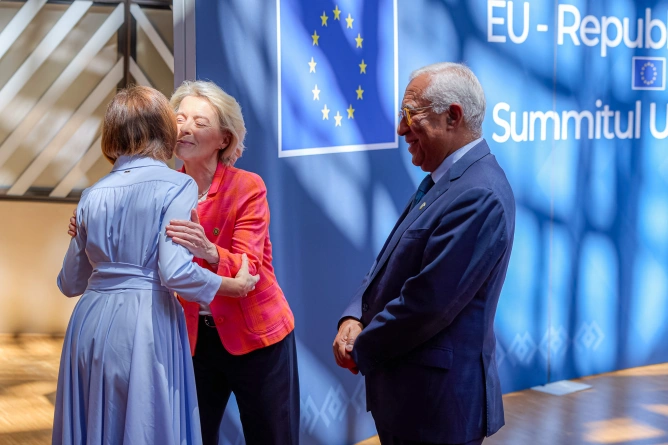
Ursula von der Leyen said at the EU-Moldova Summit in Brussels that the opening of the first negotiation cluster marks "the first and most important step" in the process of the Republic of Moldova's accession to the European Union. The President of the European Commission stated that the objective should be to open all other clusters as quickly as possible and linked this process to the 1.9 billion euro Growth Plan, which aims to bring the Moldovan economy closer to the European single market.
The European Commission says that the Republic of Moldova must quickly continue the accession process to the European Union after the opening of the first negotiation cluster. Ursula von der Leyen stated at the EU-Moldova Summit in Brussels that the goal is to open all other clusters as soon as possible, in parallel with the implementation of reforms related to the 1.9 billion euro Growth Plan.
In short
Ursula von der Leyen said that the European Union and the Republic of Moldova discussed two main topics: the accession of the Republic of Moldova to the EU and the Growth Plan.
The President of the European Commission described the opening of the first cluster as "the first and most important step" in the accession process.
The European Commission recommended to the Council the opening of the other negotiation clusters.
The Growth Plan for the Republic of Moldova is valued at 1.9 billion euros.
Von der Leyen said that the reforms create fair conditions with the single market and open its doors for Moldovan companies.
The EU-Moldova Summit in Brussels had two main stakes: the accession process of the Republic of Moldova to the European Union and the use of the Growth Plan to bring the Moldovan economy closer to the European single market. Ursula von der Leyen said, at the opening of the meeting, that the two topics are directly linked through the reforms that Chișinău is implementing.
"We have two major topics. One is, of course, Moldova's accession to the European Union," said the President of the European Commission. She added that last week, the "first and most important step, the first cluster" was opened.
In the negotiations for accession to the European Union, clusters group negotiation chapters into large areas. The opening of the first cluster is important because it marks the entry into a more concrete stage of the process, in which reforms are evaluated by areas and linked to precise criteria.
Von der Leyen said that the objective should be to open all other clusters as soon as possible. She specified that the European Executive recommended to the Council to open the clusters.
"The goal must now be to open all other clusters as soon as possible," said Ursula von der Leyen. "The Commission has recommended to the Council to open the clusters."
This wording shows that, from the perspective of the European Commission, the Republic of Moldova has advanced sufficiently for the process to continue at the political level in the Council, where member states must decide the next steps. The pace will depend both on the reforms in Chișinău and on the agreement of the member states.
The second stake is the Growth Plan for the Republic of Moldova, valued at 1.9 billion euros. Ursula von der Leyen said that she is impressed by the speed and quality with which the Moldovan authorities deliver the necessary reforms.
"I must say that it is impressive to see how quickly and excellently the necessary reforms are delivered," said the President of the European Commission. She explained that these reforms create, essentially, fair conditions with the European single market.
For the reader who does not follow the enlargement file daily, this connection is essential. The Growth Plan is not just a financial package. It aims to link European money to reforms that make the economy of the Republic of Moldova more compatible with the rules, standards, and practices of the single market.
Von der Leyen said that the reforms open the doors of the single market for Moldovan companies. In practice, this means that companies in the Republic of Moldova could have better access to European trade opportunities if the rules regarding competition, standards, administration, investments, and market functioning approach those of the European Union.
"In practice, it creates fair conditions with our single market and thus opens the doors of the single market for Moldovan companies," said Ursula von der Leyen.
The President of the European Commission reminded that the Republic of Moldova has already received the first tranches from the Growth Plan. She said that the work of the Moldovan authorities is intense and that the results are visible.
The 1.9 billion euro plan is one of the main levers through which the European Union seeks to support the economic transformation of the Republic of Moldova before accession. The money is linked to reforms and the state's ability to create better conditions for investments, companies, and proximity to the European market.
For the Republic of Moldova, the political stake is to accelerate the accession process. For the economy, the stake is that the reforms do not remain just institutional criteria, but translate into better access to markets, financing, investments, and more predictable rules for companies.
The summit in Brussels took place at a time when the Republic of Moldova is trying to advance on the accession file, strengthen its economic resilience, and reduce external vulnerabilities. The message from the European Commission is that the opening of the first cluster must be quickly followed by the opening of the others, and the Growth Plan must transform reforms into concrete economic benefits.
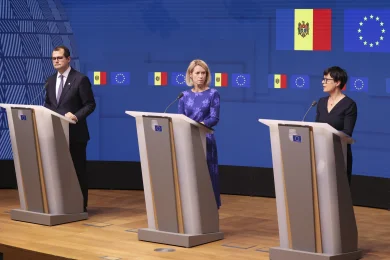
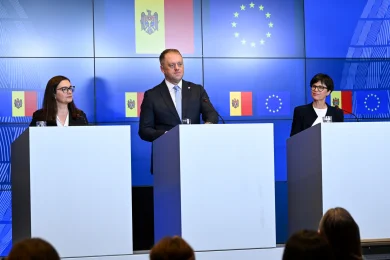
The EU-Moldova Summit is the second such meeting between the European Union and the Republic of Moldova. Ursula von der Leyen's statements were made in Brussels, at the opening of the meeting with President Maia Sandu, and focused on the accession of the Republic of Moldova to the European Union, the Growth Plan, reforms, and proximity to the single market.
Latest News
19:09
19:05
19:00
18:48
18:48
See more news
NEWS ON THE SAME TOPICS

.webp)