ANALYSIS of Censorship Motions in Post-December Romania: Overthrown Governments and Broken Alliances


Always see our news on Google
PSD and AUR are preparing to submit a motion of censure against the Bolojan Government, but it only has a chance of success if the two formations attract allied opposition members, such as POT, SOS, PACE, and independents. Since 1990, the Romanian Parliament has recorded dozens of motions of censure, but only six governments have been dismissed through this constitutional mechanism. These overthrows have often marked major political crises, with traditional alliances broken and surprising temporary coalitions formed.
First Fall: Emil Boc Government (2009)
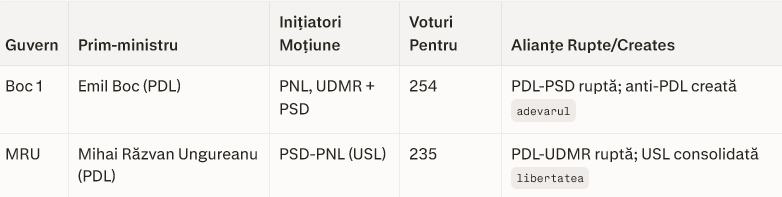
The Emil Boc 1 Government, initially supported by the PDL-PSD alliance formed after the 2008 elections, fell on October 13, 2009, through the motion "11 against Romania." Initiated by PNL and UDMR, supported by PSD – which had just exited the coalition – the motion passed with 254 votes in favor and 176 against, marking the first resignation through a motion of censure post-1989. The breaking of the PDL-PSD alliance, strained by austerity measures, allowed for the creation of an anti-Boc majority, with Boc remaining interim until the formation of the Boc 2 Government with UDMR.
This fall illustrated the fragility of the grand coalition envisioned by President Traian Băsescu, with PSD quickly moving into opposition to consolidate its pre-electoral positions.
Mihai Răzvan Ungureanu Government (2012) After six months, the Mihai Răzvan Ungureanu Government (PDL) was dismissed on April 27, 2012, through the motion "Stop the Blackmailing Government. No way, never!". Submitted by USL (PSD-PNL), the massive electoral alliance formed in 2011, it obtained 235 votes in favor and only 9 against. The PDL-UDMR alliance broke under the pressure of street protests and economic grievances, with USL capitalizing on anti-Băsescu sentiments.
The formation of USL represented a historic reunion of the left and moderate right against PDL, leading to the installation of the Victor Ponta Government and USL dominance until its breakup in 2014.
Sorin Grindeanu (2017)
A bizarre premiere took place on June 29, 2017, when PSD-ALDE dismissed its own government led by Sorin Grindeanu through the motion "Romania cannot be confiscated. We defend democracy and the vote of Romanians." Initiated by the party led by Liviu Dragnea, it passed with 241 votes in favor, following an internal conflict over judicial reforms. The PSD-ALDE alliance remained formally intact, but the rupture occurred within PSD, with Grindeanu refusing to resign.
This motion highlighted the power struggles within PSD, leading to the appointment of Viorica Dăncilă and weakening the party's image in the face of anti-ordinance protests.
Viorica Dăncilă: United Opposition (2019)
The Viorica Dăncilă Government (PSD-ALDE) fell on October 10, 2019, through the motion "To rebuild Romania, the Dăncilă Government must be urgently dismissed!". Initiated by PNL, USR, PMP, PRO Romania, ALDE (which had left the coalition), UDMR, and minorities, it obtained 238 votes in favor. The breaking of ALDE from PSD was pivotal, allowing for a broad anti-PSD coalition in the context of the presidential elections won by Klaus Iohannis.
The result paved the way for the Ludovic Orban Government (PNL), marking the end of the Dragnea era.
Ludovic Orban: The Return of PSD (2020)
Just three months later, the Ludovic Orban 1 Government (PNL, supported by USR-PLUS, UDMR) was dismissed on February 5, 2020, through "Orban Government/PNL – the privatization of Romanian democracy." PSD and UDMR initiated it, passing it with 261 votes, annulling the election of mayors in two rounds. UDMR quietly withdrew support for PNL, joining PSD for local advantages.
This motion reflected the instability created by the onset of the pandemic, with Orban subsequently forming a minority government.
Record: Florin Cîțu (2021)
The Florin Cîțu Government (PNL-USR-PLUS-UDMR) fell on October 5, 2021, with a record 281 votes on the motion initiated by PSD, supported by USR-PLUS and AUR.
This was AUR's first involvement in the success of a motion, signaling the rise of the extremes.
Lessons from the History of Motions
These six cases show that successful motions often involve temporary cross-party alliances, coalition breakups (e.g., PSD from PDL, ALDE from PSD, UDMR) and crisis contexts. The total number of motions submitted exceeds 50 until 2026, but success is rare due to the threshold of 233 votes.
*****Synthesis made with the help of a data monitoring flow provided by the media monitoring platform NewsVibe Romania. The analysis, data, and images presented have been enhanced with the help of Machine Learning and Artificial Intelligence tools.
Latest News
16:24
16:13
16:04
15:56
15:50
See more news
NEWS ON THE SAME TOPICS












.webp)