The prohibition of traditional gambling would cost Romania over 700 million euros annually and 30,000 jobs.



Always see our news on Google
The Federation of Gambling Organizers (FEDBET), a representative body for over 90% of the gambling market in Romania, warns that a potential total ban on traditional gambling would generate direct losses to the state budget of over 700 million euros annually, leave 30,000 people without jobs, and have a total estimated economic impact of over 1.3 billion euros per year.
Legislative Context
On February 24, 2026, the Government of Romania adopted Emergency Ordinance no. 7/2026, which transfers to local councils the competence to decide on the regime of gambling within each administrative-territorial unit. The decision can be used for the benefit of communities, as a fiscal tool with significant potential for municipal budgets.
Although the normative act aims for administrative decentralization and strengthening the financial capacity of localities, its improper application, through total bans, would produce the exact opposite effect: the elimination of an important source of local revenue before it has been capitalized.
Estimated Financial Impact
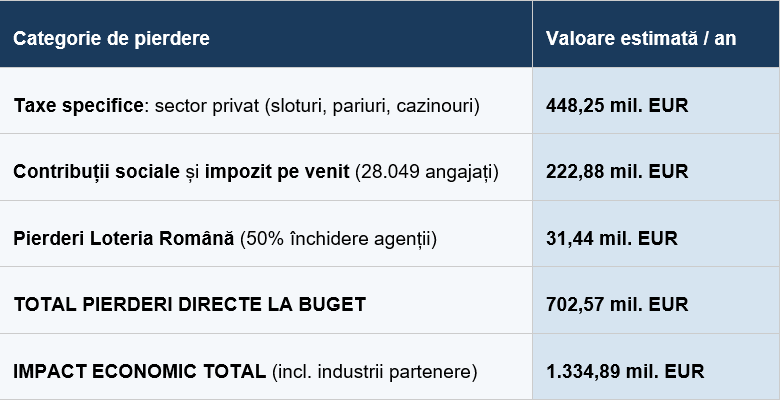
A total ban on traditional gambling would generate the following direct losses:
 Affected Jobs and Infrastructure
The traditional gambling industry currently supports 28,049 employees in the private sector and 1,380 employees of the Romanian Lottery – a total of 29,429 jobs distributed across all 42 counties and in the municipality of Bucharest. The impact would be particularly severe in small and medium-sized towns, where these jobs often represent some of the few available in the service sector.
At the same time, 3,160 sports betting agencies, 1,361 gaming halls, and 345 Loto agencies would be closed. In total, 4,866 locations, with 43,306 gaming devices taken out of operation.
Risk of Migration to the Black Market
FEDBET draws attention to the fact that banning regulated activity does not eliminate demand but redirects it to the black market, where the state simultaneously loses tax revenues, control, and any consumer protection instruments.
Recent experience from other European countries confirms that restricting or completely eliminating the regulated market leads to the development of illegal gambling, which operates outside any control or taxation framework.
Proposed Alternative: Strict Regulation, Not Prohibition
Instead of a total ban, FEDBET proposes a stricter and more effective regulatory framework built on four fundamental pillars:
• Zoning: clear establishment of permitted areas for the placement of gambling locations;
• Local taxation: using the new fiscal tool created by OUG 7/2026 to generate revenue for local budgets;
• Aesthetic and operational standards: regulating the appearance and functioning of locations;
• Protection of minors and vulnerable consumers: self-exclusion mechanisms, periodic audits, and dedicated responsible gaming programs.
This approach gives local councils full control over the activity, new revenues, and real protection for the community. Therefore, it achieves exactly the objectives that the prohibition invokes but which, in practice, it cannot achieve.
Effective Solutions Through Dialogue Between Industry and Authorities
FEDBET understands the political and social context in which this normative act was adopted and recognizes the legitimate concern of the authorities for responsible management of gambling activities at the local level. The transfer of competences to local councils can represent a valuable regulatory tool, provided that the decisions made are proportional, grounded, and adapted to the realities of each community.
The gambling industry in Romania operates within a strict framework of licensing, control, and taxation. Licensed operators consistently contribute to the state budget and local budgets and ensure tens of thousands of jobs across the country. Total prohibition decisions do not eliminate demand but redirect it to illegal circuits, where the state has neither revenues, nor control, nor consumer protection instruments.
The Federation draws attention to the fact that decisions made without a prior assessment of the economic, social, and budgetary impact risk generating unintended negative effects, including losses to local budgets and the amplification of the illegal market. Recent experience from Western Europe confirms this risk: where the regulated market has been eliminated, the black market has thrived.
In this spirit, FEDBET expresses its full willingness for constructive institutional dialogue and technical consultations to support local authorities in implementing a clear, coherent, and effective framework.
Latest News
20:33
20:20
20:15
20:08
20:01
See more news