Young people, more resilient against Russian manipulations



Always see our news on Google
In Romania in recent years, almost every time the topic of young people arises, the laments that bemoan all sorts of shortcomings of those who come after are seemingly much more frequent than would be normal, considering the natural conflict between generations. And yet, the situation does not seem to be as bleak as some might think.
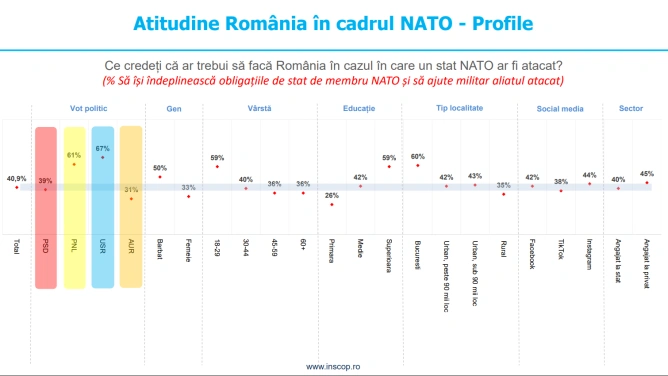
For example, let’s take the way the population believes we should relate to the obligations arising from Romania's status as a NATO member. This topic represents one of the favorite subjects of manipulations fueled from the Kremlin, and the consequences at the level of general perception are visible, especially if we compare current data to that of a few years ago. Thus, in February 2026, the agreement of the population with the idea that Romania should fulfill its obligations as a NATO member state and help militarily another member state of the Alliance in the event that it is attacked has decreased by 10 percent compared to May 2022, reaching 40.9%.
However, if we look at how people under 30 respond to this question, compared to other age categories, we will find that there is a much more pronounced inclination among young people to respect Article 5 of the North Atlantic Treaty than there is among their parents and grandparents. Thus, they agree that Romania should fulfill its obligations as a NATO member state and help the attacked ally: 40% of respondents aged between 30 and 44, 36% of those over 45, and almost twice as many people aged between 18 and 29 (59%).
Could this be a sign of the resilience of young people in the face of the informational war waged by Russia? It is difficult to draw such a conclusion, considering that there are many areas where young people seem to have easily fallen prey to manipulations coming from the East. But at least on this subject, the Russian propaganda machine seems to have jammed, and it would be worth studying what mechanisms have blocked its gears and thus take another step in building an effective defense against the subversive attacks to which the Romanian public opinion is subjected.
Methodology: The survey was conducted by INSCOP Research at the request of the New Strategy Center. Data was collected between January 28 – February 6, 2026. Research method: interview via questionnaire. Data was collected using the CATI method (telephone interviews), with a sample size of 1100 people. The sample is representative for significant socio-demographic categories (gender, age, occupation) for the non-institutionalized population of Romania, aged 18 and over. The maximum allowable error of the data is ± 3%, at a confidence level of 95%.
Latest News
20:26
20:10
19:56
19:34
19:20
See more news
NEWS ON THE SAME TOPICS