Power must be understood, assumed, and judged.



Always see our news on Google
Although omnipresent in all aspects of life, power remains a deeply contested concept, with multiple meanings, sometimes elusive, whose meanings and criteria for application will always generate debates. Despite the ubiquity of the concept – the history of reflections on power in international relations having deep roots that extend back to Antiquity – it is not surprising that there is still no consensus regarding the definition of this term or regarding the nature, exercise, and limits of power.
Robert Gilpin (one of the most influential theorists in the field of international relations) describes the concept of power as "one of the most problematic in the field of international relations" and acknowledges that "the number and variety of definitions should be a cause for concern for political scientists" (1981, 13[1]).
As David A. Baldwin (emeritus professor of international relations at Princeton University) observes, "although it sometimes seems paradoxical, studying power is nevertheless inevitable"[2]. Difficult to capture in a stable and always contested definition, power remains an impossible concept to avoid, being one of the fundamental tensions of modern political thought: the difficulty of conceptualizing power and, at the same time, the impossibility of ignoring it.
This is because power returns obsessively in moments of historical turning points, when decision-making and political action become essential. It is precisely in these critical interstices that the need for outlining a new type of strategic thinking becomes increasingly imperative, capable of providing relevant analytical tools for deciphering power.
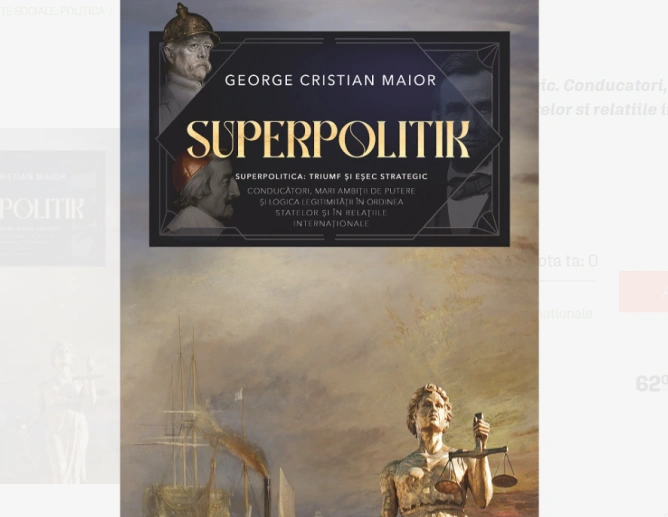
As a natural evolution of this concern for the emergence of such a "new type of strategic thinking," George Cristian Maior revisits this theme in 2025, publishing with the RAO Editorial Group the volume Managers of History. Studies and Essays on the Theory and Practice of Power in History, before artificial intelligence. As the author himself confesses, the new volume brings together studies and essays that constituted a significant part of the empirical basis for the broader and more theoretical work Superpolitik. Superpolitics: Triumph and Strategic Failure. Leaders, Great Ambitions of Power, and the Logic of Legitimacy in the Order of States and in International Relations (published in 2024).
If in Superpolitik George Cristian Maior constructed a unified theoretical framework for understanding state leadership in the Superpolitics paradigm[3] – as an ideal type (in the Weberian sense) of political exercise from the perspective of the rational and comprehensive model of strategic decision-making – Managers of History descends into the realm of empirical material and preliminary reflections that made the theoretical construction of the book published in 2024 possible. The volume explores precisely this dimension of power: the nature, exercise, and limits of power in diverse historical contexts, not only as an abstract phenomenon but also as a motor of history, balancing between authority and legitimacy, decision and assumption.
Some remarks about the study of power become necessary before anything else. The analysis of power in international relations is a complex field that requires a multidimensional approach, considering its profoundly interdependent nature.
As Guzzini suggests (2007[4]), the study of power involves a pendulum between three distinct fields of research, each with its own methods, objectives, and fundamental concepts: (1) political theory (focusing on the normative aspects of power, that is, on how power should be exercised); (2) explanatory theories (studying how power manifests and distributes in reality, using scientific methods) and (3) praxiological approach (the practice of politics, focused on the empirical analysis of real processes in international relations). In this last approach, power is exercised through politics (international), and the analysis of power is based on historical experience.
Thus, the analysis of power in international relations can only be realized through a synergy between political theory, empirical research, and political practice. While political theory helps us understand the normative aspects of power, explanatory theories provide us with tools to study the behaviors and mechanisms underlying power relations, and the praxiological approach offers us valuable insights from historical experience. All these perspectives are essential for understanding how power manifests in the real world of international relations.
In this interpretative key, the volume Managers of History is inscribed, in which George Cristian Maior proposes an integrative approach to power, naturally oscillating between the three fields of research and elegantly combining the rigor of historical analysis with the finesse of theoretical reflection.
Managers of History
From Antiquity to the modern era, theorists such as Niccolò Machiavelli, Carl von Clausewitz, Reinhold Niebuhr, or Edward Luttwak, alongside great practitioners of power – from Marcus Tullius Cicero and Cardinal Richelieu to Otto von Bismarck, Winston Churchill, Woodrow Wilson, or Henry Kissinger – are summoned in a captivating reading of history as a space of decision-making assumption.
The analysis does not limit itself to presenting the ideas or biographies of these "managers of history," but integrates into a broader framework of theoretical reflection. The book does not propose just a history of political ideas or a typology of leaders, but investigates the conditions under which human power has functioned, legitimized, and assumed over time.
Reading the historical exercise of power proposed by Maior, we discover "a Cicero as realistic as Machiavelli." Stereotypes melt away, "the difference in vision between Cicero and Machiavelli becomes increasingly blurred," and the reader understands that the history of power is not about mythologized figures, but about real people, and "the art of state leadership is not about ideals, but only about what is achievable."
If "Cicero is the one who made the transition to modern political thought," Machiavelli is the one who achieved a true "intellectual revolution," not so much by autonomizing politics from religion, but especially by understanding politics as "the practical domain of managing the internal and external affairs of the state according to its own rules." But perhaps Machiavelli's most valuable legacy is the lesson that "the world is not an ideal one and will never be, and politics must be a useful tool for governing effectively in relation to reality and not in relation to concepts and utopian representations."
From Cardinal Richelieu, Maior concludes, we inherited "the fundamental mutation from the politician to the statesman," a transformation that marks the transition from strategic vision (the quality of a good politician) to strategic construction (the extraordinary quality of a statesman). Richelieu was, in Maior's view, the master of strategic practice, developing, through "the cold and precise assessment of the state's medium- and long-term interests," a "practical recipe of the necessary tactics, the necessary steps to promote and achieve these interests."
A "true statesman" was, in turn, Otto von Bismarck, chancellor and architect of German unification, who, by promoting a policy based on political realism (Realpolitik), a lucid assessment of power relations, and a calculated use of diplomatic and military instruments, can still offer today "a lesson in the art and science of governance and strategic leadership."
If Machiavelli, Richelieu, or Bismarck demonstrated, with their lights and shadows, what the idea of superpolitics means in the light of the flow of history, Woodrow Wilson is the one who, through his political legacy, defines "the qualitative difference between a politician and a statesman" – concludes George Maior. Wilson is undoubtedly "a superpolitician," whose political action fully expresses all the qualities and attributes of superpolitics.
Just as he dismantled stereotypes about Cicero or Machiavelli, Maior shows that even the great classical theories of war must be read with the attention and discernment imposed by the present. In the case of Carl von Clausewitz, considered the founder of modern strategic thought, Maior nevertheless draws attention to the fact that, although the postulate "war is politics continued by other means" remains a cornerstone, in the face of rapid technological revolutions and the current dynamics of power, classical theses risk becoming insufficient. Clausewitz was a theorist of war, not of power.
Maior does not deny the relevance of Clausewitz's theory ("the rationalization of war"); on the contrary, he recognizes it as an essential foundation in understanding conflicts, but he recontextualizes it, demonstrating that traditional principles must be read with the eyes of the present and adapted to new realities.
Towards a "unique manager of history"?
"How can we then understand politics, power, and power relations" in this new reality in which "the old forms of the vices of political power and disorder in international relations intertwine with new models of social and material evolution?" Maior provocatively asks. In a prospective note, the author extends the reflection on the current challenges of the exercise of power, raising the provocative question: how will artificial intelligence change the exercise of power, the nature of politics, and the formulation of strategies?
Maior continues to explore the theme of uncertainty, introduced more than 10 years ago in the following[5] – as an innovative epistemological principle meant to allow the empirical investigation of the exercise of power under the vast conceptual and philosophical umbrella of postmodernity and postmodernism.
In the face of these new technological realities that bring with them increasingly complex uncertainties, strategic thinking must evolve as well. The phrase "before artificial intelligence" does not refer to nostalgia, but to a warning: the book anticipates the reconfiguration of power in the face of the rise of artificial intelligence, marking a threshold beyond which decision-making, as a fundamental act of exercising power, risks being externalized without being, in a real sense, delegated.
More than an analysis of the past, Managers of History thus becomes a meditation on the limits and conditions of exercising power in an era in which the autonomy of human decision-making is called into question. In this sense, the volume also functions as a discreet but firm warning about the danger of confusing decision-making efficiency with abdication from political judgment. Maior thus draws attention to the risk that humanity may turn towards a "unique manager of history" – artificial intelligence.
Power must be understood, assumed, and judged
"Power must be understood, assumed, and judged," insists Maior. However, artificial intelligence affects precisely this relationship between power and responsibility, between authority and legitimacy, between decision and assumption. Power that relinquishes human judgment, discernment, and the assumption of responsibility is no longer politics; it becomes merely a technological instrument. Power risks thus becoming abstract, untethered from responsibility and the moral judgment that has defined, over time, the statesman.
It is precisely here that Maior's mastery resides: a historical analysis anchored in an objective perspective on the "managers of history" – capturing both the bright sides and the shadows of those who have managed to win the most important battle – that with history – intertwined with theoretical reflections that culminate in a discreet but imperious call to vigilance: "It is time to learn something, at least a little, from these experiences and to read about these people because only in this way will we realize our limits. Those who venture into the arena of politics or those who want to understand politics and strategic thinking need these lessons. Only through a nuanced understanding of these great figures can we open the way to a clearer and more responsible vision of the political present and future."
Thus, through his book, George Maior not only interrogates the past to understand the present, but also warns against the risk that the future will be governed not by judgment, political wisdom, and assumption, but by the impersonal logic of the algorithm.
The book thus becomes not only an incursion into the past but also a guide for understanding the present, a subtle warning about how political decisions can be shaped – or distorted – by the profound transformations of the contemporary world. It is a history viewed not as a succession of managers of history, but as a space of assumption, in a moment when the emergence of artificial intelligence risks transforming power from an assumed political act into a mere algorithm.
In an era in which artificial intelligence insinuates itself into strategic calculation and political decision-making, Maior's warning becomes crucial: "Artificial intelligence does not mean, at all, wisdom. Wisdom is a definitive attribute of the human being."
https://revistacultura.ro/puterea-trebuie-inteleasa-asumata-si-judecata/
Latest News
16:53
16:45
16:44
16:42
16:32
See more news
NEWS ON THE SAME TOPICS
.webp)