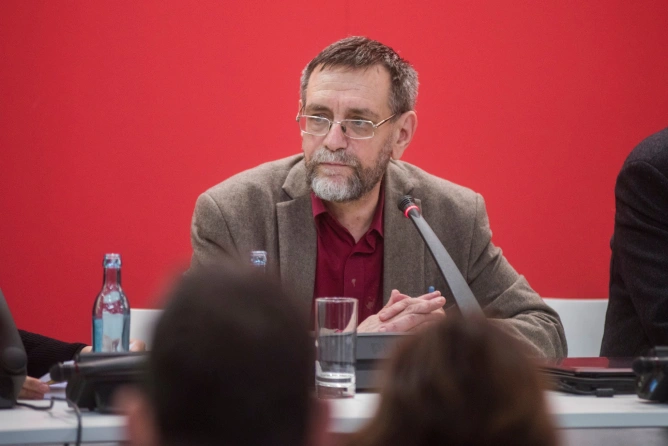
Sever Voinescu, Dilemma: The Creator of Chaos




Always see our news on Google
According to the second law of thermodynamics, systems tend naturally to move from order to disorder. Humans, however, are "separate 'systems'. Although their "natural" part, that is, the biological substrate, follows the great law of physics – death being the ultimate disorder for a living system, disintegration – in spiritual, mental, and intellectual terms, humans tend, on the contrary, towards order. Nothing frightens the spiritual part of man more than disorder and chaos. As both the testimonies of mystics and our banal observations confirm, nothing "does (more) good" to the human interior than the contemplation of order, balance, and symmetry.
It is true that some of us prefer a certain order, while others prefer a different order; some understand something through order, while others understand something else. In the socio-human realm, the element that generates differences among us is freedom. What is freedom, what are its limits, how is it exercised, who defends it – let us listen to each other and we will see how different the answers we give to these questions are. In social space, freedom is the disturbing element of order. And who can say something bad about freedom? And who can say something bad about order?
***
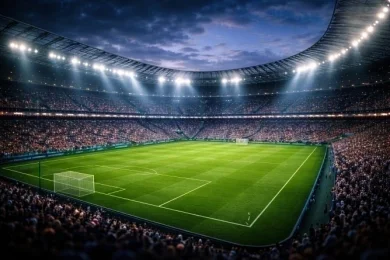
For several years now, I have passionately followed the football matches of the English Premier League. However, I am not a football enthusiast. I rarely watch matches from other leagues, not even the World or European Championships – I only become interested when these competitions reach the final stages. And I never watch matches from the local league. But the English league has captivated me for several years because it has something truly special. When I watch a Premier League football match, I see more than just an athletic spectacle, an atmosphere, a manly, honest competition. I see ideas, I see strategies, I see thinking. Today's Premier League football is, in fact, a spectacle of thought.
The participating clubs in this league have long understood that the first step to having a good team capable of winning competitions is to have a good coach and patience with him. Of course, for spectators, it is not the coach, but the players who are the most important – they are the actors of the show, they step onto the stage, they showcase their qualities. They run, dribble, pass, score goals; they are, undoubtedly, the heroes. But for me, even more than watching very good footballers in action, I like to see strategies, I like to see the plan, I like to see the score according to which, like an orchestra, the entire team expresses itself. In the English league, football is so clear that even an amateur like me can see and understand the idea or ideas that bring the team together. It gives me great satisfaction to understand these strategies, to see them changing during a match – for adapting to the opponent, to the weather, to the field, to the stakes is essential. I like to realize what the strategy is and to see it nuanced through tactics. In other words, I like to see the order in the game and to understand the order coming from the coach. This spectacle is detectable and delightful only in the case of matches between very good teams. When you see a weak team, you understand nothing – you see randomness, disorder, chaos.
While watching the matches in the Premier League, I have come, almost without realizing it, to support one team: F.C. Liverpool. I have emotionally attached myself to the main team from the city of the four Beatles, enchanted by their coach, an extremely interesting, charismatic guy, an excellent manager, with clear ideas and a strong personality, intelligent, full of humor, and capable: Jürgen Klopp.
The defensive systems of English football teams are becoming increasingly solid, reaching the point of being true defensive blocks, with players arranged in two or three lines moving compactly depending on the dynamics of the attack, capable of immediately congesting free spaces and interposing two or three in the path of the ball, wherever it may be. Therefore, for any coach, it is becoming increasingly difficult to imagine strategies to "unravel" this kind of defense. At one point, Klopp decided that he needed a player to play the role of "chaos creator" for the opponents' defense. He looked for the player with the most suitable qualities for this role, found him, and brought him to the club.
What I want to say is that the response to a well-organized opponent does not necessarily have to be superior organization, but the ability to produce chaos in their ranks. Well, this chaos creator is also the freest "player". He frolics in all directions, crosses lines, carries the ball back and forth, makes runs, and takes one or two opposing players with him who follow him to be close if he receives the ball, breaks the rhythm, disappears and reappears, alternates intensities, and is capable of being, at every moment, unexpected. Translated into the language of human behavior, the chaos creator is exactly how most people do not want to be their peers.
We also have this saying: if you cannot defeat your opponent in a straight fight, at least confuse him. But there is even more: to defeat him, disorganize him. Thus, the chaos creator, the disruptor who normally needs to be eliminated, becomes necessary and, at times, salutary. Chaos creators are sometimes sought after and most often rejected. They are rare people, with a special talent, they are the brave rebels. They are the freest among us.
But a chaos creator is truly effective only if he is put to work by a manager who knows how to build order, for there is no master of disorder who has not been, beforehand, a master of order.
Latest News
14:57
14:44
14:30
14:20
14:08
See more news
NEWS ON THE SAME TOPICS