About responsibility in coalition cabinets and the risks of the near future




Always see our news on Google
In 25 years (2001), I was in the final phase of preparing my thesis as a future graduate of Political Science. The topic of the thesis? The crisis of the coalition government, with two case studies, the Ciorbea government crisis and the Vasile government crisis. Political antiquity for many, but in reality, recent political history.
And from the political experience of then and now, we can say that the particularities of Romania – a democratic regime with a multiparty system, maximum fragmentation within the coalition (four parties), political formations that represent completely different segments of society, thus having different priorities – are the perfect ingredients for prolonged political crises and chronic instability.
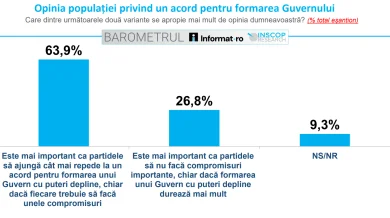
That is why, in the times we live in, with overlapping crises (energy, economic, security, etc.) and with a permanent tension between the need for effective governance and plural representation of segments of society, the supreme institutional responsibility of the main political actors (prime minister, party leaders, president) is the accommodation of the parties through permanent negotiations.
Of course, not every compromise is legitimate; you cannot negotiate the independence of the judiciary, fundamental rights, democratic rules.
On the other hand, it is natural for parties to refuse to completely abandon core values or essential promises to their electorate. That is why the art of negotiation and compromise becomes essential in such moments.
Especially when you know you are right on certain macroeconomic issues, the ability to make acceptable compromises that do not nullify democratic representation or the integrity of fundamental principles is a proof of institutional responsibility if this maintains the stability of a governmental coalition whose alternative is economic collapse or the certain rise of radical populist forces.
Of course, the country does not depend on one government or another. But in the coming years, Romania can only be governed by coalitions. Therefore, the exercise of compromise is essential for any form of governance, current or future.
The only situation in which we will escape the much-criticized "compromise" will be one in which an absolute majority (over 50%) in parliamentary elections is won by a single party. Such a situation has not occurred since the early '90s. However, it is perfectly possible in 2028 if we bury the compromise now and thus open wide the path to the "golden" age of radical populism.
Latest News
14:57
14:44
14:30
14:20
14:08
See more news
NEWS ON THE SAME TOPICS


.webp)