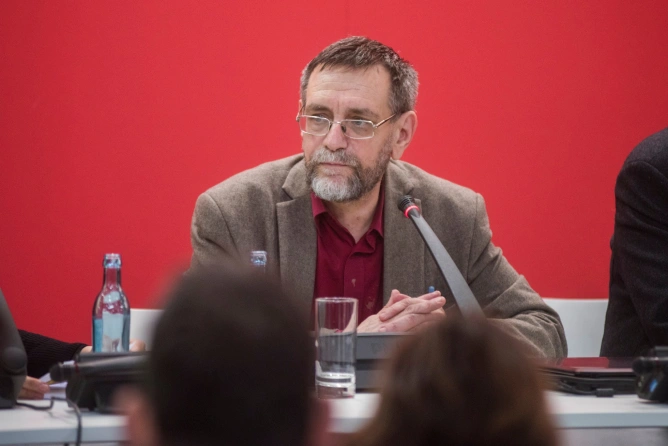
Andrei Cornea: Against Simplistic Excess (I)



Always see our news on Google
In today's world, increasingly engulfed by chaos, the need for clarity is natural and more necessary than ever for any attempt, however modest, at understanding. To discover a plan beneath the apparent disorder, to distinguish a logic beneath incoherence, to reveal a meaning where only absurdity and nonsense seemed to persist – in short, simplification and reductionism are, up to a point, not only natural conditions of any knowledge but also respond to some deep needs for psychological balance of contemporary man. Simplification – I agree. But how much?
Since, if at one end we have chaos and incoherence, at the other we can have a structure that is so simple and elementary, yet it can only betray – and in the most serious way – reality. But if chaos leaves you confused and disoriented, the false order produced by excessive simplification does even greater harm: it gives you a deceptive impression of knowledge, capable of seducing many minds. Chaos at least leaves you immobile. Excessive elementalization, however, pushes you down the slope of falsifying life. This is how ideologies are born, and the harm they cause is incalculable.
Mr. Andrei Caramitru, a very diligent commentator on FB, with an impressive "train" of followers, recently present on several television channels, seems representative of this process of "elementalization" and excessive simplification, having once reached caricature. As I said, I understand the need to impose order on the image of an increasingly formless and incomprehensible world; but the way in which he produces this order seems false and harmful to me. Here is an example: a recent article (post) of his (01.11.2026) claims not a small thing – he would have discovered the key to understanding universal history: "There are two ways of seeing the world, and from here comes the enormous tension in all societies today. There is the way of thinking that is calculated and purely rational, based on systems and hierarchies... And there is the way of thinking that is purely emotional. You have a feeling, you feel that you must save the planet, the refugees, the children in Gaza, the homeless, the people beaten by fate... From here springs both initial Christianity and later Marxism." Everything submits to this elementary dichotomy: rationality is right-wing, emotionality is left-wing, even Marxist. The former is "masculine": the "rational and cynical" are rather "white males". The empathetic are "white women plus all minority groups of any kind". Caramitru believes that both initial Christianity and Marxism had important feminine components. The drama of today's world would be, according to the author, that the two components – rationalism and emotionality (feeling) – instead of harmoniously complementing each other, are in profound divergence. In fact, the whole theory reduces to the old stereotype that men are rational and women are emotional. Hence the tragedy: "The main rift is between the masculine way of thinking and the feminine, which instead of finding balance within the family and small communities... has led to global social war." And the substrate would be biological: in the primitive tribe, men hunt, while women take care of the children.
I am astonished to see how expediently Caramitru "resolves" the data of universal history to validate his scheme. Of course, there is a feminine component in early Christianity (the three Marys), but Jesus, the apostles, the evangelists, etc. are men, not women. Buddhism – a religion (or philosophy) of universal compassion – has hardly any feminine dimension. Socialists – Marx, Engels, Lassalle, Proudhon, up to Kautsky, Plekhanov, Trotsky – were all men. I do not see where the "extremely strong feminist component" of initial Marxism is. That the left has supported women's emancipation over time is another matter. In general, I do not understand why believing in the principle of equality of all people (a principle of the Enlightenment) is sentimental and "feminine", while promoting social hierarchies is rational and "masculine".
Caramitru's problem is that he uses almost grotesque stereotypes, completely ignoring both old and new observations (I refer, for example, to Jonathan Haidt's book, The Righteous Mind, Humanitas, 2016), which show that, regardless of sex and social and material condition, the rational component of our mind is almost always subordinate to our previous affects and emotions. As someone observed, David Hume, and later, Friedrich Nietzsche, despite its claims, reason does not lead emotions, but submits to them, always seeking arguments in their favor. Most of the time – men and women alike – we do not argue to discover the truth, but to justify certain prior emotions and feelings. Reason is the advocate of emotions, not their master. Therefore, let’s say, white men, who vote (in the USA) more often in favor of conservatism, do not do so because they are more rational than a group of women who vote more to the left, but because they have different emotions (frustrations) than they do, which they justify differently through another ideology. They are conservatives because they are frustrated by social changes that challenge their traditional role; they are leftists because they want to contest a traditional social role that seems undeserved.
Then promoting "universal love" or "universal brotherhood" may be "left-wing", but they have a rationalist and abstract component that, in Caramitru's terms, "masculinizes" them. I see nothing feminine and emotional in initial Marxism or in later socialist currents, but only a certain philosophy of history, guilty of excessive abstraction and a rationalist simplification of human nature. In initial Christianity, it is evident that slaves, the poor, and women represented an important component, but this is easily explained by the promise that "the last will be first" and not by the fact that there is something "feminine" in the apocalyptic and messianic Judaism of Jesus. I do not claim that there are no psychological and cognitive differences between women and men, but the attempt to explain practically all major contemporary misunderstandings by resorting to the masculine-feminine dichotomy seems caricatural to me and even dangerous by disseminating intellectual clichés that offer a false sense of clarity.
Of course, we often need to judge by dichotomies: spirit-matter, soul-body, Apollonian-Dionysian, wave-corpuscle, etc. The essential question remains how we do it. However, the great difference between groups of people with opposing political-social opinions does not reside in the fact that some (the masculine) reason more and others (the feminine) feel more, but in the fact that both groups justify rationally feelings and intuitions that have been different from the very beginning. Simplifying ourselves, let’s say that, over time, the right (or better the far-right) has tended to justify with arguments fear (of change, of foreigners, etc.), while the far-left has wanted to justify hunger (lack, poverty, etc.). But the psychological and cognitive mechanisms of justification have remained very similar – the subordination of reason to prior passions and emotions and not vice versa, as rationalists wanted and hoped. (There are, however, two situations when reason can emerge from servitude, namely: authentic Socratic dialogue and scientific research.)
In the next issue, I will discuss another text by Mr. Andrei Caramitru from FB, written in the same perspective of excessive simplification – a text that I consider, even more than this one above, downright harmful.
https://www.dilema.ro/situatiunea/contra-excesului-simplificator-i
Latest News
18:18
18:07
17:55
17:41
17:40
See more news
NEWS ON THE SAME TOPICS





.webp)