Hubble and James Webb have identified 27 new objects beyond Neptune’s orbit



Always see our news on Google
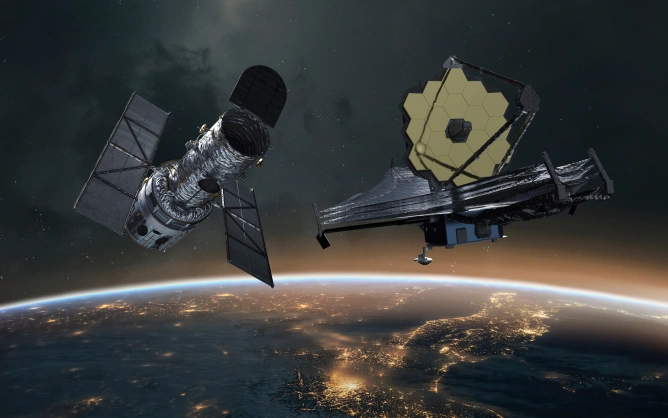
The Hubble and James Webb space telescopes have jointly discovered 27 trans-Neptunian objects located beyond Neptune’s orbit, in a little-explored region of the Solar System. All the objects have diameters smaller than 40 kilometers, with the smallest measuring approximately 10 kilometers. The results were presented in two studies published in The Astronomical Journal.
The observations, coordinated by researchers from Northern Arizona University and the University of Victoria, show that these bodies have preserved their composition and color since their formation. The discovery contradicts models according to which impacts and collisions should have altered their surfaces.
Some objects formed in the Kuiper Belt, on nearly circular orbits aligned with the plane of the Solar System. Others were ejected by gravitational resonances between Uranus and Neptune, reaching elongated and inclined orbits in what is called the “Scattered Disc.” Surprisingly, these dynamically “hot” objects also retain clues about where they formed.
The James Webb telescope’s infrared sensors enabled precise estimates of their sizes, independently of the reflectivity of their surfaces. The data also show that there are fewer very small objects than theories predicted. The observations represent the deepest analysis carried out to date in the region beyond Neptune.
Sources


Latest News
13:43
13:23
13:00
12:45
12:28
See more news
NEWS ON THE SAME TOPICS